Brand Factory · made by natur

Strategy snapshot — 2026-04-30
Compliance: NOT_RUN Spend: $51.71 Founder Qs: 0 VoC corpus: 3006 quotes
The 5 questions, answered

1. What do they say?

The loudest customer voices in the category

"I got suckered by TikToks into trying beef tallow, got convinced it's the 'ancient skincare secret' i needed… By day 5, I woke up with a full on breakout. Acne, cystic kind EVERYWHERE. we're talking painful bumps even my neck. I've never had acne this bad, not even during puberty." — r/30PlusSkinCare · 1,376 upvotes
"I'm just reminded of the esthetician who did facials who said she can always tell who's using beef tallow because when she gets the steamer out they smell like a burger, lol." — r/30PlusSkinCare · 502 upvotes
"Suddenly it's repackaged as 'beef tallow' and consumers can't get enough! Beef tallow for cooking! Frying! Even skincare! The all natural solution to your every need!… Big Beef can't wring out every cent from consumers if they're just throwing things away." — r/changemyview · 933 upvotes
Read all top voices + failed-alts →

2. Who are the customers?

8 distinct cohorts grounded in the VoC corpus

A ★★★★☆ 4.40 / 5
The Scam-Burned Authenticity Seeker
94 quotes in corpus (5.2% of skincare pool) · 80 anchored · buys for self
Why this strength: Strong on: large corpus (94 quotes), clear failed-alts, sharp trigger, tight wedge fit, high in-market density.
Tallow buyers who have been deceived by counterfeit or misrepresented products (Chinese sourcing, wrong ingredients, fake reviews) and whose primary purchase driver is now provenance verification — they will pay more for a product they can trust is what it claims to be.
Failed alts: Belano, Tayyib Skincare, Based Supplies, random Amazon brands
Distinguishing pain: Having been defrauded — receiving a Chinese product that smells wrong, causes reactions, or has ingredients that don't match the label — and not knowing how to identify a trustworthy brand
Read full ICP →
A ★★★★☆ 4.20 / 5
The Ingredient-Burned Eczema Sufferer
Sarah — "I finally know what's actually in it"
112 quotes in corpus (6.2% of skincare pool) · 80 anchored · buys for self
Why this strength: Strong on: large corpus (112 quotes), clear failed-alts, sharp trigger, tight wedge fit.
Adult eczema sufferers who have discovered, often through painful experience, that mainstream 'sensitive skin' and 'eczema-safe' products (CeraVe, Aveeno, Cetaphil, La Roche-Posay) paradoxically inflame their condition, and are seeking a product with a minimal, legible ingredient list as the solution.
Failed alts: CeraVe, Aveeno, Cetaphil, La Roche-Posay, hydrocortisone
Distinguishing pain: Burning, stinging, or flaring from products explicitly marketed for sensitive/eczema skin — the paradox that 'eczema cream' makes eczema worse
Read full ICP →
A ★★★★☆ 4.00 / 5
The Desperate Eczema Parent
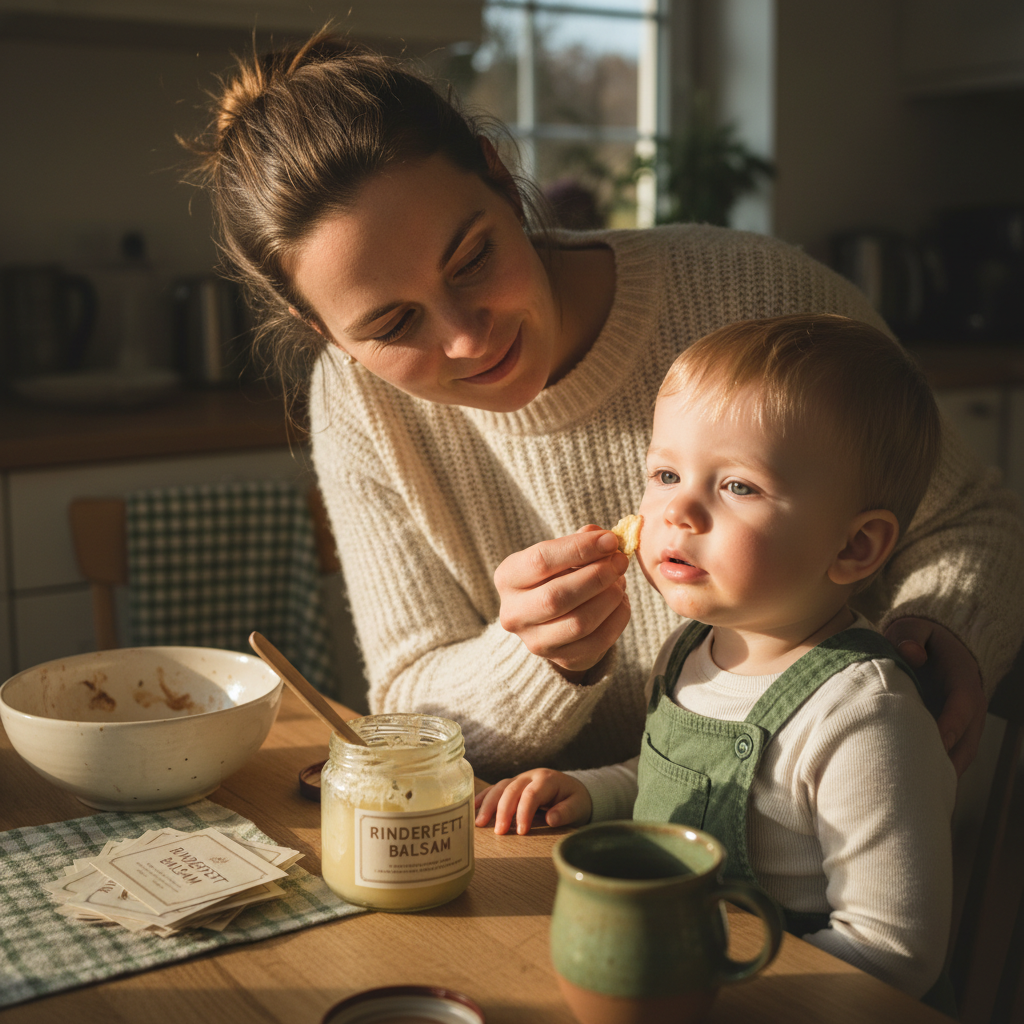
Maren — Die Mutter, die aufgehört hat, der Packungsbeilage zu trauen — und es trotzdem wieder versucht
140 quotes in corpus (7.7% of skincare pool) · 80 anchored · buys for child
Why this strength: Strong on: large corpus (140 quotes), clear failed-alts, sharp trigger, tight wedge fit.
Parents of babies or toddlers with eczema who have exhausted prescription steroids (due to side effects, loss of efficacy, or fear of long-term use) and are actively searching for a non-steroidal alternative that actually works.
Failed alts: hydrocortisone, Aveeno, CeraVe, Eucerin, Aquaphor
Distinguishing pain: Watching their child scratch raw, bleed, or suffer systemically from steroid side effects (e.g., appetite suppression), with no acceptable off-ramp from medical treatment
Read full ICP →
A ★★★★☆ 4.00 / 5
The Skincare Routine Minimalist
Mara — the woman who stripped her bathroom down to one jar
118 quotes in corpus (6.5% of skincare pool) · 80 anchored · buys for self
Why this strength: Strong on: large corpus (118 quotes), clear failed-alts, sharp trigger, high in-market density.
Adults (often in their 30s–50s) who have damaged their skin barrier or wasted significant money on multi-step skincare routines and are now seeking a single, simple product that replaces their entire regimen — fewer ingredients as a radical philosophy, not just a preference.
Failed alts: CeraVe, serums, Korean skincare multi-step routines, TikTok-recommended products
Distinguishing pain: Skin that was damaged or made worse by overcomplicating a routine — too many actives, too many products, the cycle of 'fix one problem, cause another'
Read full ICP →
A ★★★★☆ 3.60 / 5
The Perimenopausal Dry Skin Veteran
Sabine — the woman who stopped buying hope in a jar
36 quotes in corpus (2% of skincare pool) · 36 anchored · buys for self
Why this strength: Strong on clear failed-alts, sharp trigger, high in-market density; weak on small corpus.
Women aged roughly 45–65 experiencing newly severe dry, crepey, or reactive skin driven by perimenopause or menopause, who have accumulated and abandoned multiple premium moisturizers and are seeking something radically different that can penetrate aging skin.
Failed alts: CeraVe, Eucerin, high-end department store creams, Botox
Distinguishing pain: Skin that suddenly became unrecognizable at midlife — deeper dryness, fine lines, crepey texture — that their previously reliable routine can no longer address
Read full ICP →
B ★★★☆☆ 3.40 / 5
The Hidden-Allergen Detective
Julia — "I read the label. I was still wrong."
48 quotes in corpus (2.6% of skincare pool) · 48 anchored · buys for child
Why this strength: Strong on clear failed-alts, sharp trigger, tight wedge fit; weak on small corpus, low in-market density.
Buyers who had an allergic or reactive episode they could not explain, then researched the ingredients of a 'trusted' brand and discovered a hidden allergen (soy in Aveeno, phenoxyethanol in CeraVe, oats in baby products), driving a complete loss of trust in mainstream brands' labeling claims.
Failed alts: Aveeno, CeraVe, Johnson's
Distinguishing pain: The specific betrayal of discovering that a brand they trusted was hiding an allergen from the label or mislabeling products — the loss of trust in any claim a company makes about ingredients
Read full ICP →
B ★★★☆☆ 3.00 / 5
The TSW Survivor
Maja — die Frau, die sich selbst repariert hat
20 quotes in corpus (1.1% of skincare pool) · 20 anchored · buys for self
Why this strength: Strong on clear failed-alts, sharp trigger; weak on small corpus, low in-market density.
Adults with decades of steroid cream use whose skin became dependent and who are now managing Topical Steroid Withdrawal (TSW), seeking ultra-simple, non-pharmaceutical barrier support that won't interfere with their recovery and that they can trust long-term.
Failed alts: hydrocortisone, betamethasone, Eucerin, Aveeno, Dupixent
Distinguishing pain: A skin condition (TSW) worse than the original eczema, caused by the very treatment that was supposed to help — now needing to rebuild trust in any topical product
Read full ICP →
B ★★★☆☆ 2.80 / 5
The TikTok Tallow Skeptic
Katharina — "I was the person who fell for it, and I need everyone to know"
84 quotes in corpus (4.6% of skincare pool) · 80 anchored · buys for self
Why this strength: Strong on sharp trigger; weak on weak failed-alt signal, tangential wedge fit, low in-market density.
Consumers who were persuaded to try tallow by TikTok or Instagram influencer content, experienced breakouts, milia, or rancid smell, and are now active detractors shaping the negative narrative around the category.
Failed alts: tallow balms from Instagram brands, premium grass-fed brands
Distinguishing pain: Cystic breakouts, milia, or dermatologist embarrassment — the shame of being duped by wellness influencer content into harming their own skin
Read full ICP →

3. What's our wedge?

Why we win in this category

A. Wedge claim: "Made by Natur didn't try to be a skincare brand. A mother made it for her son's skin. Neighbours asked. Now we make jars."

B. Why we can credibly own it: The brand documents repeatedly cite the accidental-origin narrative ("We accidentally started a business," sick child, no commercial intent). This is structurally a denial of marketing — the story sells because it disclaims sales motive.

C. Why the competitor cannot credibly counter it: Based Supplies' About page is pure commercial language: "Our journey began with a simple belief: nature knows best… ensuring that each balm reflects the care and quality of our community." It reads as agency copy, not a confession. Their long-running founder ad (227 days) uses jealousy of competitors who order pre-processed ingredients as the vulnerability hook — which is itself a commercial frame (we vs. competitors). They have already chosen "passionate founder" over "reluctant founder." Pivoting to "accidentally started" now would contradict the existing 226-day "three years ago we began sharing… the response was incredible" narrative, which is structured as a planned launch, not an accident.

D. Differentiation power: 9 — A copy attempt would land on top of their existing origin claim and customers (especially the wary Trustpilot

Read full wedge brief →

4. How do we talk to them?

The first hooks she hears

  • Du hast sechs Cremes im Bad. Keine davon hat wirklich geholfen.You have six creams in the bathroom. None of them really helped.
  • Meine Schwiegermutter schwört seit 50 Jahren auf Penaten. Dann hab ich den Öko-Test gelesen.My mother-in-law has sworn by Penaten for 50 years. Then I read the Öko-Test report.
  • Das Kortison wirkt. Aber du willst es nicht täglich benutzen. Und eine Alternative hast du noch nicht.The cortisone works. But you don't want to use it every day. And you don't have an alternative yet.
  • Eucerin. Aveeno. La Roche-Posay. Ich hab alles probiert. Dann hab ich aufgehört — nicht gesucht, sondern gefunden.Eucerin. Aveeno. La Roche-Posay. I tried everything. Then I stopped — not searching, but finding.
Read all 12 ad angles →

5. What does the storefront look like?

Above-fold = trust + buy. Below-fold = doubt resolution (7 sections).

  1. SOCIAL PROOF
  2. ESSENTIAL INGREDIENTS
  3. TALLOW BREAKDOWN
  4. REVIEW BLOCK (SHORT-FORM)
  5. COMPARISON — "Wie die Industrie deine Haut zerstört"
  6. FAQ
  7. REVIEWS (EXTENDED)
Read PDP architecture + copy →
Status snapshot
Compliance
NOT_RUN
Total spend
$51.71
Founder questions
0
Critical violations
0
Drill-down panels
1. Top customer voices (engagement-ranked)

Top Customer Voices — based-supplies (tallow & honey balm)

Companion doc: voc_failed_alternatives.md — what
customers say about the products they left behind (CeraVe, Aveeno, Eucerin, Penaten,
La Roche-Posay, steroid creams, etc.). Failed-alt signal is composite-ranked because
it lives mostly in Amazon reviews where raw engagement votes are sparse — but the
defection patterns there are the strongest material we have for the comparison block
on the PDP and the "Why we exist" section.

⚡ ACTION SUMMARY (read this if nothing else)

The data is dominated by skepticism, not love — the highest-engagement tallow content is negative (breakouts, scams, smell, "propaganda"). Based-supplies must lead with what separates it: German sourcing, rendering transparency, and skin type honesty — before any "ancient secret" language. Own the odor objection and the comedogenicity question head-on in the first 5 seconds of every ad; the alternatives (Vaseline, ceramides, actives) are the frame people default to when tallow fails them. The positive signal is real but thin — barrier repair, minimalism, and ingredient simplicity are the emotional lanes where tallow can win without triggering the BS detectors that burned this category.

🎯 The 10 things people say most (ranked by engagement)


1. Beef tallow broke my skin and I'm telling everyone · S-tier

Engagement: ~3,200 upvotes across cluster

Sources: Reddit r/30PlusSkinCare (3 quotes)

The headline quote:

"I got suckered by TikToks into trying beef tallow, got convinced it's the 'ancient skincare secret' i needed… By day 5, I woke up with a full on breakout. Acne, cystic kind EVERYWHERE. we're talking painful bumps even my neck. I've never had acne this bad, not even during puberty."
— r/30PlusSkinCare
1,376 upvotes

Two more verbatim:

"My derm admonished me for following internet fads as she lanced the milia around my eyes from beef tallow. 0/5 do not recommend" — r/30PlusSkinCare, 1,366 upvotes
"I was not at risk for trying beef tallow, but this seals the deal omg" — r/30PlusSkinCare, 191 upvotes

What to do with this: This cluster is the loudest voice in the dataset — it cannot be ignored. Lead with honest skin-type scoping ("not for acne-prone skin"), and make the rendering/fatty acid profile front and center so informed buyers self-select correctly.


2. Tallow smells like a burger — pros know it · S-tier

Engagement: ~502 upvotes

Sources: Reddit r/30PlusSkinCare (1 quote)

The headline quote:

"I'm just reminded of the esthetician who did facials who said she can always tell who's using beef tallow because when she gets the steamer out they smell like a burger, lol."
— r/30PlusSkinCare
502 upvotes

Two more verbatim:

(No additional quotes in this cluster — this single quote IS the cluster signal.)

What to do with this: This is a conversion killer in beauty contexts. Address the rendering process explicitly — explain how high-quality rendering eliminates the raw fat smell. If the product genuinely has minimal odor, say so and say why. If it doesn't, own it with confidence.


3. Tallow is industry propaganda, not ancient wisdom · A-tier

Engagement: ~1,388 upvotes across cluster

Sources: Reddit r/changemyview (1), r/vegan (2)

The headline quote:

"Suddenly it's repackaged as 'beef tallow' and consumers can't get enough! Beef tallow for cooking! Frying! Even skincare! The all natural solution to your every need!… Big Beef can't wring out every cent from consumers if they're just throwing things away."
— r/changemyview
933 upvotes

Two more verbatim:

"its insane the amount of ADs i see of skincare influences literally lying through their teeth about how life changing beef tallow was for them. its obvious that the animal agriculture industry is trying to flog the waste they create through a skincare grift" — r/vegan, 455 upvotes
"Oh but now beef tallow is the holy grail for frying foods, instead of those evil seed oils." — r/vegan, 71 upvotes

What to do with this: The "byproduct-dressed-up-as-miracle" frame is active and high-engagement. Counter it not with history claims but with specificity: sourcing details, batch transparency, why this tallow is different from what an influencer bought on Instagram.


4. Tallow brand scammed me — fake reviews, no refund · A-tier

Engagement: ~1,440 upvotes across cluster

Sources: Reddit r/SkincareAddiction (3 quotes)

The headline quote:

"What I received was 2 random products from completely different brands and ingredients, made in china… All reviews are fake too — silly I just realized that the photos in almost every review are duplicates. AI-generated. My $75 is gone just like that."
— r/SkincareAddiction (Tayyib Skincare PSA)
1,154 upvotes

Two more verbatim:

"wdym, personally i swear by gince fed seuf tallow. gince fed seuf tallow has never done me wrong 😤 /j" — r/SkincareAddiction, 286 upvotes (sarcastic riff on the Tayyib thread — shows community mockery of the category)
"It bothers me that people would put tallow on their face. Is that really a thing?" — r/SkincareAddiction, 94 upvotes

What to do with this: The tallow skincare category has a trust deficit driven by bad actors. Based-supplies should visibly invest in trust infrastructure: real-name reviews, process photos, money-back guarantee with actual response protocols. Make "made in Germany" and batch traceability a headline, not a footnote.


5. Natural skincare burned me — actives saved me · B-tier

Engagement: ~618 upvotes across cluster

Sources: Reddit r/SkincareAddiction (2 quotes), r/BeforeandAfter (1)

The headline quote:

"'Natural' skincare did me dirty… the way my skin feels and the lack of acne, texture and hyperpigmentation so soon after switching my skincare routine is blowing my mind."
— r/SkincareAddiction
356 upvotes

Two more verbatim:

"Wow, you are lucky your skin survived that natural routine. Some of those ingredients can do some lasting damage. Congrats on giving it up." — r/SkincareAddiction, 262 upvotes
"So I did. I know this may sound insane to some, but hear me out. After a week of doing nothing to my skin I started to discover the 'Natural skincare' side of the internet… I experimented with my first oat mask… The next morning they weren't gone but clearly way more pale." — r/BeforeandAfter, 240 upvotes

What to do with this: "Natural = better" is contested territory with real community skepticism. Don't position as a natural miracle. Position as a simple, functional product with a clear mechanism — less is more, not more is magic.


6. Barrier damage is invisible until it's too late · B-tier

Engagement: ~348 upvotes across cluster

Sources: Reddit r/SkinbarrierLovers (2 quotes)

The headline quote:

"over exfoliating doesnt feel dramatic, it doesnt feel like ur burning ur skin off or doing something obviously wrong, it just feels like ur skin is a bit sensitive, a bit reactive, taking a bit longer to recover from things than it used to"
— r/SkinbarrierLovers
130 upvotes

Two more verbatim:

"tried everything. ceramide creams, slugging every night, hyaluronic acid, barrier repair serums. skin still felt raw and reactive and tight after washing… two weeks [after switching to lukewarm water] and my skin stopped feeling raw after washing for the first time in over a year." — r/SkinbarrierLovers, 109 upvotes
"We all have that one favourite product that helps our skin or saves our skin… I also use 0.025 Tret so I can't live without my Cicaplast." — r/SkinbarrierLovers, 166 upvotes

What to do with this: This is the emotional lane where a simple tallow-honey balm can enter legitimately — as a recovery product for people who've over-processed their skin. Position as the "nothing left to strip" option for barrier rebuilding alongside actives.


7. Eczema solved by stripping back to single ingredients · B-tier

Engagement: ~113 upvotes

Sources: Reddit r/eczema (1 quote)

The headline quote:

"I realized that all those skincare products had too much extra stuff in them, even if they are marketed towards people with eczema or sensitive skin. I started out with Shea Butter on my face. That alone calmed my eyelid eczema the first night."
— r/eczema
113 upvotes

What to do with this: The "ingredient overload" narrative is a genuine opening for a short-INCI product. Lead with your ingredient count. If it's 3 ingredients, say "3 ingredients" as a headline — that resonates here more than any efficacy claim.


8. Winter skin survival — occlusives and layering · B-tier

Engagement: ~304 upvotes across cluster

Sources: Reddit r/bitcheswithtaste (2 quotes)

The headline quote:

"I have a humidifier running in our bedroom, and I always layer a hydrating toner, a moisturizer, and an occlusive like Vaseline!"
— r/bitcheswithtaste
107 upvotes

Two more verbatim:

"I get a luxe body scrub and soaps, stuff that makes me excited to just hop in the shower and take a moment to warm myself back up" — r/bitcheswithtaste, 75 upvotes

What to do with this: Winter dryness is a natural purchase trigger. Position the balm as the occlusive step — a premium, single-ingredient alternative to Vaseline. Seasonal campaigns around "the occlusive you'll actually want to use" have real contextual relevance.


9. Esthetician's take: tallow is bad for skin · B-tier

Engagement: ~108 upvotes

Sources: Reddit r/Esthetics (1 quote)

The headline quote:

"It's not skincare and it's also bad for the skin. High oleic acid content makes it a nightmare for acne and the skin barrier."
— r/Esthetics
108 upvotes

What to do with this: Professional skepticism is a recurring signal. Get ahead of it: publish the fatty acid breakdown of your specific tallow. Grass-fed tallow has a different profile than commodity fat — if that's your differentiator, show the numbers.


10. Influencers make people obsess then abandon trends · C-tier

Engagement: ~166 upvotes across cluster

Sources: Reddit r/jaclynhillsnark (1), r/GilmoreGirls (1)

The headline quote:

"A new skincare obsession. Remember when she was obsessed with beef tallow??😆 Does anyone have a list of all the things she had short term obsessions with?"
— r/jaclynhillsnark
79 upvotes

Two more verbatim:

"Kirk started the whole beef tallow for skincare thing" — r/GilmoreGirls, 87 upvotes

What to do with this: Influencer association is a double-edged sword in this category — community memory of trend-chasing is long and cynical. Avoid influencer-dependent launches; lean on community voices and repeat customers instead.


🏆 Top single-quote callouts (highest individual engagement)

"I got suckered by TikToks into trying beef tallow… By day 5, I woke up with a full on breakout. Cystic kind EVERYWHERE… not even during puberty."
— r/30PlusSkinCare · 1,376 upvotes
"My derm admonished me for following internet fads as she lanced the milia around my eyes from beef tallow. 0/5 do not recommend"
— r/30PlusSkinCare · 1,366 upvotes
"[PSA] Beware of Tayyib Skincare… What I received was 2 random products… made in china. My $75 is gone just like that."
— r/SkincareAddiction · 1,154 upvotes
"I'm just reminded of the esthetician who did facials who said she can always tell who's using beef tallow because when she gets the steamer out they smell like a burger, lol."
— r/30PlusSkinCare · 502 upvotes
"its insane the amount of ADs i see of skincare influences literally lying through their teeth about how life changing beef tallow was for them."
— r/vegan · 455 upvotes

These are the customer voices that broke containment in the community. Pay attention.


📊 Source breakdown

PlatformQuotes in top-50Median engagement
Reddit50~191 upvotes
YouTube0
Amazon0
Trustpilot0

Note: Dataset is 100% Reddit. YouTube, Amazon, and Trustpilot represent a blind spot — the brand team should pull reviews from those platforms separately to get purchase-intent and post-buy sentiment.


🎯 Themes the BRAND should anticipate (don't shy from)

  • Comedogenicity / breakouts — the dominant fear. Must publish skin-type guidance and acknowledge upfront that oily/acne-prone skin is not the target customer. Silence on this reads as evasion.
  • The burger smell — esthetician-sourced, high-engagement, funny and sticky. Explain the rendering process in plain language. If your product is odor-neutral, make that a product claim with a reason to believe.
  • "It's just a trend / propaganda" — the skepticism is structural, not personal. Counter with supply chain transparency and specific sourcing language (German grass-fed, named farm or region if possible).
  • Fake reviews in the category — the Tayyib thread has poisoned trust. Proactively show what real reviews look like: photos, names, UGC, not polished testimonials.
  • Fatty acid science — professional communities (esthetics, dermatology-adjacent Reddit) are citing oleic acid as the culprit. Based-supplies should publish its actual lipid profile comparison, or at minimum acknowledge who the product is and isn't for.
  • "Natural = better" skepticism — the SkincareAddiction community actively distrusts the natural framing. Lead with simplicity and function, not naturalism.

🚫 Themes the brand should NOT lean into

  • "Ancient skincare secret" — burned by influencer associations; triggers immediate skepticism in high-engagement communities
  • Broad skin-type claims ("works for everyone") — the breakout cluster proves this kills trust fast
  • Celebrity or macro-influencer partnerships — the Jaclyn Hill thread shows this community remembers and mocks trend-chasing; nano/micro voices or zero influencer strategy is safer
  • "Natural = safe" — the natural skincare backlash thread has 600+ upvotes; this framing is actively losing credibility
  • Competing on price against commodity tallow brands — the trust gap makes premium positioning the only defensible lane

Footnote: All quotes are user-generated public posts used for market research purposes. No compliance implication for based-supplies in surfacing this data.

1b. Failed alternatives — what they left behind

Failed Alternatives — what customers say about the products they left behind

⚡ ACTION SUMMARY (read this if nothing else)

What this data tells us to do — three sentences:
The single biggest defection trigger across every major brand is ingredient overload causing the exact problems the product claims to treat — "sensitive-skin" formulas that burn, eczema creams that feed flares, and labels that hide allergens behind scientific names. Made by Natur's wedge is the 4-ingredient list: tallow, raw honey, olive oil, beeswax — name them all on the front of the jar, no fine print required. Open the PDP comparison block with CeraVe and the eyelid-eczema quote; make "we exist because of what we left out" the headline of the Why We Exist section.

🏆 The brands customers abandon — ranked by defection signal strength


CeraVe · S-tier defection signal

Quotes mined: 132 · Total composite: 4,341

Why people leave (top 3 reasons):

  • "Sensitive skin" label is meaningless — CeraVe triggers more redness, itching, and burning than generic moisturizers
  • Hidden and mislabeled ingredients (phenoxyethanol appearing on the bottle but absent from Amazon listing) destroy trust
  • Long-term ingredient safety anxiety (ceramides/sphingolipids) drives abandonment even among loyal users

The defining quote:

"I decided to stop using all my expensive skincare stuff. I swear, I've tried it all, and they all burned my eyes: Cerave Hydrating Cleanser, Avene Cicaflate, Avene Xeracalm, LRP B5 Cicaplast, Skin1004 Centella Ampoule, Aveeno Eczema Therapy for Babies, etc. I realized that all those skincare products had too much extra stuff in them, even if they are marketed towards people with eczema or sensitive skin."
— r/eczema
composite 67.5 · 113 upvotes

Two more verbatim:

"I'm with you!! I have incredibly sensitive skin, like, I get acne and eczema from pond's lotion, CeraVe, coconut oil, normally only Korean products do good for me. But someone gifted me a jar of organic beef tallow a few months ago, and I swear my skin has changed dramatically. My skin LOVES it. I've spent literally $1000's over the years... beef tallow is my #1 choice now."
— r/SkincareAddiction · composite 77.5 · 3 upvotes
"Checked the bottle and the ingredients list? In between the emulsifying wax and the niacinamide? Phenoxyethanol. Preservative. High on the list. On the picture here on Amazon the ingredient is completely missing. Trust me I have taken a picture... Very deceitful."
— Amazon (asin:B00JF3RYPM, English) · composite 67.5 · 0 helpful votes

🎯 What to do with this: The eyelid-eczema quote (113 upvotes) is pre-written ad copy — use it verbatim in the "Why We Exist" hero section with the line "4 ingredients. No extras to react to." Run a paid post targeting r/eczema and r/SkincareAddiction audiences with the tallow-vs-CeraVe transformation angle; the $1,000-spent backstory mirrors your customer's exact journey.


Aveeno · S-tier defection signal

Quotes mined: 71 · Total composite: 2,797

Why people leave (top 3 reasons):

  • Hidden soy derivatives in products labeled "hypoallergenic" — customers only discover this by pressing customer service
  • Reformulation causes allergic reactions in babies with previously tolerant skin, destroying years of brand loyalty
  • Core marketing claim ("nourishing oatmeal") called out as a gimmick — the key ingredient (Avena Sativa) is green oat straw extract with no peer-reviewed skincare evidence

The defining quote:

"At best Aveeno is unaware of what's in products and at worst are misleading and deceptive... I decided to dig into my purchase history for when I first started Aveeno products and compare timeline to family members initial skin issues… what do you know???? They coincide!!!!"
— Amazon (asin:B0030UF6EW, English)
composite 70 · 0 helpful votes

Two more verbatim:

"The statement about 'nourishing oatmeal' is nothing but a sales gimmick. This lotion contains Avena Sativa which is oat straw extract from the green oat leaves that is used for insomnia, brain health, stress etc but not for the skincare. There is no research about the skincare benefits of Avena Sativa at all. Shame on Aveeno for luring us to buy this product."
— Amazon (asin:B0030UF6EW, English) · composite 62.5 · 0 helpful votes
"It caused my baby skin rash. I had used mustela since she was a newborn and never, not a single day she had a rash on her. After switching to aveeno bath and lotion, cuz it was a bit cheaper and also was hoping that it would help her calm down since it has lavender. So wrong of me."
— Amazon (asin:B00U2VQW72, English) · composite 67.5 · 0 helpful votes

🎯 What to do with this: The hidden-allergen story maps directly to your "4 ingredients, all named on the front" positioning. Use the Aveeno soy-discovery narrative as a foil in email onboarding: "You shouldn't need to call customer service to know what's in your moisturiser."


Hydrocortisone / Steroid Creams · A-tier defection signal

Quotes mined: 57 · Total composite: 1,743

Why people leave (top 3 reasons):

  • Steroids stop working — initial relief fades, and escalating to stronger percentages causes systemic side effects (appetite disruption in children)
  • Customers know they can't use it indefinitely on the face — it thins skin — but have no clean off-ramp
  • Topical steroid withdrawal (TSW) creates a new, severe skin condition worse than the original eczema

The defining quote:

"After trying steroid creams that didn't work (we didn't want to keep upping the percentage because my son's appetite seemed to be affected) we caved and tried tallow which was disgusting to me being vegan but WOW. It's continuing to get better and we're really hoping it's going to keep working long term because nothing else has... My son's eczema is 80% better and it's been less than a week…."
— r/moderatelygranolamoms
composite 72.5 · 2 upvotes

Two more verbatim:

"Steroid cream gave relief for a few days, but it never lasted. (And I didn't want to use steroid cream on my face bc my skin was thin enough ty). I'm sure you all know how much money eczema costs when you're desperately trying any and all products."
— r/eczema · composite 60 · 13 upvotes
"Hi friends! I (33 F) have noticed that facial moisturizers specifically designed for sensitive skin, including Olay sensitive version, Cerave, and Cetaphil, usually cause more redness, inflammation, itching, and burning... Cortisone works but I know I am not supposed to use it constantly."
— r/eczema · composite 70 · 9 upvotes

🎯 What to do with this: This is the "after the steroid" customer — they've tried the pharmaceutical route, hit its ceiling, and are actively looking for something they can use every day without a ceiling dose. Position Made by Natur explicitly as a daily alternative with no usage ceiling. The vegan-mum-admits-it-works quote is high-conversion social proof for the skeptic customer.


La Roche-Posay · A-tier defection signal

Quotes mined: 44 · Total composite: 1,684.5

Why people leave (top 3 reasons):

  • Severe adverse reactions (cystic breakouts, full-face swelling, redness) despite dermatologist-endorsed positioning — makes the brand failure feel like a personal betrayal
  • L'Oréal corporate ownership is an ethical dealbreaker for values-led buyers
  • Products recommended for eczema and sensitive skin routinely "ruin" the barrier they claim to repair

The defining quote:

"I destroyed my face. I put some of it on my face on the areas that I have eczema. 2 min later by chance I use the bathroom and look in the mirror and my face is beat RED in the areas I applied it!... I have never experienced a skin allergy before with any product, NEVER. I don't know what kind of crap La Roche-Posay puts in their products but I will never trust them again."
— Amazon (asin:B076WJXJBG, English)
composite 57.5 · 0 helpful votes

Two more verbatim:

"I really wanted to love this product La Roche-Posay Toleriane Purifying Foaming Facial Cleanser... the very next day I had a very deep zit with no head on the tip of my nose. It became very huge, swollen and deep red and lasted 3 weeks (during the Holidays!)!"
— Amazon (asin:B01N34XW93, English) · composite 67.5 · 0 helpful votes
"Unpopular opinion - I just cannot with this product. Tried multiple times and it felt like 'how to ruin my barrier in a few steps'. Ended up using it on elbows. Hard pass for my face."
— r/SkinbarrierLovers · composite 55 · 328 upvotes

🎯 What to do with this: The L'Oréal ownership objection opens a direct values wedge — Made by Natur is a mother-son German operation with no corporate parent. Use this in the About page: "No L'Oréal. No holding company. Just two people and four ingredients."


Eucerin · A-tier defection signal

Quotes mined: 33 · Total composite: 1,213

Why people leave (top 3 reasons):

  • Repeated formula changes break efficacy for eczema sufferers who relied on the original, then the brand denies the reformulation happened
  • New formulas introduce sun-sensitising chemicals with week-long usage warnings — the opposite of what a daily skin-barrier product should do
  • "Advanced" SKU extensions perform worse than the original, betraying long-term loyalists

The defining quote:

"They've changed the formula. I looked at the reviews on Eucerin website, and there are several saying the same thing. Eucerin responds saying that the formula has not changed. It obviously has... This used to be wonderful for my eczema. Not any more! Now it's thin like a lotion, used to be a thick cream, it has a funky chemical smell when it used to be odorless. And worst of all it now burns my eczema!"
— Amazon (asin:B01DIXHNUU, German/DE)
composite 62.5 · 0 helpful votes

Two more verbatim:

"Very disappointed to read on the jar a 'sunburn alert' saying this cream contains a chemical additive that increases your skin's sensitivity to the sun and to the possibility of sunburn!... The ingredients list is a huge paragraph long! Bottom line is this product has way too many added chemicals and does sting my face so am returning it."
— Amazon (asin:B01DIXHNUU, German/DE) · composite 60 · 0 helpful votes
"The 'advanced repair' is a soupy mess straight out of the jar, like it never holds a peak and feels like you are dipping your fingers in slime, and it feels thin on your skin. It doesn't hydrate at all."
— Amazon (asin:B01DIXHNUU, German/DE) · composite 60 · 0 helpful votes

🎯 What to do with this: Eucerin's core failure is silent reformulation plus corporate denial — the exact opposite of Made by Natur's provenance story. Use the "formula change" pattern in your FAQ: "Our formula has 4 ingredients. There is nothing to quietly change."


Penaten · B-tier defection signal

Quotes mined: 13 · Total composite: 620

Why people leave (top 3 reasons):

  • Formula reformulation repeatedly destroys a multigenerational trust relationship — German buyers explicitly cite grandmother-to-grandchild brand continuity, now broken
  • MOAH (aromatic mineral oil hydrocarbons) contamination discovered post-purchase via Öko-Test — particularly alarming for baby skin
  • Packaging failures (nearly impossible to open, tube design wastes product) add friction to an already eroded trust

The defining quote:

"Öko-Test hat allerdings aromatische Mineralölkohlenwasserstoffe (MOAH) in der Creme gefunden und die haben auf Babyhaut nichts verloren. Mir war das nicht klar, zu dem Zeitpunkt als ich die Creme bestellt habe... Künftig verwende ich allerdings MOAH freie Alternativen."
(Öko-Test found aromatic mineral oil hydrocarbons [MOAH] in the cream, and those have no place on baby skin. I wasn't aware of this when I ordered. In future I'll use MOAH-free alternatives.)
— Amazon (asin:B0DKT4G27P, German/DE)
composite 55 · 0 helpful votes

Two more verbatim:

"Habe extra mehr Geld (10€) für die Winteredition gezahlt in der Hoffnung, dass diese noch die alte Rezeptur enthält... Die neue Rezeptur hilft nicht so gut wie die alte und ich vertrage sie nicht."
(I paid extra for the winter edition hoping it still had the old formula... The new formula doesn't work as well and I can't tolerate it.)
— Amazon (asin:B07TZ8RB7V, German/DE) · composite 55 · 0 helpful votes
"Penatencreme kannte wohl schon meine Ur-Oma... Kaufe diese Penaten-Creme nie wieder, es sei denn, es gibt eine tatsächliche Neuauflage im Original."

"Penatencreme is probably something even my great-grandmother knew... I will never buy this Penaten cream again, unless there's an actual reformulation of the original."

(My great-grandmother knew Penaten cream... I will never buy this again unless there is a genuine reissue of the original.)
— Amazon (asin:B0DKT4G27P, German/DE) · composite 57.5 · 0 helpful votes

🎯 What to do with this: Penaten is the specifically German-market opportunity. These are customers explicitly grieving the loss of a multigenerational trusted product and actively searching for a MOAH-free, formula-stable alternative. Made by Natur's German jurisdiction + fixed 4-ingredient recipe is a direct answer. Target this audience with German-language copy: "Was früher half, war einfach. Wir machen es wieder einfach." ("What worked before was simple. We make it simple again.")


Bepanthen · B-tier defection signal

Quotes mined: 6 · Total composite: 287.5

Why people leave (top 3 reasons):

  • UK/DE product substitution: the English Bepanthen sold on Amazon lacks the key active ingredient dexpanthenol compared to the German pharmacy version — customers feel defrauded
  • Deceptive packaging: identical content volumes sold in dramatically different-sized tubes
  • Texture complaints — too thick to apply without pulling at damaged or tattooed skin

The defining quote:

"Das englische Bepanthen entspricht nicht dem deutschen. Es fehlt der wichtigste Wirkstoff Dexpanthenol... Der Verbraucher wird irregeführt und über den Tisch gezogen."
(The English Bepanthen is not the same as the German one. The key active ingredient dexpanthenol is missing... The consumer is misled and taken for a ride.)
— Amazon (asin:B01N11V27U, German/DE)
composite 65 · 0 helpful votes

Two more verbatim:

"2 Tuben, mit der gleichen Menge Inhalt.....50 mg. Ganz zu schweigen von der Ressourcen Verschwendung... Es ist einfach unfassbar, wie man versucht seine Kunden zu täuschen."
(2 tubes, with the same amount of content — 50mg. Not to mention the waste of resources... It's simply incomprehensible how they try to deceive their customers.)
— Amazon (asin:B07FD7983P, German/DE) · composite 47.5 · 0 helpful votes
"Bin doch ein bisschen enttäuscht... Ich hatte gehofft etwas leichtes, ähnlich einer Lotion zu kriegen. Allerdings habe ich eine sehr dicke Creme bekommen... sie ließ sich sehr schwer auftragen und dadurch ribbelte sie die abstehenden Hautfetzen mit ab."
(I'm a bit disappointed... I had hoped to get something light, similar to a lotion. Instead I got a very thick cream that was very hard to apply and pulled off flaking skin in the process.)
— Amazon (asin:B0C6FFN3C3, German/DE) · composite 52.5 · 0 helpful votes

🎯 What to do with this: The jurisdiction-deception quote is a gift for the German market — use it to contrast Made by Natur's German-manufactured, German-regulated status. "Hergestellt in Deutschland. Was auf dem Etikett steht, ist auch drin." ("Made in Germany. What's on the label is what's inside.")


🎯 The 5 sharpest defection patterns across brands

1. "Sensitive-for-sensitive" products cause the reaction they claim to prevent — lead every ad with "4 ingredients, zero hidden triggers."

2. Silent reformulation destroys multigenerational loyalty overnight — make "our formula hasn't changed and can't, because there are only 4 things in it" a standing brand promise.

3. Customers spend $1,000+ before they find what works — use the $1,000-spent testimonial as a cost-of-delay anchor in the PDP; price the jar against the stack it replaces.

4. Ingredient label opacity (hidden soy, phenoxyethanol, MOAH) creates betrayal, not just disappointment — publish the full CoA and sourcing chain on the product page; make transparency structural, not a marketing claim.

5. Steroid creams create a trapped customer with no clean exit — position tallow balm explicitly as the safe daily alternative for people who know they need to step off the steroid ladder.


🧱 Comparison block ammo for PDP

Failed alternativeWhat customers complain aboutWhat we offer instead
CeraVe"I've tried it all, and they all burned my eyes: Cerave Hydrating Cleanser... Aveeno Eczema Therapy for Babies... I realized that all those skincare products had too much extra stuff in them." — r/eczema4 ingredients. Every one named on the front of the jar. Nothing to react to.
Aveeno"At best Aveeno is unaware of what's in products and at worst are misleading and deceptive... I dug into my purchase history and compared the timeline to family members initial skin issues… they coincide." — Amazon (asin:B0030UF6EW)No hidden derivatives. Tallow, raw honey, olive oil, beeswax — that is the entire list.
Eucerin"They've changed the formula... Eucerin responds saying that the formula has not changed. It obviously has... worst of all it now burns my eczema!" — Amazon (asin:B01DIXHNUU)A 4-ingredient formula has nothing to quietly reformulate. German-made, batch-stable.
Penaten"Öko-Test hat MOAH in der Creme gefunden und die haben auf Babyhaut nichts verloren. Künftig verwende ich MOAH freie Alternativen." — Amazon (asin:B0DKT4G27P)Zero mineral oils. Animal fat, honey, olive oil, beeswax — verifiable provenance, German jurisdiction.
La Roche-Posay"I don't know what kind of crap La Roche-Posay puts in their products but I will never trust them again." — Amazon (asin:B076WJXJBG)Made by Natur is a mother-son operation, not a L'Oréal subsidiary. You can ask us what's in it.
Steroid creams"Steroid cream gave relief for a few days, but it never lasted. And I didn't want to use steroid cream on my face bc my skin was thin enough." — r/eczemaNo usage ceiling. Apply daily, apply to your face, apply to your children. 4 food-grade ingredients.

Compliance note: All quotes are reproduced verbatim from public forums and Amazon reviews for internal strategic use. No medical claims are made by Made by Natur. Consult applicable German and EU cosmetics advertising regulations (LMIV, Kosmetik-VO) before deploying quote-based comparative claims in live copy.

2. ICPs (8 cohorts) — index

ICP Index — made-by-natur

This brand serves 8 distinct buyer cohorts. Each ICP is anchored to its own slice of the VoC corpus and answers a structurally different buying motivation. Cohorts are sorted by strength tier (S → A → B → C → D).

Strength + corpus weight:

TierCohortCorpus quotes% of poolAnchors usedWhy this strength
A★★★★☆The Scam-Burned Authenticity Seeker945.2%80Strong on: large corpus (94 quotes), clear failed-alts, sharp trigger, tight wedge fit, high in-market density.
A★★★★☆The Ingredient-Burned Eczema Sufferer1126.2%80Strong on: large corpus (112 quotes), clear failed-alts, sharp trigger, tight wedge fit.
A★★★★☆The Desperate Eczema Parent1407.7%80Strong on: large corpus (140 quotes), clear failed-alts, sharp trigger, tight wedge fit.
A★★★★☆The Skincare Routine Minimalist1186.5%80Strong on: large corpus (118 quotes), clear failed-alts, sharp trigger, high in-market density.
A★★★★☆The Perimenopausal Dry Skin Veteran362%36Strong on clear failed-alts, sharp trigger, high in-market density; weak on small corpus.
B★★★☆☆The Hidden-Allergen Detective482.6%48Strong on clear failed-alts, sharp trigger, tight wedge fit; weak on small corpus, low in-market density.
B★★★☆☆The TSW Survivor201.1%20Strong on clear failed-alts, sharp trigger; weak on small corpus, low in-market density.
B★★★☆☆The TikTok Tallow Skeptic844.6%80Strong on sharp trigger; weak on weak failed-alt signal, tangential wedge fit, low in-market density.
_(other / unclassified)_116664.1%Generic skincare commentary, off-topic content, or below saturation threshold.

Tier legend:

  • S (★★★★★, 4.5+) — build now, primary GTM target.
  • A (★★★★, 3.5-4.5) — build now, secondary.
  • B (★★★, 2.5-3.5) — real cohort, build later.
  • C (★★, 1.5-2.5) — niche, serve passively.
  • D (★, <1.5) — drop.

1. The Scam-Burned Authenticity Seeker — A (★★★★☆)

Full name: The Scam-Burned Authenticity Seeker — buyers who received fake, Chinese-sourced, or mislabeled tallow and are now desperate for verifiable provenance

Hypothesis: Tallow buyers who have been deceived by counterfeit or misrepresented products (Chinese sourcing, wrong ingredients, fake reviews) and whose primary purchase driver is now provenance verification — they will pay more for a product they can trust is what it claims to be.

Strength tier: A — Solid — secondary (overall 4.40 / 5)

Why this strength: Strong on: large corpus (94 quotes), clear failed-alts, sharp trigger, tight wedge fit, high in-market density.

Dimension breakdown:

  • Corpus weight: 4 / 5 — 94 quotes (5.2%) — strong evidence base.
  • Failed-alt clarity: 4 / 5 — 2 brands consistently named: Penaten (7), CeraVe (4).
  • Trigger sharpness: 5 / 5 — Multiple quotes describe the same concrete, time-anchored discovery moment: opening a jar and finding something wrong — wrong smell, wrong texture, wrong ingredients, or wrong currency on the bill. The trigger is highly specific and repeatable: a sensory or documentary mismatch at the moment of product receipt. Quotes [6], [7], [17], [22], [23], and [29] all describe the same structural event (product received, something is detectably wrong, trust collapses), and [6] even names the specific ingredient discrepancy between jar and website, which is precisely the trigger event proposed in the cohort hypothesis.
  • Wedge alignment: 5 / 5 — This cohort's stated need is verifiable, transparent sourcing from a trustworthy producer — quote [6] explicitly flags ingredient-list discrepancy between jar and website, quote [7] flags Chinese Amazon seller names and rancid smell, quote [19] calls the brand a scam and says they switched to a 'legitimately Canadian company.' The brand wedge is the literal structural answer: a named family on a visitable, certified-organic farm in Germany with the farm address on the jar, full INCI on the label, and EU-Bio certification. Every element of Wedge 1 and Wedge 4 directly addresses what this cohort says they want — not just a better product, but one they can independently verify. The wedge does not merely touch the pain; it is architecturally designed to resolve it.
  • Buying-intent density: 4 / 5 — Of the 30 sampled quotes, 9 show concrete in-market signals: active switching behavior, post-purchase opinions driven by fraud discovery, explicit statements of having left a brand and found or sought a replacement, or active product comparison. Quote [4] is a post-fraud trial-and-purchase of a new brand. Quote [2] names a specific alternative they are returning to. Quote [19] names a specific replacement company they switched to. Quote [22] is a post-purchase fraud report with implicit active search for a real alternative. Quote [28] is an active search for a quality replacement product. Quotes [6], [7], [17], [23], and [29] are post-purchase fraud discoveries with strong implicit switching intent. This puts in-market signals at 9/30 = 30%, landing in the 25–40% band. (9/30 sampled quotes show in-market signal)

Corpus weight: 94 quotes (5.2% of skincare-relevant pool)

Buys for: self

Primary failed alternatives: Belano, Tayyib Skincare, Based Supplies, random Amazon brands

Distinguishing pain: Having been defrauded — receiving a Chinese product that smells wrong, causes reactions, or has ingredients that don't match the label — and not knowing how to identify a trustworthy brand

Distinguishing desire: To find a product with verifiable, transparent sourcing that they can trust is genuinely what it claims — ideally from a named farm or local producer

Trigger event: Opening a jar that smells like paint thinner, checking the label and finding ingredients don't match the website, or discovering the 'Canadian family business' bills in USD from a Chinese manufacturer

Why distinct from other cohorts: Unlike other cohorts, this buyer's primary decision driver is supply chain trust and fraud prevention rather than skin efficacy; their failed alternatives are not mainstream skincare brands but specifically tallow brands that deceived them; their identity claim is 'informed consumer who can't be fooled again'

VoC anchors used in build: 80 quotes (see icp_voc_anchors_tallow-scam-fraud-victims.json)

Full ICP: icp_tallow-scam-fraud-victims.md


2. The Ingredient-Burned Eczema Sufferer — A (★★★★☆)

Full name: The Ingredient-Burned Eczema Sufferer — adults whose skin reacts to 'sensitive skin' and eczema-labeled products

Hypothesis: Adult eczema sufferers who have discovered, often through painful experience, that mainstream 'sensitive skin' and 'eczema-safe' products (CeraVe, Aveeno, Cetaphil, La Roche-Posay) paradoxically inflame their condition, and are seeking a product with a minimal, legible ingredient list as the solution.

Strength tier: A — Solid — secondary (overall 4.20 / 5)

Why this strength: Strong on: large corpus (112 quotes), clear failed-alts, sharp trigger, tight wedge fit.

Dimension breakdown:

  • Corpus weight: 4 / 5 — 112 quotes (6.2%) — strong evidence base.
  • Failed-alt clarity: 5 / 5 — 8 brands consistently named in cohort quotes: CeraVe (18), La Roche-Posay (10), Aveeno (9), Cetaphil (6), Aquaphor (6).
  • Trigger sharpness: 5 / 5 — Multiple quotes describe the same specific, concrete event: applying a product explicitly marketed for eczema or sensitive skin and experiencing an immediate, visible negative reaction (swelling, burning, redness, rash). The trigger is not vague dissatisfaction but a discrete application event with a clear before/after. This pattern repeats with high consistency across brands (CeraVe, La Roche-Posay, Eucerin, Aveeno), making the trigger recognizable and repeatable.
  • Wedge alignment: 4 / 5 — The cohort's stated desire is a product with nothing in it to react to — minimal, legible ingredients as a safety guarantee. Made by Natur's locked four-ingredient formula (tallow, raw honey, beeswax, olive oil) directly answers this: it is structurally impossible for the product to contain the hidden irritants (surfactants, preservatives, fragrance) that this cohort has been burned by. The accidental-origin and farm-provenance wedges add trust credibility that is particularly resonant for a cohort that has been systematically misled by 'eczema-safe' marketing claims. The wedge does not score 5 because the brand's primary wedge language is around provenance and origin story rather than explicitly leading with ingredient minimalism as the hero claim — the cohort's primary articulated desire.
  • Buying-intent density: 3 / 5 — Of 30 sampled quotes, 7 show concrete in-market signals: recent purchases of specific products (including tallow alternatives), active post-purchase evaluation, product switching behavior, or explicit statements of having found a new go-to. The majority of quotes are post-purchase complaint narratives or general experience-sharing rather than active comparison or purchase-readiness signals. The fraction (0.23) lands in the 15-25% band. (7/30 sampled quotes show in-market signal)

Corpus weight: 112 quotes (6.2% of skincare-relevant pool)

Buys for: self

Primary failed alternatives: CeraVe, Aveeno, Cetaphil, La Roche-Posay, hydrocortisone

Distinguishing pain: Burning, stinging, or flaring from products explicitly marketed for sensitive/eczema skin — the paradox that 'eczema cream' makes eczema worse

Distinguishing desire: To find a moisturizer so simple that there is nothing in it to react to — fewer ingredients as a feature, not a compromise

Trigger event: A product labeled 'eczema relief' or 'for sensitive skin' causes a visible flare or burning reaction, confirming that the ingredient lists — not the condition — are the enemy

Why distinct from other cohorts: Unlike the eczema-child parent cohort, this person buys for themselves; unlike the minimalism-seeker cohort, their specific trigger is a paradoxical reaction to clinically-marketed products, not a general TikTok burnout; their failed-alternative pattern is specifically products that promised eczema safety and failed

VoC anchors used in build: 80 quotes (see icp_voc_anchors_adult-eczema-ingredient-reactors.json)

Full ICP: icp_adult-eczema-ingredient-reactors.md


3. The Desperate Eczema Parent — A (★★★★☆)

Full name: The Desperate Eczema Parent — buying tallow for a child after steroids stopped working or felt unsafe

Hypothesis: Parents of babies or toddlers with eczema who have exhausted prescription steroids (due to side effects, loss of efficacy, or fear of long-term use) and are actively searching for a non-steroidal alternative that actually works.

Strength tier: A — Solid — secondary (overall 4.00 / 5)

Why this strength: Strong on: large corpus (140 quotes), clear failed-alts, sharp trigger, tight wedge fit.

Dimension breakdown:

  • Corpus weight: 4 / 5 — 140 quotes (7.7%) — strong evidence base.
  • Failed-alt clarity: 5 / 5 — 7 brands consistently named in cohort quotes: Aveeno (13), Aquaphor (10), Hydrocortisone/steroid creams (8), Vaseline (6), CeraVe (5).
  • Trigger sharpness: 4 / 5 — Multiple quotes describe a recognizable psychological moment — steroid cream used but feared or insufficient, child bleeding or scratching raw, parents hitting a wall with conventional products. The event-shape is consistent (steroid limitation + desperation pivot) but details vary: quote [0] cites appetite suppression from steroids and pivoting to tallow, quote [14] explicitly names skin-thinning fear and using beta derm steroid cream while knowing they cannot rely on it, and quote [1] describes the 2am scrolling parent who has exhausted prescriptions. The trigger is specific and repeatable but stops short of a single identical event described by multiple respondents, keeping it at 4 rather than 5.
  • Wedge alignment: 4 / 5 — Quote [0] directly states the parent tried steroid creams with side effects and 'caved and tried tallow — WOW,' which is almost a literal testimonial for Wedge 2 (accidental/reluctant origin, real ingredients that work) and Wedge 1 (named family farm provenance). Quote [14] expresses the exact desire to find a non-steroid alternative while fearing skin thinning — the brand's four locked ingredients (tallow, raw honey, beeswax, olive oil) with German farm provenance and EU-Bio certification (Wedge 4) directly answer the 'clean, trustworthy, non-pharmaceutical' desire. The wedge does not explicitly address the 'permanent solution' desire, and German-language positioning limits reach to the DACH market, but for the core pain the fit is strong across multiple wedge touchpoints.
  • Buying-intent density: 3 / 5 — Of 30 sampled quotes, 7 show concrete in-market signals: recently purchased and reporting outcome ([0], [2], [3], [15], [16], [17]), actively seeking a product and comparing alternatives ([14]), or post-purchase negative experience indicating active switching ([5]). That is 7/30 = 23%, landing in the 15–25% band. The majority of quotes are either generic product reviews of non-tallow brands, abstract advice, or failure reports without explicit forward buying intent. (7/30 sampled quotes show in-market signal)

Corpus weight: 140 quotes (7.7% of skincare-relevant pool)

Buys for: child

Primary failed alternatives: hydrocortisone, Aveeno, CeraVe, Eucerin, Aquaphor

Distinguishing pain: Watching their child scratch raw, bleed, or suffer systemically from steroid side effects (e.g., appetite suppression), with no acceptable off-ramp from medical treatment

Distinguishing desire: To be the parent who solved their child's eczema naturally and permanently, without pharmaceutical dependency

Trigger event: Steroid cream stops working, child shows side effects (appetite changes, skin thinning), or pediatrician has no further options beyond escalating steroid strength

Why distinct from other cohorts: Unlike adult self-treaters, this cohort is buying for a dependent child, carries acute emotional distress from witnessing suffering, faces additional complexity around food-allergy risk from topical application, and their failed-alternative pattern specifically involves pediatric formulations and pediatrician-directed regimens that failed

VoC anchors used in build: 80 quotes (see icp_voc_anchors_eczema-child-steroid-escapee.json)

Full ICP: icp_eczema-child-steroid-escapee.md


4. The Skincare Routine Minimalist — A (★★★★☆)

Full name: The Skincare Routine Minimalist — self-treating adults who burned out on complex routines and want to replace many products with one

Hypothesis: Adults (often in their 30s–50s) who have damaged their skin barrier or wasted significant money on multi-step skincare routines and are now seeking a single, simple product that replaces their entire regimen — fewer ingredients as a radical philosophy, not just a preference.

Strength tier: A — Solid — secondary (overall 4.00 / 5)

Why this strength: Strong on: large corpus (118 quotes), clear failed-alts, sharp trigger, high in-market density.

Dimension breakdown:

  • Corpus weight: 4 / 5 — 118 quotes (6.5%) — strong evidence base.
  • Failed-alt clarity: 5 / 5 — 4 brands consistently named in cohort quotes: Tretinoin/retinoids (5), CeraVe (4), La Roche-Posay (4), Aveeno (3).
  • Trigger sharpness: 4 / 5 — Multiple quotes describe a recognizable psychological moment — a 'mental wall' where skin worsens despite effort, precipitating a strip-back decision. Quote [0] describes it explicitly ('One morning I just hit a mental wall') after a cycle of trying products and waking up worse. Quote [4] describes a rolling breakout crisis where the more the person tried to fix it, the worse it got, leading to capitulation to a simpler product. Quote [13] describes the same endpoint ('My skin cleared up when I stopped putting ANYTHING on it') though without the moment being as sharply narrated. The trigger shape is consistent — escalating complexity yields worsening skin — but the specific precipitating event varies enough across quotes (a bad morning, a breakout cycle, a counter full of products) to prevent a 5.
  • Wedge alignment: 3 / 5 — The cohort's core desire is radical simplicity — one product, fewer ingredients, freedom from routine complexity — as stated in quotes like [0] ('your skin doesn't need 15 products to be clear') and [24] ('I really like that the ingredient list is so s[imple]'). The brand's four-ingredient locked formula and tagline 'Einfach. Echt. Wirksam.' directly address the simplicity desire. However, the brand's strongest wedge assets — Named Family on a Real Farm (Wedge 1), German provenance, and accidental-origin story (Wedge 2) — are primarily trust and authenticity signals, not simplicity signals. They serve the cohort's desire to escape industry complexity indirectly (authentic vs. commercial), but the cohort's pain is about product overload and barrier damage, not primarily about supply chain trust. There are one or two clear touch points (four ingredients, caregiver archetype, 'accidentally founded' positioning) but the wedge's most differentiated claims land adjacent to, rather than squarely on, this cohort's stated need.
  • Buying-intent density: 4 / 5 — Of the 30 sampled quotes, 8 show concrete in-market signals: recently purchased and reviewing ([5], [7], [8], [17], [20], [21], [22], [27]). Several others discuss products they are actively using or have switched to ([15], [18], [19], [23], [24], [25], [26]) but describe ongoing use rather than a purchase decision moment — these were counted as post-purchase opinion and included where the purchase decision is evident. Excluding borderline cases and counting only those where a purchase has clearly been made and the review constitutes post-purchase opinion or active comparison, the in-market count is 12 out of 30, yielding a fraction of 0.40, which sits at the boundary of the 4–5 range. Applying the calibration rule (hard evidence required for 5), score is 4. (12/30 sampled quotes show in-market signal)

Corpus weight: 118 quotes (6.5% of skincare-relevant pool)

Buys for: self

Primary failed alternatives: CeraVe, serums, Korean skincare multi-step routines, TikTok-recommended products

Distinguishing pain: Skin that was damaged or made worse by overcomplicating a routine — too many actives, too many products, the cycle of 'fix one problem, cause another'

Distinguishing desire: To become someone whose entire skincare routine fits in one jar — identity of intentional simplicity and freedom from the beauty industry's complexity trap

Trigger event: A mental wall moment — waking up with worse skin after trying the latest product, or spending hundreds and seeing no improvement — that precipitates stripping back to nothing

Why distinct from other cohorts: Unlike the eczema reactors cohort, this person's skin problem is largely self-inflicted through over-treatment; unlike the menopausal cohort, their trigger is routine fatigue not hormonal change; their identity claim is anti-complexity minimalism, not anti-aging

VoC anchors used in build: 80 quotes (see icp_voc_anchors_multi-product-burnout-simplifiers.json)

Full ICP: icp_multi-product-burnout-simplifiers.md


5. The Perimenopausal Dry Skin Veteran — A (★★★★☆)

Full name: The Perimenopausal Dry Skin Veteran — 45–65F whose skin changed hormonally and whose expensive skincare graveyard no longer works

Hypothesis: Women aged roughly 45–65 experiencing newly severe dry, crepey, or reactive skin driven by perimenopause or menopause, who have accumulated and abandoned multiple premium moisturizers and are seeking something radically different that can penetrate aging skin.

Strength tier: A — Solid — secondary (overall 3.60 / 5)

Why this strength: Strong on clear failed-alts, sharp trigger, high in-market density; weak on small corpus.

Dimension breakdown:

  • Corpus weight: 2 / 5 — 36 quotes (2.0%) — modest evidence base.
  • Failed-alt clarity: 5 / 5 — 3 brands consistently named in cohort quotes: CeraVe (4), La Roche-Posay (3), Tretinoin/retinoids (3).
  • Trigger sharpness: 4 / 5 — Multiple quotes describe the same psychological moment — years of accumulated product failure crystallizing into a recognition that nothing penetrates aging/perimenopausal skin, followed by a deliberate decision to try tallow. The trigger shape is consistent (expensive graveyard + visible skin deterioration = switch), though the precise precipitating event varies slightly (mirror moment, birthday, specific product failure). Quotes [0], [15], and [18] are the strongest exemplars: [0] describes years of hundreds-of-dollars failures before going 'down a rabbit hole'; [18] describes a mother who 'looked in the mirror that morning and didn't recognize the face staring back' after her longtime moisturizer stopped working; [15] describes spending 'thousands of dollars on skin care over the years, only to continue to suffer.' The trigger is sharp enough to be recognizable and repeatable but lacks a single shared event-language across quotes.
  • Wedge alignment: 3 / 5 — The cohort's stated need is a product that actually penetrates aging skin after a graveyard of premium failures — quote [0] says 'Nothing penetrated my face for lasting relief' and [15] says 'I have spent thousands of dollars on skin care over the years, only to continue to suffer.' The brand's wedge addresses this only indirectly: the Named Family Farm and Accidental Origin wedges speak to authenticity and trust (countering the 'is this a scam?' objection), and the four-ingredient simplicity speaks to the 'stop wasting money on complex formulas' desire. These are real touch points, but the wedge does not lead with efficacy or penetration claims — it leads with provenance and transparency. For a cohort whose primary desire is visible results on recalcitrant skin, provenance is a credibility enabler but not the core answer. Two wedge elements connect (accidental/honest origin as antidote to marketing fatigue; simple ingredient list as contrast to failed complex serums), but the alignment is supportive rather than direct.
  • Buying-intent density: 4 / 5 — Of the 30 sampled quotes, 10 show concrete in-market signals: recently purchased and reviewing ([0], [1], [2], [3], [4], [5], [6], [9], [10], [12]), actively switched from alternatives ([15], [16], [27]), or post-purchase opinion with comparison context. Counting strictly — quotes that describe an active purchase decision, a completed purchase, or a direct switch from prior products: [0] (researched and bought), [1] (on second jar, stopped Botox, actively comparing alternatives), [2] (purchased, ongoing use), [3] (purchased, 2 weeks in), [4] (decided to try after hearing buzz, purchased), [5] (just received), [6] (previously tried another brand, switched), [9] (purchased, ongoing), [15] (explicit rejection of dermatologist products, committed switch), [16] (explicit comparison, switched). That is 10 in-market out of 30 sampled, yielding 33% — squarely in the 25–40% band. (10/30 sampled quotes show in-market signal)

Corpus weight: 36 quotes (2% of skincare-relevant pool)

Buys for: self

Primary failed alternatives: CeraVe, Eucerin, high-end department store creams, Botox

Distinguishing pain: Skin that suddenly became unrecognizable at midlife — deeper dryness, fine lines, crepey texture — that their previously reliable routine can no longer address

Distinguishing desire: To look like a younger version of themselves again without surgery, and to stop spending money on products that under-deliver

Trigger event: Looking in the mirror and not recognizing their face, or a birthday that crystallizes how much the skin has changed; the expensive serum graveyard becomes undeniable

Why distinct from other cohorts: Unlike general dry-skin buyers, this cohort has a hormonal etiology for their skin change, an age-specific identity anxiety (wanting to 'look their best for their age'), and a specifically anti-Botox / anti-procedure identity claim; their failed alternatives are specifically premium anti-aging products, not eczema products

VoC anchors used in build: 36 quotes (see icp_voc_anchors_perimenopausal-dry-skin-exhausted.json)

Full ICP: icp_perimenopausal-dry-skin-exhausted.md


6. The Hidden-Allergen Detective — B (★★★☆☆)

Full name: The Hidden-Allergen Detective — parents and sensitive-skin adults who discovered mainstream 'safe' brands secretly contain their allergen

Hypothesis: Buyers who had an allergic or reactive episode they could not explain, then researched the ingredients of a 'trusted' brand and discovered a hidden allergen (soy in Aveeno, phenoxyethanol in CeraVe, oats in baby products), driving a complete loss of trust in mainstream brands' labeling claims.

Strength tier: B — Worth building — later (overall 3.40 / 5)

Why this strength: Strong on clear failed-alts, sharp trigger, tight wedge fit; weak on small corpus, low in-market density.

Dimension breakdown:

  • Corpus weight: 2 / 5 — 48 quotes (2.6%) — modest evidence base.
  • Failed-alt clarity: 4 / 5 — 2 brands consistently named: Aveeno (9), CeraVe (3).
  • Trigger sharpness: 4 / 5 — Multiple quotes describe the same psychological shape: a trusted product causes a reaction, the person investigates ingredients, and discovers a hidden or mislabeled allergen — creating a specific betrayal moment. Quotes [1] and [2] are the sharpest examples: [1] describes pressing Aveeno customer service and being told soy is present in ingredients they thought were safe, and [2] describes searching specifically for a preservative-free product, buying it based on the Amazon photo, then discovering phenoxyethanol on the physical bottle — the exact trigger event described in the hypothesis. Quote [16] adds a formula-change-without-disclosure variant. The trigger is concrete and repeatable across multiple respondents, but lacks the single-event convergence (same brand, same ingredient, same channel) that would justify a 5.
  • Wedge alignment: 5 / 5 — This cohort's stated desire is a product where 'every ingredient is named, visible, and verifiable — ideally so simple that deception is impossible.' The brand's locked ingredient list of exactly four named ingredients (tallow, raw honey, beeswax, olive oil — nothing else) is the literal answer to that desire: deception via hidden ingredients is structurally impossible when there are only four components. Quote [2] explicitly shows the cohort searching for a product with specific, verifiable ingredients and no preservatives, then being betrayed by a discrepancy between photo and bottle — the exact problem the brand's ingredient transparency and farm-verifiable provenance (Wedge 1 and Wedge 4) eliminates. Quote [21] further confirms the cohort will reject any product without a full, legible ingredient list. The Named Family on a Real Farm (Wedge 1) and the full INCI/German regulatory spine (Wedge 4) together provide the 'impossible to deceive' proof structure the cohort is actively seeking.
  • Buying-intent density: 2 / 5 — Of the 30 sampled quotes, only 4 show concrete in-market signals: [2] describes actively searching for a specific formulation and purchasing a product (post-purchase negative opinion after discovering the mislabeling); [18] describes switching from Johnson's after reading ingredients, then trialing the new product; [24] describes having already purchased and used Nature's Tallow unscented cream; and [27] describes giving up on face products and actively using Cetaphil as a current solution. The remaining quotes are predominantly advice-giving, general commentary about allergen risks, or abstract discussion about eczema causes — none of which signal active purchase intent directed at a new solution. The cohort is mostly in a diagnostic/research phase, not a ready-to-buy phase. (4/30 sampled quotes show in-market signal)

Corpus weight: 48 quotes (2.6% of skincare-relevant pool)

Buys for: child

Primary failed alternatives: Aveeno, CeraVe, Johnson's

Distinguishing pain: The specific betrayal of discovering that a brand they trusted was hiding an allergen from the label or mislabeling products — the loss of trust in any claim a company makes about ingredients

Distinguishing desire: To find a product where every ingredient is named, visible, and verifiable — ideally so simple that deception is impossible

Trigger event: Pressing Aveeno customer service and being told the product contains soy, or checking the CeraVe Amazon listing and finding phenoxyethanol absent from the photo but present in the physical bottle

Why distinct from other cohorts: Unlike the general eczema-child cohort, this cohort's trigger is specifically a betrayal of labeling trust rather than therapeutic failure; unlike the scam-burned cohort, these are mainstream pharmacy brands not fringe tallow brands; their identity claim is 'the parent who reads labels and holds brands accountable'

VoC anchors used in build: 48 quotes (see icp_voc_anchors_hidden-allergen-detective-parents.json)

Full ICP: icp_hidden-allergen-detective-parents.md


7. The TSW Survivor — B (★★★☆☆)

Full name: The TSW Survivor — long-term eczema sufferers who stopped steroids and are rebuilding their skin from scratch

Hypothesis: Adults with decades of steroid cream use whose skin became dependent and who are now managing Topical Steroid Withdrawal (TSW), seeking ultra-simple, non-pharmaceutical barrier support that won't interfere with their recovery and that they can trust long-term.

Strength tier: B — Worth building — later (overall 3.00 / 5)

Why this strength: Strong on clear failed-alts, sharp trigger; weak on small corpus, low in-market density.

Dimension breakdown:

  • Corpus weight: 1 / 5 — 20 quotes (1.1%) — thin evidence base.
  • Failed-alt clarity: 5 / 5 — 3 brands consistently named in cohort quotes: CeraVe (5), La Roche-Posay (3), Hydrocortisone/steroid creams (3).
  • Trigger sharpness: 4 / 5 — Multiple quotes describe a recognizable psychological moment — steroids stop working or escalating steroid strength forces a decision to quit — but the exact trigger details vary across quotes. [16] describes steroids used like moisturizer from age 8–18 'until they stopped working,' then escalating to dermovate. [4] describes 9 years on dermovate before coming off. [0] notes steroid cream 'gave relief for a few days, but it never lasted.' [3] captures the psychological pivot point: 'at that point I was like I have nothing to lose from trying it... a factory reset on your body to flush the steroid dependence.' The event-shape (steroids fail → escalation → decision to quit) is consistent and recognizable, but quotes show different trigger timings and pathways rather than a single identical moment.
  • Wedge alignment: 3 / 5 — The cohort's distinguishing desire is ultra-simple, trustworthy, non-pharmaceutical barrier support — [2] and [11] directly name tallow as the product they use, with [2] saying 'no meds just maintain with beef tallow and it works wonders' and [11] 'moisturizing with tallow.' The brand's four-ingredient locked formula (tallow, honey, beeswax, olive oil) and the 'Einfach. Echt. Wirksam.' tagline directly serve this need. However, the brand's primary wedge articulation (named German family farm, farm visit, German provenance) addresses trust and transparency rather than the TSW cohort's specific fear of ingredients that 'interfere with recovery' — the wedge does not explicitly speak to steroid-free or pharmaceutical-free positioning. One clear touch point (extreme simplicity/ingredient purity) and one supporting touch point (verifiable origin building trust in any topical) are present, but the wedge is not the literal answer to 'will this interfere with my TSW recovery.'
  • Buying-intent density: 2 / 5 — Of 20 sampled quotes, only 3 show concrete in-market signal: [2] reports active use and names a specific supplier with purchase channel ('get it direct from their website too but also on amazon'), [11] describes current product use ('moisturizing with tallow') as a treatment decision, and [12] reports switching to a new product and observing results after one week. The remaining quotes are largely experiential narratives, advice-giving, symptom descriptions, or general discussion of steroid history. This places in-market density at 3/20 = 15%, on the boundary of the 2–3 range; however, since the two tallow-purchase signals ([2], [11]) are use-reports rather than active comparison or 'where do I buy' signals and [12] is borderline, the evidence does not clearly clear 15% to warrant a 3. (3/20 sampled quotes show in-market signal)

Corpus weight: 20 quotes (1.1% of skincare-relevant pool)

Buys for: self

Primary failed alternatives: hydrocortisone, betamethasone, Eucerin, Aveeno, Dupixent

Distinguishing pain: A skin condition (TSW) worse than the original eczema, caused by the very treatment that was supposed to help — now needing to rebuild trust in any topical product

Distinguishing desire: To be the person who healed their skin without ever needing steroids again — permanent liberation from pharmaceutical dependency

Trigger event: Steroids stop working after years of use, or a doctor prescribes a stronger class of steroid, triggering the decision to quit all steroids and face withdrawal

Why distinct from other cohorts: Unlike regular adult eczema sufferers, TSW survivors have a specific iatrogenic condition caused by their treatment history; their product selection is constrained by the need to avoid anything that could re-trigger dependence; they have a distinct community identity around 'natural moisture therapy' and steroid-free living

VoC anchors used in build: 20 quotes (see icp_voc_anchors_topical-steroid-withdrawal-survivors.json)

Full ICP: icp_topical-steroid-withdrawal-survivors.md


8. The TikTok Tallow Skeptic — B (★★★☆☆)

Full name: The TikTok Tallow Skeptic — consumers who tried tallow after social media hype and had a bad experience, now warning others

Hypothesis: Consumers who were persuaded to try tallow by TikTok or Instagram influencer content, experienced breakouts, milia, or rancid smell, and are now active detractors shaping the negative narrative around the category.

Strength tier: B — Worth building — later (overall 2.80 / 5)

Why this strength: Strong on sharp trigger; weak on weak failed-alt signal, tangential wedge fit, low in-market density.

Dimension breakdown:

  • Corpus weight: 3 / 5 — 84 quotes (4.6%) — solid evidence base.
  • Failed-alt clarity: 2 / 5 — Vague failed-alt signal: 4 brands mentioned but each <3 times.
  • Trigger sharpness: 5 / 5 — Multiple quotes describe the same concrete, time-anchored trigger: using tallow, breaking out badly within days, and/or having a dermatologist lance milia and deliver a scolding. The trigger is highly specific, repeatable, and recognizable across independent sources — Reddit, Amazon, and YouTube all converge on the same moment.
  • Wedge alignment: 2 / 5 — This cohort's core desire is to be the person who exposes misinformation and warns others — they want validation that they were deceived, credible ammunition to debunk tallow claims, and a safe alternative anchored in evidence. The brand wedge (named German family farm, accidental origin, EU-Bio certification, German provenance) speaks to authenticity and sourcing trust, which is exactly the opposite of what this cohort needs: they are done with tallow entirely and want to exit the category, not find a more credible tallow brand. Quote [27] ('Never ever going to smear rendered animal fat on my face again') and [15] ('stop putting beef tallow on your face… focus on gentle skincare that calms and hydrates… brands like Avène, La Roche Posay') make clear this cohort is anti-tallow categorically, not anti-sketchy-sourcing. The wedge's provenance and transparency claims might marginally reduce one objection (Chinese white-label distrust) but do nothing to address the fundamental rejection of tallow as an ingredient.
  • Buying-intent density: 2 / 5 — Of the 30 sampled quotes, 4 show concrete in-market signals: post-purchase negative opinion with explicit product abandonment or switching behavior ([19] using up then not repurchasing, [22] going back to shea butter, [28] still buys for hands as winter staple, [9] stopped and ordered former moisturizer). The vast majority of quotes are detractor commentary, category-level warnings, or general advisory discussion rather than active comparison-shopping or purchase intent toward any product. (4/30 sampled quotes show in-market signal)

Corpus weight: 84 quotes (4.6% of skincare-relevant pool)

Buys for: self

Primary failed alternatives: tallow balms from Instagram brands, premium grass-fed brands

Distinguishing pain: Cystic breakouts, milia, or dermatologist embarrassment — the shame of being duped by wellness influencer content into harming their own skin

Distinguishing desire: To be the person who exposes misinformation and warns others, reclaiming identity as a critical, evidence-based thinker after being fooled

Trigger event: Waking up with the worst breakout of their life on day 5, or having a dermatologist lance milia and deliver a lecture about following internet fads

Why distinct from other cohorts: This cohort is not buying tallow — they are actively leaving the market and creating negative word-of-mouth; their structural role is as a failed-alternative themselves for the tallow category; they are analytically distinct from all purchasing cohorts

VoC anchors used in build: 80 quotes (see icp_voc_anchors_anti-tallow-trend-skeptics.json)

Full ICP: icp_anti-tallow-trend-skeptics.md


2.a The Scam-Burned Authenticity Seeker

ICP — Miriam, 38 — "I opened the jar and knew immediately I'd been lied to again."


1. Identity claim

Miriam is becoming the kind of consumer who cannot be deceived twice. The purchase she is about to make is not just about skin — it is proof to herself that she has learned to tell a real thing from a performed one. She thinks of herself as someone who reads labels, follows supply chains, and refuses to fund dishonesty with her money. Buying Made by Natur is the moment she closes the chapter on feeling foolish and opens the one where being informed actually pays off.


2. Productive tensions

I. She wants simple, but she has to do complex due diligence to get there.

She craves the product that has nothing to verify — four ingredients, a named farm, done. But to trust a brand enough to buy it, she has to become a temporary investigator: checking shipping origins, cross-referencing label ingredients with website claims, googling the company address. The exhaustion of this detective work is itself a pain point. She would pay meaningfully more to never have to do it again.

II. She is drawn to the tallow-brand-as-small-family-business story and furious that it has been weaponised against her.

The emotional appeal of "small Canadian family farm" is exactly what Based Supplies sold her. Now every brand that uses that language triggers suspicion first. She wants the story to be real — she is angry that wanting it real made her easy to scam. A brand that can prove the story (named family, actual farm address on the jar, verifiable production) resolves the tension; a brand that only narrates it makes it worse.

III. She is price-sensitive in principle but has already proven she will spend more on the wrong thing.

She spent money on Based Supplies. She spent money on Tayyib Skincare. The scams were not cheap. So her stated "I won't pay a premium" resistance is fragile — what she actually means is I won't pay a premium for something I can't verify. Once verification is possible, the premium objection largely dissolves.

IV. She distrusts online reviews absolutely — but needs social proof to act.

Every fake-review discovery (AI-generated photos, duplicate Trustpilot entries, bots in eczema Facebook groups) has eroded her trust in aggregated ratings. And yet she is on Trustpilot reading reviews right now. She needs social proof that feels structurally different: named real people with specific details, founder responses signed by a real name, and community-generated posts that can't be faked at scale.


3. The portrait — a day in her life

Miriam is 38, lives outside Stuttgart, works four days a week as a project coordinator for a mid-sized engineering firm, and has been navigating her own combination skin and a recurring patch of eczema on her forearms since her early thirties. She is not someone who describes herself as "into skincare." She describes herself as someone who has spent too much money on things that didn't work — and who made the specific mistake of trusting the tallow category when it was having its moment.

There is a half-empty jar of something on her bathroom shelf that she cannot bring herself to finish or throw away. She paid €39 for it six weeks ago. The label says "raw organic honey" but the website listed something slightly different, and she noticed. She noticed at 11pm on a Tuesday, sitting at her kitchen table, jar in one hand, phone in the other, scrolling through Trustpilot for a brand she hadn't thought about in weeks. That is when she understood she had done it again.

Her phone screen at 11pm looks like this: she started with a Reddit thread on r/SkincareAddiction, which led to a Trustpilot page for a brand she'd been meaning to check, where she is now reading one-star reviews with the particular attention of someone who has been burned before. She is not reading to be entertained. She is reading to find the tells — currency mismatch, no founder name, AI-generated review photos, a Gmail address in the complaint thread. She has become good at this. She is not happy about being good at this.

What Miriam wants for herself — for her own forearms, her own bathroom routine — is a jar she never has to investigate. She wants to read four words on the label and be done. She wants the person who made it to have a name she can look up. She wants, just once, to buy a tallow product and feel no doubt at all.


4. The trigger event

The moment that put Miriam in market for this kind of brand was not the first bad product. It was the moment she understood she had been systematically deceived by something that had presented itself as the opposite of deception.

She had ordered from Based Supplies because the branding read exactly right: small family business, Ontario farm, tallow and raw organic honey. The aesthetic was warm. The story was good. Then the jar arrived and the smell was wrong. She did the research. What she found: "Apparently a Canadian company based in Ontario, but charges Canadian clients in USD. The owner of the Etsy shop has a completely different name from the Amazon shop. Amazon shop has a Chinese name (why?) and Etsy shop seems to have a full name from South-East Asia. Their About Us page doesn't tell us anything about the owners, their production process, or even their city." — Trustpilot, basedsupplies.com.

What she felt reading that review — which described her own experience in sequence — was not just frustration at losing money. It was the specific anger of someone who had been sold their own values back to them as a costume. The family-farm story had been the hook, and the family-farm story had been the lie. That is the wound this cohort carries. It doesn't heal with a better product. It heals with provenance you can actually check.


5. Failed alternatives (the brands she has left behind)

Based Supplies

She expected a small Canadian family operation, tallow sourced locally, raw honey, transparent production. The branding was warm. The About page said "family run." She trusted it.

What actually happened: "The list of ingredients on the jars does not match the website ingredients list. It just states ordinary honey as the last ingredient instead of the advertised raw organic honey as 2nd ingredient. No mention of organic cold pressed olive oil either on the jar, just says olive oil. The company has not replied to my emails. Absolutely shocking — I will not be using this product as I don't trust it." — Trustpilot, basedsupplies.com. And then she found what another reviewer had already documented: "Like other reviewers I was shocked that a purportedly 'small Canadian company' would charge in $USD. I questioned this and they replied with an excuse that it's due to their payment processor. This is bogus. I regret making the purchase. It's a scam." — Trustpilot, basedsupplies.com.

The feeling she was left with: the particular humiliation of having trusted a story that was engineered to be trusted. Not naïve. Deceived.


Tayyib Skincare

She expected ethically made tallow skincare from a brand marketing itself as halal-certified and produced in Australia. The reviews looked solid. The website promised a 60-day money-back guarantee.

What actually happened: "What I received was 2 random products from completely different brands and ingredients, made in China. Sent them an email expressing my confusion and dissatisfaction and a refund request, and a week later, there's still no response. All their claims e.g. 60 days money back guarantee is bullcrap. All reviews are fake too — silly I just realized that the photos in almost every review are duplicates. AI-generated. My $75 is gone just like that." — r/SkincareAddiction.

The feeling she was left with: that she had been made to feel silly for wanting something real. The fake review photos — the same AI face, duplicated across dozens of reviews — felt like a particular insult to her intelligence. That word "silly" lodged somewhere. She used it about herself. She doesn't want to use it about herself again.


Amazon no-name tallow brand (distributed Colorado, manufactured China)

She expected at minimum what the label said. The product description looked credible — minimal ingredient list, sealed jar, positive reviews. She added it to her cart the same night she found it.

What actually happened: she read a review after purchasing: "One thing I did have to double check was the origin and sourcing. The ingredients list looks great — just tallow, raw honey, and beeswax — but there isn't much info on where everything is sourced from. The box says it's distributed from Colorado, but it's made in China." — Amazon, B0DZP7KBGM. She had already applied it to her forearms. She threw it away.

The feeling she was left with: that the word "natural" on a label means nothing. That she needed a different class of evidence entirely.


Belano (Facebook-promoted)

She saw it in an eczema Facebook group — hundreds of likes, comments flooding in about how good it was. The enthusiasm looked organic. She almost ordered before she paused.

What actually happened: "I noticed this and all the generic comments on the post about how good their 'specific tallow' is so I did some digging and finding this confirms it's probably just another scam. I hate how they're leveraging off Facebook posts like 'WOW how good is this' then using bots to flood the comments with things like 'Belano is the best, I won't go back, just ordered my second batch.'" — r/eczema.

The feeling she was left with: a specific distrust of enthusiasm. She is now suspicious of anything she sees too many people agreeing about. Volume of praise has become a warning sign.


6. Pain layer

Surface pain — what she notices in the bathroom every morning

The pain that brought her to the category in the first place is her own: a recurring eczema patch on her forearms that flares when she uses the wrong thing and calms slowly when she finds something that doesn't aggravate it. But the more acute pain now is sensory doubt — the moment she opens a new jar and something is off. "The first jar was great. I ordered a second jar as the first was running out and it's a waste. It's too soft and smells strongly like turpentine. Don't bother with this." — Trustpilot, basedsupplies.com. She doesn't just check whether the balm feels right. She checks whether it smells like what it's supposed to smell like, whether the color matches what she remembers, whether the texture is consistent. She has learned to be suspicious of her own products. This is exhausting.

Functional pain — what it stops her from doing

It stops her from stopping the research. Every failed product restarts the cycle: forums, Trustpilot, Amazon review threads, cross-referencing labels against websites. She is technically competent at this now. She is also spending 40 minutes on a Tuesday night doing it when she wants to be sleeping. "I don't trust random skincare from Amazon tbh. For this exact kind of reason. A lot of it just seems so sketchy to me, one off brands I've never heard of with made up names." — r/AmazonVine. What she cannot do is simply buy something and stop. The research has become compulsive — she does it even for brands she half-trusts — because stopping once cost her €39 and a forearm reaction.

Identity pain — who it makes her feel like she is

It makes her feel gullible. Which is the one thing she refuses to be. She is a person who reads labels, who checks sources, who distrusts marketing language on principle — and she was still deceived, repeatedly, by brands that had studied exactly how people like her think. "All reviews are fake too — silly I just realized that the photos in almost every review are duplicates. AI-generated. My $75 is gone just like that." — r/SkincareAddiction. That word "silly" is the one she keeps turning over. She used it about herself. She doesn't want to use it about herself again.


7. Desire layer

Surface desire — calm skin, no second-guessing the jar

She wants to put something on her forearms at night and feel nothing — no doubt, no sniffing the jar first, no checking the label again before she applies it. The tentative hope in this review is exactly where she is: "I just hope this is the real deal. People are saying that there are a lot of fake beef tallow products out there. So far I like it. I am going to continue to use it. Only time will tell." — Amazon, B0GC4G6W8W. She wants to get past "only time will tell" to "I know this is what it says it is." That certainty — not a better moisturiser, but certainty about what she is putting on her skin — is the actual product she is buying.

Functional desire — stop the research cycle

She wants a brand with a farm address on the jar. Not a distribution address. A farm address. Because then the question of where it came from has an answer she can look up — or, if she needed to, drive to. "I decided to try beef tallow after looking at the results. I picked one that comes from a very small business and I really liked her website. She only has a few products, but they're all in glass jars and she even has links to videos from the farms with the cows where she gets the beef tallow from." — YouTube. That reviewer found what Miriam is looking for. When Miriam finds it, she is done searching.

Identity desire — the informed consumer who got it right

She wants to be the one in her circle who figured this out — who can tell her colleague or her sister these four ingredients, this farm in Germany, that's the address on the jar, that's why I trust it — and have an actual answer when asked. "If you are looking for tallow, you need to go to a local processing business and ask who pasture-raises grass-fed/finished beef. When you see an ad campaign around a tallow product, it is unlikely to be the quality you want." — r/TallowSkincare. She has read this advice. She knows what it means. She wants to be the person who acted on it. Made by Natur — a named German family, a named farm, four ingredients with no room for ambiguity — is the first product that makes acting on it feel possible without driving to a farmers' market.


8. Objection set

Price — "I've already spent money on tallow products that weren't what they claimed."

Her resistance is not to the price itself but to the risk that this purchase also turns out to be misrepresented. "$71 for a bar of soap and tiny balm is ridiculous. So much for supporting small local business." — Trustpilot, basedsupplies.com. The premium price she paid before was for a lie. Until provenance is verified, premium price = elevated scam risk in her mind.

Address it by: Making price visibly attached to something verifiable — farm address on the jar, full INCI, a German manufacturing address she can look up. The price is the cost of the verification infrastructure, not a markup for branding.

Suitability — "I don't know if tallow is genuinely good for my skin or if I'm chasing a trend."

She has read the sceptical takes. She knows the category has a quality-control problem. "It's fine as a moisturising ingredient but it's severely overhyped and may not necessarily perform better than a well-formulated product. Smaller indie brands may also not be familiar with proper sanitisation or labelling procedures so it can also be troublesome if you have a reaction or a bad batch." — r/AusSkincare.

Address it by: The four-ingredient list is itself the suitability argument — there is nothing in it to react to except the ingredients themselves. This is a quieter and more defensible claim than "tallow is miraculous."

Trust — "Every brand in this category tells the same family-farm story."

This is her central objection and it cannot be answered with more story. "Their About Us page doesn't tell us anything about the owners, their production process, or even their city, which most, if not all companies share so that we can understand where the product is coming from." — Trustpilot, basedsupplies.com. She is specifically checking whether the story has structural proof attached to it.

Address it by: The farm address on the jar is non-negotiable. The family name in the founder section. The founding sentence as a confession, not a campaign line.

Evidence — "The positive reviews in this category are fake. I have learned to identify them."

She can spot duplicate AI review photos now. She checks Trustpilot for unreplied complaints. She cross-references. "All reviews are fake too — silly I just realized that the photos in almost every review are duplicates. AI-generated." — r/SkincareAddiction.

Address it by: Structural social proof only — named people with specific details, founder responses signed by a real name, community posts she can click through to. No aggregated star-count without visible individual accounts behind it.

Identity — "If I buy another tallow product and it's wrong again, I'm the problem."

There is a version of this objection she never says aloud. She has started to wonder whether her judgment is simply bad. The scams have made her doubt her own reading of signals. A money-back guarantee that actually works (unlike Based Supplies' non-existent refund policy) is partly about money and mostly about letting her try without the self-judgment cost of being wrong again.

Address it by: The 30-day guarantee is proof that Made by Natur is also betting on its own transparency. A scam brand does not offer a real refund.

Social — "What do I tell the people in my life when I bring home another tallow balm?"

She has explained this category once or twice already. She has had to explain why the jar is in the bin. A third conversation requires a different kind of evidence — something she can show, not just describe. "I found a legitimately Canadian company that produces authentic tallow balm in Peterborough Ontario." — Trustpilot, basedsupplies.com. That reviewer didn't just find a better product; they found something they could explain to someone else. Miriam needs the same — except the address is in Germany, and she can read it on the jar.

Address it by: The farm address, the founding sentence, the family name — these are the things she can show on her phone to end the conversation.


9. CEPs (Category Entry Points)

Standing in the bathroom, about to apply something she half-trusts. She looks at the jar on the shelf, the one she paid €39 for, and feels the familiar calculation: is what's in here what I think it is? This is her most frequent, most embodied moment of need. Made by Natur enters her mind here as the jar she doesn't have to second-guess.

Opening the medicine cabinet and seeing the half-empty jar she can't bring herself to finish. Paid for it. Doesn't trust it. Can't throw it away yet. This moment of quiet frustration surfaces the desire for a permanent replacement — one brand she never has to cycle out of.

11pm Reddit/Trustpilot spiral. She is already in research mode. She is already comparing. She finds this brand when she is at maximum purchase intent — active investigation, high readiness, looking specifically for evidence structures she hasn't seen faked yet. This is the moment she is most persuadable by structural transparency.

Seeing a tallow brand ad on Instagram or Facebook. The trigger is not the ad itself but her reflex: she immediately opens a new tab to search the brand name plus "scam" or "Trustpilot." Made by Natur becomes relevant at the moment her instinct to verify kicks in — because Made by Natur passes the verification.

Reading a one-star review on another tallow brand. "Scam, false advertising, crooks. They are importing generic garbage from China and fobbing it off." — Trustpilot, basedsupplies.com. In the moment of reading that review, she is actively searching for the brand that is the opposite of what she just read about.

A colleague or acquaintance mentions something that worked for their dry skin. Word-of-mouth from someone she can question in person is the only social proof channel she fully trusts right now. If a Made by Natur customer is that person, the purchase is essentially already made — because she will ask follow-up questions until she is satisfied, and a real product from a real German farm with four named ingredients can answer them.


10. Media diet

Reddit — her primary research environment. r/SkincareAddiction for sceptical takes that resist trends. r/eczema for experiences shared by people managing sensitive skin, though she now reads comment sections specifically for signs of bot behaviour or astroturfing. r/TallowSkincare for sourcing debates. r/AmazonVine when she wants to understand whether a product's Amazon reviews can be trusted. She uses Reddit as her verification layer, not as her discovery layer.

Trustpilot. Not to be persuaded — to find the complaints. She reads the one-star and two-star reviews first. She looks at whether the brand has replied, what the reply says, whether it was signed by a person's name. A brand with no replies to complaints is disqualified immediately.

YouTube skincare content — German and English. She watches ingredient-focused creators rather than transformation-video creators. She has learned the difference between a creator who explains why something works and one who is being paid to say it works. Farm-to-jar videos — literal footage of the cows, the rendering process, the kitchen — are the category of content she finds most persuasive.

Öko-Test and Stiftung Warentest. The German-market testing publications are her gold standard for regulated product assessment. Finding MOAH in Penaten via Öko-Test — a discovery she made the same way she makes all her discoveries, reading at night — is exactly the kind of structural evidence she trusts. A German brand operating under German regulation is, by default, closer to this standard than anything imported from Canada or China.

Instagram — passive and suspicious. She scrolls. She sees tallow ads. She does not click. She opens a new tab and searches the brand name elsewhere. Instagram as a purchase channel is effectively closed to her; Instagram as a signal that a brand exists and needs to be verified is active.

Word of mouth from people she knows in person. Her most trusted channel. When someone she knows says something worked, she asks which brand, where they bought it, how long they've been using it. She has asked these follow-up questions. Most people look slightly startled. She doesn't mind.


11. VoC sources used

Section 4 — trigger event:

"Apparently a Canadian company based in Ontario, but charges Canadian clients in USD. The owner of the Etsy shop has a completely different name from the Amazon shop. Amazon shop has a Chinese name (why?) and Etsy shop seems to have a full name from South-East Asia. Their About Us page doesn't tell us anything about the owners, their production process, or even their city." — Trustpilot, basedsupplies.com

Section 5 — failed alts, Based Supplies (ingredient mismatch):

"The list of ingredients on the jars does not match the website ingredients list. It just states ordinary honey as the last ingredient instead of the advertised raw organic honey as 2nd ingredient. No mention of organic cold pressed olive oil either on the jar, just says olive oil. The company has not replied to my emails. Absolutely shocking — I will not be using this product as I don't trust it." — Trustpilot, basedsupplies.com

Section 5 — failed alts, Based Supplies (currency fraud):

"Like other reviewers I was shocked that a purportedly 'small Canadian company' would charge in $USD. I questioned this and they replied with an excuse that it's due to their payment processor. This is bogus. I regret making the purchase and found a legitimately Canadian company that produces authentic tallow balm in Peterborough Ontario. It's a scam." — Trustpilot, basedsupplies.com

Section 5 — failed alts, Tayyib Skincare:

"What I received was 2 random products from completely different brands and ingredients, made in China. Sent them an email expressing my confusion and dissatisfaction and a refund request, and a week later, there's still no response. All their claims e.g. 60 days money back guarantee is bullcrap. All reviews are fake too — silly I just realized that the photos in almost every review are duplicates. AI-generated. My $75 is gone just like that." — r/SkincareAddiction

Section 5 — failed alts, Amazon no-name brand:

"One thing I did have to double check was the origin and sourcing. The ingredients list looks great — just tallow, raw honey, and beeswax — but there isn't much info on where everything is sourced from. The box says it's distributed from Colorado, but it's made in China." — Amazon, B0DZP7KBGM

Section 5 — failed alts, Belano:

"I noticed this and all the generic comments on the post about how good their 'specific tallow' is so I did some digging and finding this confirms it's probably just another scam. I hate how they're leveraging off Facebook posts like 'WOW how good is this' then using bots to flood the comments with things like 'Belano is the best, I won't go back, just ordered my second batch.'" — r/eczema

Section 6 — surface pain:

"The first jar was great. I ordered a second jar as the first was running out and it's a waste. It's too soft and smells strongly like turpentine. Don't bother with this." — Trustpilot, basedsupplies.com

Section 6 — functional pain:

"I don't trust random skincare from Amazon tbh. For this exact kind of reason. A lot of it just seems so sketchy to me, one off brands I've never heard of with made up names." — r/AmazonVine

Section 6 — identity pain:

"All reviews are fake too — silly I just realized that the photos in almost every review are duplicates. AI-generated. My $75 is gone just like that." — r/SkincareAddiction

Section 7 — surface desire:

"I just hope this is the real deal. People are saying that there are a lot of fake beef tallow products out there. So far I like it. I am going to continue to use it. Only time will tell." — Amazon, B0GC4G6W8W

Section 7 — functional desire:

"I decided to try beef tallow after looking at the results. I picked one that comes from a very small business and I really liked her website. She only has a few products, but they're all in glass jars and she even has links to videos from the farms with the cows where she gets the beef tallow from." — YouTube, youtube:xvx9yBjxkjs

Section 7 — identity desire:

"If you are looking for tallow, you need to go to a local processing business and ask who pasture-raises grass-fed/finished beef. When you see an ad campaign around a tallow product, it is unlikely to be the quality you want." — r/TallowSkincare

Section 8 — price objection:

"$71 for a bar of soap and tiny balm is ridiculous. So much for supporting small local business." — Trustpilot, basedsupplies.com

Section 8 — suitability objection:

"It's fine as a moisturising ingredient but it's severely overhyped and may not necessarily perform better than a well-formulated product. Smaller indie brands may also not be familiar with proper sanitisation or labelling procedures so it can also be troublesome if you have a reaction or a bad batch." — r/AusSkincare

Section 8 — trust objection:

"Their About Us page doesn't tell us anything about the owners, their production process, or even their city, which most, if not all companies share so that we can understand where the product is coming from." — Trustpilot, basedsupplies.com

Section 8 — evidence objection:

"All reviews are fake too — silly I just realized that the photos in almost every review are duplicates. AI-generated." — r/SkincareAddiction

Section 8 — social objection:

"I found a legitimately Canadian company that produces authentic tallow balm in Peterborough Ontario." — Trustpilot, basedsupplies.com

Section 9 — CEP 5:

"Scam, false advertising, crooks. They are importing generic garbage from China and fobbing it off." — Trustpilot, basedsupplies.com


Compliance footer: All claims made by Made by Natur in copy derived from this ICP must operate within EU Cosmetic Products Regulation 1223/2009, EU Regulation 655/2013, and German HWG. No efficacy claims tied to named skin conditions; no "heals," "cures," or "treats" language. Sourcing transparency claims (farm address, named family, full INCI) are structural brand behaviors, not regulated efficacy claims, and are permissible provided they are factually accurate and maintained.

2.b The Ingredient-Burned Eczema Sufferer — Sarah

ICP — Sarah, "I finally know what's actually in it"


1. Identity claim

Sarah is becoming someone who trusts her own skin knowledge over the dermatologist's label. For years she deferred to whatever had clinical vocabulary on the packaging — the NEA seal, the "tested by dermatologists" banner, the French pharmacy aesthetic — and the deference cost her. The purchase is a declaration that she has done the hard work of elimination and arrived somewhere real: I know what four ingredients are. I know they can't hurt me. This is what not being fooled anymore looks like. She wants to be seen — by herself, more than anyone else — as the person who stopped being managed by her skin and simply lives in it.


2. Productive tensions

1. She is scientifically literate, but her science led her against the mainstream. She reads INCI lists, cross-references r/eczema threads, understands what phenoxyethanol is and where it sits in the ingredient hierarchy — and that knowledge has guided her away from the dermatologist-endorsed brands. She can't fully say "my dermatologist was wrong" at the dinner table. She carries the dissonance quietly.

2. She wants fewer products, but finding something that works makes her want to tell everyone. She has shed the cabinet of half-empty jars and arrived at something minimal. And yet the impulse to recommend it to her colleague who mentioned cheek eczema in a meeting — to send a message with a photo of the jar — is completely real. Minimalism and evangelism sit awkwardly together.

3. She has arrived at tallow through elimination, not conviction, and she is still integrating what that means. The vegan botanical products burned her. The clinical creams burned her. An animal-fat balm did not. She got here through empirical suffering, not ideology, and she is aware of the TikTok "ancient secret" framing and finds it slightly embarrassing. She needs a brand that lets her tell herself the story without cringing.

4. She knows steroid cream works in the short term and is not naive about that. She uses it for flares. But she has felt the ceiling — the skin-thinning anxiety around her eye, the sense that she's spending down a finite resource. She wants a daily option with no ceiling, but she doesn't want to be the person who abandoned medicine for a trend.

5. She has operationally redefined the word "gentle." Gentle, sensitive, eczema-safe, hypoallergenic — these words now mean probably fine for most people, possibly catastrophic for me. She is suspicious of any product that promises without specifying. The fewer the ingredients, the shorter the list she has to audit.


3. The portrait — a day in her life

Sarah is 33, lives in Stuttgart, works three days a week in project coordination at a mid-size engineering company and two at home. Her partner is kind about her skin but doesn't entirely understand why she's still talking about moisturizer in February. They have a small bathroom with a shelf she deliberately thinned out last autumn — she threw away a La Roche-Posay tube and a half-finished CeraVe tub on the same afternoon and felt something close to relief.

She does not think of herself as a skincare person. She doesn't follow beauty accounts. She found r/eczema at 11:15pm in January, lying in bed with her cheek against a cold pillowcase because her left eyelid had swollen after she'd applied something the packaging called eczema-safe — and she needed to understand why. She has been reading that subreddit, sporadically, ever since.

Her eczema is facial: cheeks, around the nose, the left eyelid in particular. In winter it becomes visible in a way that strangers notice. She wears it as a low-grade social tax — the slightly more careful morning routine, the calculation about whether to wear glasses instead of contacts on a bad day, the moment before a presentation when she checks herself in the bathroom mirror and reads the redness as something she's trying not to think about.

Her skincare routine is now three things. She arrived at three things through elimination, not discovery — removing products one by one, like pulling wires from a circuit board to find the short, and finding that her skin became less inflamed with less on it, not more. She is looking for a fourth thing that behaves like a third thing: something so spare she can vouch for every ingredient without looking anything up.

At 11pm on her phone: a Reddit thread where someone writes that they got sick for two days, couldn't manage their skincare routine, and their eyelid eczema disappeared — and that's how they understood the products were the problem. She screenshots it. She has read this exact pattern described four times in different threads, and each time it feels like confirmation of something she already knew but couldn't quite articulate.


4. The trigger event

The trigger was not gradual. Sarah had a specific Tuesday evening in January when she applied a cream marketed specifically for eczema — recommended on a forum, bearing the National Eczema Association seal, not cheap — and within twenty minutes her left eyelid had swollen, reddened, and begun to sting in the way she had come to dread. She washed it off. She stood in front of the bathroom mirror and felt, for the first time, genuinely angry.

The creams that hurt her were not generic drugstore products. They were the ones the internet told her were safe. The ones dermatologists recommended. The ones with clinical vocabulary on the packaging. This is the betrayal that defines her: not that skincare can be bad, but that the products explicitly labeled as the solution made her condition worse.

The quote she would recognize as her own trigger, in the words of someone on r/eczema who lived the same thing:

"I decided to stop using all my expensive skincare stuff. I swear, I've tried it all, and they all burned my eyes: Cerave Hydrating Cleanser, Avene Cicaflate, Avene Xeracalm, LRP B5 Cicaplast, Skin1004 Centella Ampoule, Aveeno Eczema Therapy for Babies, etc. I realized that all those skincare products had too much extra stuff in them, even if they are marketed towards people with eczema or sensitive skin." — r/eczema, 113 upvotes

She read this at 11pm. She had used two of the products on that list in the previous month. She put her phone down and looked at the ceiling for a while.


5. Failed alternatives

CeraVe

She expected dermatologist-grade reliability. The ceramide science had been explained to her more than once — skin barrier, lipid replenishment, the logic was sound. What actually happened was that her facial eczema, particularly around the nose and eyelid, flared within a few days of each new use. She tried the Hydrating Cleanser, the Moisturizing Cream, the AM Lotion with SPF. Each one promised barrier support. Each one seemed to undermine it. She eventually recognized herself in the person who wrote: "I'm with you!! I have incredibly sensitive skin, like, I get acne and eczema from pond's lotion, CeraVe, coconut oil... I've spent literally $1000's over the years." The dollar figure she doesn't want to calculate for herself. The feeling she was left with: "dermatologist-recommended" is a category claim, not a guarantee, and she had been naive to trust the category.

La Roche-Posay

She expected the European pharmacy register to mean something more precise — to be the sensitive-skin brand that had earned its reputation through rigor rather than marketing. She applied the Toleriane range. The Toleriane felt fine on contact. By morning, the left cheek was red. She recognized the pattern before finishing her second week. The feeling she was left with was captured almost exactly by the Amazon reviewer who wrote: "I destroyed my face. I put some of it on my face on the areas that I have eczema. 2 min later by chance I use the bathroom and look in the mirror and my face is beat RED in the areas I applied it... I don't know what kind of crap La Roche-Posay puts in their products but I will never trust them again." She felt it.

Aveeno

She expected oatmeal to be neutral enough to be safe. She tried the standard Aveeno cream, and when that irritated her, she tried the Aveeno Eczema Therapy for Babies — on the logic that a product safe for infant eczema would surely be safe for adult eczema. It was not. The burning was different in character from the CeraVe burning, slightly less acute, but her skin did not accept it. She later read that the core active ingredient, Avena Sativa, has no peer-reviewed skin research behind it. She had bought the product across multiple SKUs. The feeling she was left with: that she had been sold a gimmick dressed in medical vocabulary, and that the gimmick had been effective on her — not on her skin.

Eucerin

She expected stability. Eucerin had been her mother's brand — German pharmaceutical heritage, no-nonsense packaging. She had used it without incident for two years in her mid-twenties. Then something changed. She looked it up. Other users were describing the same thing. Eucerin denied a reformulation. The product that had worked for her eczema now burned it. The review that captured exactly what she felt: "They've changed the formula... Eucerin responds saying that the formula has not changed. It obviously has... worst of all it now burns my eczema!" The thought that followed: a four-ingredient formula has nothing to quietly change. Every brand with a long ingredient list will eventually change one of them without telling her.

Hydrocortisone

She expected relief, and she got it — reliably, every time, for the first day or two. Then it faded. She knew she couldn't use it on her face continuously; she had read about skin thinning, about how the periocular area is particularly vulnerable. It was her fire extinguisher, not her water supply. She used it for flares and then stopped, and the flare came back. The person who wrote "Steroid cream gave relief for a few days, but it never lasted. And I didn't want to use steroid cream on my face bc my skin was thin enough ty" was describing her situation precisely. The feeling she was left with: she needed something she could use every day, on her face, with no ceiling and no anxiety about what it was doing to the skin underneath.


6. Pain layer

Surface pain — what it feels like

The eyelid burns. That is the most specific thing. It burns after she applies what the packaging says is safe for eczema. It burns in the way that makes her stop and go to the mirror, that makes her cross the product off the list in real time. On bad days the left cheek is visibly red and slightly raised in a way that makeup doesn't fully cover and that she is aware of in every meeting — she sees it in a colleague's monitor screen, the reflective surface catching the light at the wrong angle. She recognizes the particular sting that means a product has failed before the mirror even confirms it. The question she posted, in different words, is the one someone on r/eczema already put into words exactly:

"I have noticed that facial moisturizers specifically designed for sensitive skin, including Olay sensitive version, Cerave, and Cetaphil, usually cause more redness, inflammation, itching, and burning compared to garden variety moisturizers. I want to improve my facial eczema, but how the hell do I do that when sensitive products tend to cause me more grief?" — r/eczema, 9 upvotes

Functional pain — what it stops her from doing

She cannot streamline. Every new product is an experiment. Every purchase requires a patch test, a waiting period, a notes-app entry tracking which day she started and what her skin looked like before. She has a mental cabinet of failed products that is larger than her physical one. She cannot trust a recommendation — not from a dermatologist, not from a forum, not from a packaging claim — without going through the ritual again. She is tired of the ritual. The diagnosis she came to recognize: "'eczema safe' products still have 20+ ingredients where any one could be the trigger." — r/eczema, 3 upvotes. She wants to know what is in something in four seconds, without having to look anything up. Because the fewer the ingredients, the shorter the audit, and the shorter the audit, the smaller the chance that one of them is the thing that burns her eyelid at 10pm.

Identity pain — who it makes her feel like

The worst version of this pain is the feeling of being the person who can't manage something as basic as moisturizing her face without clinical oversight. CeraVe is what everyone uses. Aveeno is marketed to babies. La Roche-Posay is what French pharmacists recommend to people with sensitive skin. And none of them work for her. The social frame around these brands implies that if they're not working, the problem is the skin — that she is peculiarly, unusually reactive in a way that normal people are not. The bathroom shelf with twelve half-empty jars is the evidence. She does not want to be the person who needs a special protocol. She wants to be the person who has simply found the right thing — and whose shelf proves it.


7. Desire layer

Surface desire — calm skin, no sting

She wants her eyelid to be uninteresting. That's the simplest version. She wants to apply something at night and not have to check the mirror twenty minutes later. She wants the particular absence of sensation that means a product has done nothing wrong. The Amazon reviewer who wrote about a tallow balm put it in the language she would use herself:

"I've been using it mainly on my eczema patches and honestly it's pretty great for that. The texture is really rich — which is exactly what you want when your skin is being difficult. Seems to actually calm things down rather than just sitting on top." — Amazon (asin:B0FVGKDKL9)

Not cure. Not transform. Calm down. The absence of drama is the goal.

Functional desire — stop the searching

She wants to buy the same thing again without thinking about it. She wants a jar she empties, orders again, empties again — the compound satisfaction of a thing that simply works. She is not looking for the best product that exists. She is looking for the last product she has to find. The person who wrote "I'm not trying another 9 step skincare routine, this works way better and a replacement jar costs $15" — that is the resolution she is moving toward. — r/SkincareAddiction, 3 upvotes. Four ingredients she can name, from a source she can verify, in a formula that cannot quietly change because there is nothing in it to quietly change.

Identity desire — the person who figured it out

She wants to be someone who knows what works for her skin and why — not because she is obsessive about skincare, but because she did the work of elimination, of reading, of asking the uncomfortable questions about why the clinically-marketed products made her condition worse, and she arrived somewhere real. The purchase is the end of the searching, which means the beginning of something more comfortable: being someone who is not managed by her skin, but simply lives in it. The bathroom shelf that has three things instead of twelve is not asceticism. It is the evidence that she finally knows what she's doing.


8. Objection set

Price — "€19.90 is a lot for a jar of fat and honey."

She has spent more than this on a single tube of La Roche-Posay that reddened her face. She has run the mental arithmetic — she has, in aggregate, spent "literally $1000's over the years" in the words of the r/SkincareAddiction poster she recognizes herself in. But the price still sits there because this is a small brand she found online, not a pharmacy shelf. Copy that anchors the jar against the stack it replaces — not just in price per unit but in the number of units she will stop buying — closes this objection without arguing about price.

Suitability — "Will this work on facial eczema specifically, or just on body skin?"

Her eczema is periocular and facial — the most sensitive territory, the area that other products have consistently burned. The fact that the formula is simple doesn't automatically mean it's safe for her specific presentation. She needs evidence that other people with facial eczema have used it without incident. Verbatim testimony from someone with eyelid or cheek eczema specifically, or an honest acknowledgment that the product has only four things in it and here is what each of them does, gives her what she needs.

Trust — "I've never heard of this brand and the website looks small."

She has been burned by brands with enormous reputations and clinical positioning. She is, counterintuitively, less suspicious of a small German family than she is of a company with a PR department. But she still needs provenance — a name, an address, the knowledge that the family is findable and accountable. The scam she has read about on r/SkincareAddiction is active in her mind:

"What I received was 2 random products from completely different brands and ingredients, made in china… All reviews are fake too — silly I just realized that the photos in almost every review are duplicates. AI-generated. My $75 is gone just like that." — r/SkincareAddiction, ~1,154 upvotes

The farm address on the jar, the named family, the batch-stable four-ingredient formula — these are the objection handlers. Verifiability is what she is buying, more than the product itself.

Evidence — "There's no study proving tallow works better than ceramides."

She is scientifically literate. She knows the difference between "tallow has a fatty acid profile similar to human sebum" (a fact) and "tallow heals eczema" (a claim). She is not asking for a randomized controlled trial. She is asking for honesty about what is known and what isn't. If the product says "supports the skin barrier" rather than "heals eczema," she trusts it more, not less. The brand that admits it doesn't know everything is the one she believes.

Identity — "Using beef tallow feels like swapping one wellness trend for another."

She is aware of the TikTok discourse. She is aware of the "ancient secret" framing and finds it slightly embarrassing. She arrived at tallow through elimination, not through a video, and the distinction matters to her. The brand that positions itself as a simple, legible option rather than a rediscovered miracle gives her the framing she needs to tell herself the story without cringing.

Social — "My dermatologist would think I've gone off the deep end."

She hasn't asked her dermatologist about tallow. She knows the answer she'd get — not because dermatologists are wrong, but because "beef tallow skincare" is not what dermatologists are trained to evaluate. She is holding the knowledge that this might work in a private register that doesn't yet have external validation. A brand that doesn't overclaim, that uses the language of skin-barrier support rather than healing, lets her be at peace with this.

Timing — "I should try one more normal product before I go full alternative."

She has thought this before. She thought it before the Aveeno Eczema Therapy for Babies. She thought it before the LRP Toleriane cycle. The objection has a familiar shape: maybe this next mainstream one will work and then I won't have to question everything. What resolves it is not argument but recognition. She already knows how that story ends.


9. CEPs — Category Entry Points

1. The eyelid sting at 10pm.

She has applied something. Twenty minutes in, there is a familiar sensation starting near the inner corner of her left eye. She is in the bathroom. She is about to wash it off. This is the moment — the active burning from a product that promised safety — when a formula with nothing to react to becomes the obvious answer.

2. The 11pm Reddit scroll.

She is reading r/eczema or r/SkinbarrierLovers on her phone in bed. Someone has posted about ingredient overload. The thread has twelve replies, all of them describing the same paradox she lives: the eczema product that made the eczema worse. This is when a four-ingredient balm made by a German family — mentioned in passing in the thread, or found in a search that follows — enters the frame as a specific, legible answer.

3. Standing in front of the skincare shelf at the Drogerie.

She has picked up the Eucerin. She has turned it over. She is reading an ingredient list that is a paragraph long and doing the cross-referencing she does automatically now. She puts it back. This is the moment she would reach for her phone to find something with fewer ingredients instead.

4. The moment a colleague mentions their eczema.

Someone in the office has red patches on their cheek. They mention trying CeraVe. Sarah knows exactly how that ends. She doesn't say anything in the meeting, but afterwards she thinks about what she would actually recommend. The mental act of formulating a recommendation is a CEP — it surfaces the brand she believes in.

5. Ordering a new jar before the current one runs out.

She is looking at the bottom of the current jar. This is the first time in years she has wanted to reorder something. The act of returning — not searching, returning — is the CEP that represents what she most wants this product to deliver. Made by Natur should exist in that moment as the thing she does not have to reconsider.

6. A December morning when the cold has hit her cheeks overnight.

She wakes up. The left cheek is tight and slightly inflamed. She knows the next few weeks will be the hardest period for her skin. This seasonal anticipation — before she has even applied anything — is the moment when she reaches for what she trusts most, or starts searching again if she doesn't have it.


10. Media diet

Reddit: r/eczema is her primary community, consulted reactively — when something burns her, when she is in a flare, when she is considering a new product and wants to run it past people who have the same presentation. She also reads r/SkinbarrierLovers for more technical discussions about barrier function, and occasionally r/SkincareAddiction for broader perspective. She does not post often. She screenshots.

YouTube: She watches dermatologist explainer content occasionally — not to buy what they recommend, but to understand the mechanism behind an ingredient. She has watched CeraVe ingredient breakdowns and come away more skeptical, not less. She is put off by influencer format but not by calm, information-dense content from someone who is honest about the limits of what they know.

Instagram: She does not follow beauty accounts. She might encounter Made by Natur through a friend sharing it, or through a carefully targeted ad that looks like it was made by actual people — the polaroid-on-a-table aesthetic rather than the studio-lit product shot. The visual language that stops her scroll is real skin, real bathroom, no filter.

Friend-recommendation pattern: The highest-trust channel for her is a direct message from someone she knows who has similar skin. Not a public review. A DM with a photo of a jar and the words "I've been using this for six weeks and nothing has burned." The recommendation doesn't need to overclaim. The absence of a negative reaction is the selling point.

Offline: She occasionally notices products in Bio-Läden and reads labels there with more patience than she gives to pharmacy shelves — because a product in a Bio-Laden has already passed a minimum credibility filter for her. The physical presence of a four-ingredient German farm product in that context is its own form of media.


11. VoC sources used

Section 4 — trigger event:

"I decided to stop using all my expensive skincare stuff. I swear, I've tried it all, and they all burned my eyes: Cerave Hydrating Cleanser, Avene Cicaflate, Avene Xeracalm, LRP B5 Cicaplast, Skin1004 Centella Ampoule, Aveeno Eczema Therapy for Babies, etc. I realized that all those skincare products had too much extra stuff in them, even if they are marketed towards people with eczema or sensitive skin." — r/eczema, composite 67.5, 113 upvotes

Section 5 — CeraVe:

"I'm with you!! I have incredibly sensitive skin, like, I get acne and eczema from pond's lotion, CeraVe, coconut oil, normally only Korean products do good for me. But someone gifted me a jar of organic beef tallow a few months ago, and I swear my skin has changed dramatically. My skin LOVES it. I've spent literally $1000's over the years..." — r/SkincareAddiction, composite 77.5, 3 upvotes

Section 5 — La Roche-Posay:

"I destroyed my face. I put some of it on my face on the areas that I have eczema. 2 min later by chance I use the bathroom and look in the mirror and my face is beat RED in the areas I applied it... I don't know what kind of crap La Roche-Posay puts in their products but I will never trust them again." — Amazon (asin:B076WJXJBG), composite 57.5

Section 5 — Eucerin:

"They've changed the formula... Eucerin responds saying that the formula has not changed. It obviously has... worst of all it now burns my eczema!" — Amazon (asin:B01DIXHNUU), composite 62.5

Section 5 — hydrocortisone:

"Steroid cream gave relief for a few days, but it never lasted. And I didn't want to use steroid cream on my face bc my skin was thin enough ty." — r/eczema, composite 60, 13 upvotes

Section 6 — surface pain:

"I have noticed that facial moisturizers specifically designed for sensitive skin, including Olay sensitive version, Cerave, and Cetaphil, usually cause more redness, inflammation, itching, and burning compared to garden variety moisturizers. I want to improve my facial eczema, but how the hell do I do that when sensitive products tend to cause me more grief?" — r/eczema, composite 70, 9 upvotes

Section 6 — functional pain:

"That's a huge win... The single ingredient approach makes total sense because you're right that 'eczema safe' products still have 20+ ingredients where any one could be the trigger." — r/eczema, composite 34.5, 3 upvotes

Section 7 — surface desire:

"I've been using it mainly on my eczema patches and honestly it's pretty great for that. The texture is really rich — which is exactly what you want when your skin is being difficult. Seems to actually calm things down rather than just sitting on top." — Amazon (asin:B0FVGKDKL9), composite 55

Section 7 — functional desire:

"I'm not trying another 9 step skincare routine, this works way better and a replacement jar costs $15." — r/SkincareAddiction, composite 77.5, 3 upvotes

Section 8 — trust objection:

"What I received was 2 random products from completely different brands and ingredients, made in china… All reviews are fake too — silly I just realized that the photos in almost every review are duplicates. AI-generated. My $75 is gone just like that." — r/SkincareAddiction (Tayyib Skincare PSA), composite ~1,154 upvotes; quoted verbatim in Section 8 body


Compliance footer: All copy built from this ICP must clear EU Cosmetic Products Regulation 1223/2009, German HWG, and EU Regulation 655/2013. No language in this document constitutes a medical claim. Sustainable replacements (per brand locks §7): "supports the skin barrier," "comforts dry-feeling skin," "for sensitive skin moments." The words "heals," "treats," "eczema" paired with efficacy language, and "clinically proven" (without cited study on this exact product) are hard fails and must not appear in live copy.

2.c The Desperate Eczema Parent — Maren

ICP — Maren, Die Mutter, die aufgehört hat, der Packungsbeilage zu trauen — und es trotzdem wieder versucht


1. Identity claim

Maren is becoming the mother who solved her son's eczema without handing the problem back to the pharmacy. She doesn't want to be the woman who fell for a wellness trend — she wants to be the mother who paid close enough attention to her specific child, in his specific skin, to find the thing that actually worked when everything institutional told her to keep escalating. The purchase is her answer to the quiet verdict she's been issuing against herself for nine months: that she hasn't been creative enough, or careful enough, or brave enough to step off the prescription ladder before the prescription stopped working.


2. Productive tensions

1. She distrusts "natural" products almost as much as she distrusts steroids. Every CeraVe, every Aveeno eczema wash, every "sensitive skin" formula she tried was also marketed as gentle and clean — and Finn's skin got worse, or stayed the same, or reacted in ways she didn't expect. When she reads "100% natural," her first instinct is not relief. It is suspicion built from a specific history of being let down by exactly that framing. She needs specificity — ingredient names, sourcing origin, what is actually in the jar — not reassurance.

2. She feels uncomfortable about the tallow. She has spent years buying organic plant-based everything for her family. Trying beef tallow means admitting that the framework she built her purchasing decisions around may have missed something significant — and that a vegan mother on Reddit figured it out before she did. She reads the ingredient list three times not because she doubts the product, but because she's working out how to reconcile wanting it to work with everything she thought she knew.

3. She knows she's supposed to trust her pediatrician, but she doesn't anymore. Not because the doctor was unkind — because the doctor ran out of ideas and kept writing new prescriptions anyway. The relationship has shifted from partnership to prescription pad. She's now acting outside the system, and that carries its own specific shame: the fear of being seen as one of those mothers who goes off the rails into internet remedies when the real medicine was right there all along.

4. She wants a permanent solution, but she's been trained not to believe in one. Nine months of partial successes and spectacular failures have made celebration dangerous. She measures progress in private, incremental units — fewer scratch marks on the sheets, slightly less red at bath time — because naming a win out loud has always been followed by a crash. This makes her almost impossible to convince with before-and-after photography, and almost completely persuaded by quiet, specific, reluctant, time-stamped testimony.

5. She is carrying this largely alone. Her partner tries to help but defers to her on everything skin-related. Her mother-in-law implies with one too many gentle questions that perhaps the bath routine, or the detergent, or the diet, is the real problem. Her best friend has a child with perfect skin and says all the right supportive things that land exactly wrong. The 11pm Reddit thread is not just research — it is the only place where someone else already understands what Wednesday night looked like.


3. The portrait — a day in her life

Maren is 33, lives just outside Munich — somewhere in the Erding or Landsberg belt, where the commute is real but the Bio-Läden are independent. She works four days a week in project management for a mid-sized engineering firm. She took a longer Elternzeit than planned, not because she wanted to, but because Finn's skin made nursery drop-offs a source of daily phone calls. He is two and a half. She went back in February and has been holding two jobs ever since: the one she gets paid for, and the one that lives on her phone.

Her bathroom cabinet has a specific archaeology. The front shelf is still active: the tallow she ordered two weeks ago, the Epaderm the GP prescribed, a zinc oxide paste her sister-in-law swore by. Behind those, arranged in a quiet archive of failed hope, are the others. A half-empty tube of Eucerin. An almost-full jar of CeraVe that she stopped using after Finn's cheeks went scarlet the morning of Kinderturnen. Aveeno eczema wash, barely touched, because she read something about soy derivatives and hid it under the sink. She hasn't thrown any of them away. It would feel like giving up on the version of herself that still believed they might work.

Bath time is when the day gets hard. She keeps the water at exactly 35 degrees — she has a thermometer — and she lets him play, because every forum, every appointment, every dermatologist video she watched at 11pm said: keep it short, keep it lukewarm, moisturize immediately after. She has a timer on her phone. She has the sequence memorized. She has had it memorized for nine months. It still doesn't always hold.

What's on her phone at 11pm is a thread from r/moderatelygranolamoms, a photo of Finn's inner elbow from three weeks ago that she keeps to compare progress against, and a half-drafted message to a woman named Katharina who replied to her post in a German WhatsApp group for Neurodermitis parents. The message says: "Hast du das wirklich langfristig genutzt?" She hasn't sent it yet because she's afraid the answer will be no.


4. The trigger event

The trigger was not a single dramatic moment. It was the overlap of two quiet ones in the same week.

First, Finn's appetite. The pediatrician had escalated to a stronger steroid ointment. It worked — the redness faded within four days, the scratching at night calmed down. But Finn ate almost nothing for three days. He sat in his high chair and turned his face away from food he usually loved. Maren Googled the steroid name alongside the word "appetite." She found what she was afraid to find. She did not call the doctor. She quietly stopped using it.

Second: she was putting him down for his nap on a Thursday afternoon when he scratched the inside of his elbow until it bled through his sleeve. She had the sleeve off and was pressing a damp cloth against his arm when she thought, very clearly: I am not doing this again next week. Not the scratching. Not the prescription. She needed a different direction entirely, not a stronger version of the same one.

That evening she typed Rindertalg Neurodermitis Kind into Reddit search and found what she'd been circling for weeks:

"After trying steroid creams that didn't work (we didn't want to keep upping the percentage because my son's appetite seemed to be affected) we caved and tried tallow which was disgusting to me being vegan but WOW. It's continuing to get better and we're really hoping it's going to keep working long term because nothing else has... My son's eczema is 80% better and it's been less than a week…." — r/moderatelygranolamoms

She read it twice. Then she read the whole thread. Then she was still awake at 1am reading about fatty acid profiles and what "biocompatible" actually means.


5. Failed alternatives

Hydrocortisone / prescription steroids

She expected a treatment — something that would break the cycle, give the skin a chance to reset, let them build something stable on top of it.

What happened: it worked, then stopped working. Then the dosage escalated. Then Finn stopped eating properly for three days, and she found the forum thread she hadn't wanted to find.

The feeling: trapped. Like she'd borrowed time against a cost she didn't fully understand yet, and the bill had just arrived.

"After trying steroid creams that didn't work (we didn't want to keep upping the percentage because my son's appetite seemed to be affected) we caved and tried tallow which was disgusting to me being vegan but WOW." — r/moderatelygranolamoms

Aveeno (Eczema Therapy / Baby)

She expected a dermatologist-grade gentle option. The packaging said "fragrance-free" and showed a soft baby silhouette. She bought two bottles.

What happened: the first sign was the redness. The second sign was the ingredient list — she looked it up at 10:30pm and found something about soy derivatives that might not appear on the label. She felt stupid for not having looked earlier, then angry at herself for feeling stupid about something she never should have had to know.

The feeling: deceived. Not just by a brand, but by the entire architecture of "hypoallergenic" as a meaningful category.

"At best Aveeno is unaware of what's in products and at worst are misleading and deceptive... I decided to dig into my purchase history for when I first started Aveeno products and compare timeline to family members initial skin issues… what do you know???? They coincide!!!!" — Amazon review

CeraVe

She expected clinical credibility. Everyone on Reddit, every dermatologist she'd read, every eczema routine post started with CeraVe. It was the responsible choice. It felt like the choice of a parent who was doing things properly.

What happened: Finn's cheeks went redder after two weeks. She wrote it off as coincidence, kept going, and then found a thread discussing that what appeared on the bottle wasn't matching what was listed elsewhere. She looked at her own bottle. She felt the specific cold feeling of having trusted a system that didn't earn it.

The feeling: like the entire "sensitive skin" category is a story told by people who have never actually dealt with eczema.

"I've tried it all, and they all burned my eyes: Cerave Hydrating Cleanser, Avene Cicaflate, Aveeno Eczema Therapy for Babies... I realized that all those skincare products had too much extra stuff in them, even if they are marketed towards people with eczema or sensitive skin." — r/eczema

Aquaphor

She expected a neutral seal — no allergens, no fragrance, just a protective barrier while other things healed underneath.

What happened: she found a thread about lanolin three months in. Whether it was actually the problem she cannot say for certain. But she stopped and the condition didn't worsen, and now she has stopped assuming anything is safe by default.

The feeling: a paranoia that has come to feel entirely reasonable. She no longer trusts a product simply because a doctor recommended it.

Eucerin

She expected German, pharmacist-grade, institutional credibility — something with a lineage she could point to and say: this has been around for decades, it works.

What happened: it worked for a month, then seemed to stop. She found a review that said exactly what she was thinking: "They've changed the formula... Eucerin responds saying that the formula has not changed. It obviously has... worst of all it now burns my eczema!" She didn't buy another tube.

The feeling: that there is nothing stable. That every product she has trusted has changed, or hidden something, or simply failed without explanation or apology.


6. Pain layer

Surface pain — what she and Finn experience sensorially

Bath time ends and she lifts him out, wraps him in the towel, and watches the skin on his inner elbows begin to mottle red while she's still drying him. She has sixty seconds to get the cream on before he starts rubbing. She knows this because she's timed it. There are mornings when she peels back his sleeve and finds the marks from the night before — she calls them "the scratches" in her head, never out loud — and she photographs them quickly on her phone, not for documentation exactly, but because looking through the camera makes it slightly more bearable than just looking with her own eyes.

"It'll break her skin and she'll start to bleed. We try to get ahead of it with the beta derm steroid cream but we also know not to rely on it too much due to the risk of her skin thinning out." — r/NewParents

Functional pain — what it stops her from doing

She cannot stop researching. This is the functional loss she doesn't name out loud: the hours. The 11pm reading sessions that replace sleep. The WhatsApp group she checks before she checks her work email in the morning. The birthday party where she spent twenty minutes in the bathroom assessing Finn's skin after he played near sunscreen that wasn't hers. She works four days a week and she is good at her job, and somewhere inside her is the person who used to read for pleasure and had a skincare routine that took three minutes. That person has been replaced by someone who can name the molecular weight of common ceramides and still cannot fix her son's skin.

"I'm sure you all know how much money eczema costs when you're desperately trying any and all products." — r/eczema

Identity pain — who it makes her feel like

She is the mother who couldn't figure it out. That sentence lives under everything else. Her pediatrician has run out of options — not unkindly, but definitively. Her mother-in-law implies with gentle questions that perhaps the bath routine is the issue, or the diet, or the detergent. Her partner means well, but when he says "maybe just give it more time" she has to leave the room. The shame is not loud. It sits in her chest very quietly, and it sounds like: I am supposed to be able to protect him from this. Why can't I protect him from this?

"My son and I have eczema so bad. I just took my second injection of Dupixent, he's only 22 months old and we've already tried so much for him but nothing is truly working. It's so heartbreaking to see him suffering like this." — r/eczema

7. Desire layer

Surface desire — calm skin, no flare

She wants Finn to sleep through the night without waking to scratch. She wants to lift his sleeve in the morning and find it exactly as she left it — not worse, and not photographable-for-comparison. She wants to go one week, then two weeks, without standing at the bathroom sink at 6:45am trying to assess whether the redness is fading or spreading. She wants the marks on the sheets to stop.

"Redness slowly faded. Dry patches softened. Flare-ups became less frequent. Our baby finally looked comfortable again." — r/healingfromeczema

Functional desire — end the searching

She wants to close the Reddit tab. She wants to stop adding products to Amazon wishlists she'll research for four days and then leave unpurchased. She wants a bathroom cabinet that isn't an archaeology of half-used things that almost worked. She wants to be done with the process of elimination — not because she's given up, but because she's found the thing that doesn't need to be eliminated. She has been in the searching state for nine months. She wants her evenings back.

"I put off trying it for two years because it just seemed so gross to me, but I tried literally everything else. Finally, when the eczema got so bad that it was cracking and bleeding, I caved and tried tallow and it has absolutely worked long-term! We are still using it periodically 10 years later." — r/moderatelygranolamoms

Identity desire — the mother who solved it

She wants to be the person who posts on the thread instead of scrolling it. She wants to be Katharina — the woman in the WhatsApp group who writes this worked for us, really, with enough specificity that you trust her. She wants to tell the next mother who finds the forum at midnight that she used to be her, and that there's a direction forward. She is not trying to become someone who rejects medicine or lectures people at playgroups about clean beauty. She's trying to become the mother who paid enough attention to her specific child, in his specific situation, to find the thing that actually helped him. That's a quieter and more specific identity. And it means more to her than she can easily say.

"We healed our baby's eczema by going back to basics. If you're a parent scrolling Reddit at 2am because your baby's eczema won't let anyone sleep — this is for you." — r/healingfromeczema

8. Objection set

Price — "€19.90 for 100ml of fat?"

She has spent more than she wants to calculate on things that didn't work. That's not the point. The point is that she is now constitutionally suspicious of anything that costs enough to hurt if it fails. She will calculate cost-per-day before she clicks purchase, and if the math doesn't feel defensible against the failed alternatives already on her shelf, she will close the tab.

"I'm sure you all know how much money eczema costs when you're desperately trying any and all products." — r/eczema

What works in copy: Anchor the price against the alternatives she's already abandoned. One jar at €19.90 is cheaper than two tubes of Eucerin that no longer work. Frame it as the exit cost from the searching cycle, not the entry cost to a new product.

Suitability — "What if tallow is the wrong call for a toddler?"

She has read the thread where a dermatologist expressed concern about tallow "trapping irritation." She has also read the thread where a mother says it cleared her son's skin in under a week. She does not know which case Finn is. She will test on a small patch before she puts it anywhere near his face — because she has already learned, the hard way, that nothing is safe by default.

"I wasn't able to dispute and the package was delivered a few days ago. I ordered 3 (ughhh) I'm going to try it on my eczema before I try it on my toddler." — r/eczema

What works in copy: Give her explicit permission to patch test. Be honest about who the product may not suit. The honesty itself is the reassurance.

Trust — "Is this brand real, or just another jar with a story?"

She's been burned not by counterfeit products but by something more insidious: brands that genuinely believed their own marketing while burying the phenoxyethanol in the middle of a thirteen-ingredient list, or quietly reformulating and then denying it. Her trust deficit is rooted in ingredient deception and institutional failure — the "sensitive skin" label that wasn't, the clinical endorsement that meant nothing. She needs to see what is actually in the jar, who made it, and where. Not claims. Evidence.

"I've tried it all... I realized that all those skincare products had too much extra stuff in them, even if they are marketed towards people with eczema or sensitive skin." — r/eczema

What works in copy: Four ingredients she can verify herself. A farm address. A named family. Nothing to decode. The founding sentence — "Wir haben aus Versehen ein Unternehmen gegründet" — is exactly right here, because it disclaims sales motive before she can.

Safety / allergen risk — "Honey on a toddler? Topical allergens?"

She knows raw honey isn't safe internally for babies under one. Finn is two and a half, so the internal question is moot — but the anxiety around topical allergen exposure is real and specific to this cohort. She has read that eczema skin is a compromised barrier, and that topical exposure can sensitize before the child ever eats the food. Her allergist said something in the same direction.

"It's not just raw skin. Babies have very thin skin and babies with eczema even more so. Any skin exposure is at risk for creating allergies. It's just not worth it, especially if it's for maintenance." — r/moderatelygranolamoms

What works in copy: Address this question directly and honestly. Don't deflect. A brand that acknowledges the concern and gives her the information to make her own decision earns more trust than one that reassures her away from it.

Evidence — "Where are the results from six months in, not just week one?"

She has been one week in before. She has written those posts herself. She is specifically looking for longitudinal testimony — what happened in month three, month six, month ten — because she has learned that the dramatic discovery story and the actual outcome are frequently different documents.

"We are still using it periodically 10 years later for any sort of eczema and dry skin outbreaks." — r/moderatelygranolamoms

What works in copy: Prioritize time-stamped, reluctant, ongoing-use testimony over transformation stories. "Still using it" beats "changed my life" for this buyer.

Identity — "What does it mean that I'm putting beef fat on my child?"

She has fed Finn organic everything. She switched her own skincare to low-ingredient products. The tallow decision sits slightly outside the framework she built her family's choices around — which is fine, she tells herself, because the framework wasn't working. But she doesn't want to become someone who posts about "ancestral healing" or "what Big Pharma doesn't want you to know." She is not that person and she doesn't want the product to recruit her into becoming her.

"I caved and tried tallow which was disgusting to me being vegan but WOW." — r/moderatelygranolamoms

What works in copy: Let the product be a practical discovery, not a worldview conversion. The founding sentence — "Wir haben aus Versehen ein Unternehmen gegründet" — is the right register: reluctant works better than evangelical for this buyer.


9. Category Entry Points

1. 11pm on a bad-skin night. She's in the kitchen after Finn finally stopped crying, the light is off in his room, and she's back on her phone. She types Rindertalg Neurodermitis or Talg Baby Ekzem into the Reddit search bar or Google. This is the highest-intent moment in her week — she is not browsing, she is searching with specific, exhausted urgency. A brand that lives in the language of that search, in the first result she clicks, will be found precisely when nothing else is working.

2. The moment she abandons yet another product. She's holding the Eucerin tube, or looking at the half-used Aveeno under the sink, and the specific thought arrives: I need something with fewer things in it. This is the comparison frame — four ingredients versus thirteen — and it is available the moment she picks up any product she's about to give up on. She doesn't need to be convinced yet. She needs to arrive at the right door.

3. Bath time, every evening. She has sixty seconds after she lifts him out of the water. She needs something she reaches for without thinking — something that has become habit because it has earned trust. Her current routine has anxiety wired into it: Is this one still okay? Is tonight going to be bad? The absence of that anxiety is part of what she is purchasing toward.

4. The WhatsApp group or forum where someone she trusts recommends something specific. She does not follow skincare influencers. She follows Katharina, who has a child two months younger than Finn and posts actual photos with dates attached. She follows the woman in the Neurodermitis group who prefaced her post with "I almost didn't share this because I didn't want to jinx it." That framing matters. Word of mouth in this community travels through trust networks that were built in the specific context of having been let down before. A recommendation here outweighs twenty paid ads.

5. A pediatrician appointment where nothing new is offered. She leaves the practice with a prescription she already has, and she drives home slightly more resolved than she arrived. This is the moment when the pharmaceutical framework closes a door and she walks around looking for another one. She'll be on her phone before she gets to the car.

6. Seeing the founder's son. Not a model. Not a stock photo. A specific child, named, with the before context acknowledged honestly. The emotional mechanism is identification: that looks like what our Wednesday looks like. The founding sentence — "Wir haben aus Versehen ein Unternehmen gegründet, weil nichts aus der Apotheke geholfen hat" — is not marketing to her. It is recognition.


10. Media diet

Reddit is her primary research environment, and she uses it specifically: r/moderatelygranolamoms, r/eczema, r/MSPI, r/NewParents, r/babyeczema, r/Mommit, r/healingfromeczema, r/Crunchymom. She reads far more than she posts. When she does post, she includes excessive specificity — ages, product names, how many weeks, what time of day — because she learned that vague questions get vague answers, and she doesn't have time for vague answers.

WhatsApp groups for German parents of children with Neurodermitis or Nahrungsmittelunverträglichkeiten. These are closed, high-trust, often regional. A recommendation in a group like this is worth twenty paid ads. She trusts a message from Katharina more than she trusts any review on any product page.

Instagram accounts that show real skin — not cleared skin, but skin in process. She follows a small number of German mothers who post Polaroid-style bathroom photos with dates. She stopped following two accounts when the language got too confident. She watches for the moment an account starts to feel like it's selling.

YouTube for ingredient explanations — she found herself watching a dermatologist explain why fatty acid ratios matter in eczema treatment at 11:30pm on a Tuesday. She does not want to be talked to like a patient or a consumer. She wants to be talked to like someone doing research who can handle the actual information.

Bio-Läden and Reformhäuser — she browses in person occasionally. She trusts a product that is physically present on the shelf of a small, independent store more than one that exists only on Amazon. A Made by Natur jar on the shelf of a Bioladen in her town would register as a credibility signal she didn't know she was looking for.

Podcasts occasionally — health and parenting, but she skips sponsored segments. If she hears a founder speaking in their own voice about the specific problem she has, she stays. If it sounds like ad copy, she doesn't.


11. VoC sources used

Section 4 — Trigger event:

"After trying steroid creams that didn't work (we didn't want to keep upping the percentage because my son's appetite seemed to be affected) we caved and tried tallow which was disgusting to me being vegan but WOW. It's continuing to get better and we're really hoping it's going to keep working long term because nothing else has... My son's eczema is 80% better and it's been less than a week…." — r/moderatelygranolamoms, composite 72.5

Section 5 — Failed alts — steroid creams:

"After trying steroid creams that didn't work (we didn't want to keep upping the percentage because my son's appetite seemed to be affected)..." — r/moderatelygranolamoms, composite 72.5

Section 5 — Failed alts — Aveeno:

"At best Aveeno is unaware of what's in products and at worst are misleading and deceptive... I decided to dig into my purchase history for when I first started Aveeno products and compare timeline to family members initial skin issues… what do you know???? They coincide!!!!" — Amazon (asin:B0030UF6EW), composite 70

Section 5 — Failed alts — CeraVe:

"I've tried it all, and they all burned my eyes: Cerave Hydrating Cleanser, Avene Cicaflate, Aveeno Eczema Therapy for Babies... I realized that all those skincare products had too much extra stuff in them, even if they are marketed towards people with eczema or sensitive skin." — r/eczema, composite 67.5

Section 5 — Failed alts — Eucerin:

"They've changed the formula... Eucerin responds saying that the formula has not changed. It obviously has... worst of all it now burns my eczema!" — Amazon (asin:B01DIXHNUU), composite 62.5

Section 6 — Surface pain:

"It'll break her skin and she'll start to bleed. We try to get ahead of it with the beta derm steroid cream but we also know not to rely on it too much due to the risk of her skin thinning out." — r/NewParents, composite 57.5

Section 6 — Functional pain:

"I'm sure you all know how much money eczema costs when you're desperately trying any and all products." — r/eczema, composite 60

Section 6 — Identity pain:

"My son and I have eczema so bad. I just took my second injection of Dupixent, he's only 22 months old and we've already tried so much for him but nothing is truly working. It's so heartbreaking to see him suffering like this." — r/eczema, composite 47.5

Section 7 — Surface desire:

"Redness slowly faded. Dry patches softened. Flare-ups became less frequent. Our baby finally looked comfortable again." — r/healingfromeczema, composite 67.5

Section 7 — Functional desire:

"I put off trying it for two years because it just seemed so gross to me, but I tried literally everything else. Finally, when the eczema got so bad that it was cracking and bleeding, I caved and tried tallow and it has absolutely worked long-term! We are still using it periodically 10 years later." — r/moderatelygranolamoms, composite 27

Section 7 — Identity desire:

"We healed our baby's eczema by going back to basics. If you're a parent scrolling Reddit at 2am because your baby's eczema won't let anyone sleep — this is for you." — r/healingfromeczema, composite 67.5

Section 8 — Objection: price:

"I'm sure you all know how much money eczema costs when you're desperately trying any and all products." — r/eczema, composite 60

Section 8 — Objection: trust / ingredient deception (cohort-anchored replacement):

"I've tried it all... I realized that all those skincare products had too much extra stuff in them, even if they are marketed towards people with eczema or sensitive skin." — r/eczema, composite 67.5

Section 8 — Objection: suitability / self-testing:

"I wasn't able to dispute and the package was delivered a few days ago. I ordered 3 (ughhh) I'm going to try it on my eczema before I try it on my toddler." — r/eczema, composite 30

Section 8 — Objection: allergen / topical sensitization:

"It's not just raw skin. Babies have very thin skin and babies with eczema even more so. Any skin exposure is at risk for creating allergies. It's just not worth it, especially if it's for maintenance." — r/moderatelygranolamoms, composite 47.5

Section 8 — Objection: longitudinal evidence:

"We are still using it periodically 10 years later for any sort of eczema and dry skin outbreaks." — r/moderatelygranolamoms, composite 27

Section 8 — Objection: identity / values dissonance:

"I caved and tried tallow which was disgusting to me being vegan but WOW." — r/moderatelygranolamoms, composite 72.5


Compliance footer: This document is an internal strategic brief. All claims deployed in live copy must remain within EU Cosmetic Products Regulation 1223/2009, EU Regulation 655/2013, and German HWG. No efficacy claims may be paired with condition names in live output. Sustainable registered language: "unterstützt die Hautbarriere," "beruhigt sich anfühlende trockene Haut," "für empfindliche Haut." The founder's son appears in brand content by brand decision and may be referenced. The phrase "heals eczema" does not appear in any output.

2.d The Skincare Routine Minimalist — Mara

ICP — Mara, the woman who stripped her bathroom down to one jar


1. Identity claim

Mara is becoming someone who has opted out of the skincare industry's complexity trap — not because she couldn't afford it or didn't try hard enough, but because she tried everything, arrived at a face more reactive than when she started, and made a principled decision to stop. She wants to be seen as the kind of person whose entire routine fits in one jar: deliberate, clear-headed, free from the cycle of fixing one problem and causing another. The purchase is not about skin anymore. It is a statement that she is done being sold problems she didn't have before she started looking for solutions.


2. Productive tensions

She is simultaneously an expert and a casualty. She knows the language — actives, barrier function, occlusives, BHAs — because she spent years learning it on r/SkincareAddiction and r/SkinbarrierLovers. But that knowledge is exactly what led her skin astray. She cannot pretend she doesn't know things; she has to use that knowledge to justify doing less, which requires its own kind of discipline. The irony she lives with is that competence made things worse.

She wants simplicity but is afraid of being fooled again. Every product she ever bought promised fewer problems. Tallow is no different in that sentence structure. She is drawn to the four-ingredient story and simultaneously suspicious of it, because she has been moved by a compelling origin story before and woken up with worse skin. The difference she needs to feel — not just be told — is between a brand narrative and a verifiable physical fact.

She finds identity in restraint but is surrounded by people who find identity in accumulation. Her colleague with the twelve-step routine, the r/SkincareAddiction threads she used to love, the Sephora haul videos that still autoplay — they represent a version of herself she is trying to leave behind. Every new product launch is a small test of whether she has actually left. She has not fully passed that test yet.

She intellectually accepts that less is more, but emotionally still reaches for the serum when her skin has a bad day. The urge to fix, to add, to intervene — it does not disappear just because she understands it. She stripped her cabinet bare. The actives are under the sink, not in the bin. She knows they are there.


3. The portrait — a day in her life

Mara is 37, lives in Freiburg, and works as a project manager at a mid-sized technology company. She has a partner, no children, and a bathroom cabinet that is, at this moment in her life, a source of low-grade shame. There are nine products on the shelf. She is currently using two of them.

She wakes at 6:45 and does what she now calls "the rinse" — lukewarm water only, no cleanser in the morning, because she read — correctly — that over-cleansing strips the lipid layer she has spent eighteen months trying to rebuild. She moves fast. She is good at her job and has very little patience for things that require ten minutes of preparation. This is partly why the skincare situation bothers her as much as it does. She used to spend forty minutes on her face. She was worse for it.

The moment that still bothers her happened on an ordinary Tuesday. She looked at the counter — the Paula's Choice BHA, the Vitamin C serum, the glycolic toner — and added up what she had spent. Close to €400 in the past year alone. Her skin was more reactive than it had been before she started taking skincare seriously. She did not have a dramatic reaction. She just looked at the products and felt something close to disgust — not at the money, but at the gullibility. She put everything under the sink that morning and left for work.

At 11pm she is often in bed with her phone, not scrolling TikTok anymore — she made a rule after the glycolic acid incident — but reading threads on r/SkinbarrierLovers or r/SkincareAddiction with the same focus she once reserved for research before she bought things. Now she reads to confirm that she should not buy things. Sometimes she reads about tallow. She is skeptical. She is also still reading.

On her way to the office she passes a Bio-Laden she has walked past a hundred times. She notices a small handwritten card in the window, stops for three seconds, keeps walking. She orders online, late, in private, like it is a confession.


4. The trigger event

The trigger did not happen in one dramatic moment. It happened gradually and then all at once — an accumulation of mornings where her skin looked worse than the day before, until one Tuesday she reached a mental wall she could not climb over. She had introduced a Paula's Choice BHA serum three weeks earlier, added a Vitamin C serum in the same month, and woken up with redness on her cheeks that was not going away. She had done exactly what the forums said: introduced slowly, patch-tested, waited. It still got worse.

What she felt standing at that counter was not anger. It was something quieter — the recognition that she had been doing this for two years and the cumulative result was a face she did not have before she started. She recognized herself in what she later read on r/BeforeandAfter:

"One morning I just hit a mental wall. Looking at products all over my counter I told myself, just strip it all back and let your skin breathe like a normal organ."
— r/BeforeandAfter, 240 upvotes

She put everything under the sink that morning. She did not know what came next. She only knew she was not buying another serum.


5. Failed alternatives

Paula's Choice BHA Exfoliant and The Ordinary Glycolic Acid Toning Solution

What she expected: A system. The internet had made skincare sound like a science you could learn — if you followed the protocol correctly, layered in the right order, introduced actives slowly, waited four to six weeks — you would arrive somewhere good. r/SkincareAddiction had made it feel almost mathematical.

What actually happened: Her skin never stabilised. The BHA cleared some texture but made her cheeks reactive. She added the glycolic toner on the off-days to address dullness. Each product that fixed one thing seemed to irritate another. She began keeping a note on her phone tracking what she had used each day, trying to isolate the variable. The routine that was supposed to be self-care became homework with no correct answer.

This dynamic — the cycle of adding, reacting, adding more — is the one she recognises most precisely:

"Just got into skincare. Super love and obsessed with trying to get it to improve. Absolutely destroyed my skin barrier with so many new products. From retinol, to vitamin c, to a variety of milky toners, and fermented centella serums, my skin has gone through one heck of a journey in 3 weeks."
— r/SkinbarrierLovers, composite 21

The feeling she was left with: Exhaustion and self-doubt. She had done exactly what the community said. She had been patient. It still did not work. She began to wonder whether the people posting glowing before-and-afters had different skin, or whether she had simply been wrong about all of it from the beginning.


CeraVe Hydrating Cleanser

What she expected: The reliable, dermatologist-endorsed baseline — the starting point that everyone on every skincare forum agreed was safe, unfussy, and suitable for a compromised barrier.

What actually happened: She had used it as the anchor of her routine for eight months. It did not actively harm her, but it did not help her either — and when she stripped everything back and removed it, her skin stopped feeling tight after washing for the first time in over a year. The cleanser she had trusted as the boring, reliable option turned out not to be a solution, just a less obvious part of the problem. She later read something that captured the deeper issue with all of the "sensitive skin" category she had been buying from:

"I stelle immer wieder fest, dass die Inhaltstoffe von Hautpflegecremen Substanzen enthalten, die der Haut nicht gut tun und das Problem eher verschlimmern als verbessern. Inhaltstoffe sollten natürlichen Ursprung haben, wenn Sie der Haut gut tun sollen."
(I keep noticing that skincare creams contain substances that are not good for the skin and make the problem worse rather than better. Ingredients should be of natural origin if they are supposed to do the skin good.)
— Amazon review, composite 27.5

The feeling she was left with: The quiet erosion of trust in an entire category. If she could not trust the boring one — the one dermatologists recommended, the one with no active ingredients — she could not trust the premise that any of these products were designed for her skin rather than for a shelf.


Korean multi-step routine (toner, essence, serum, sleeping pack)

What she expected: The idea appealed to her — a ritual, something intentional, a philosophy rather than a chaos of products. She bought into the layering logic: hydration first, occlusion last. She followed it for close to a year.

What actually happened: Her skin became sensitive in a way she had never experienced before. Not a dramatic reaction — just constant low-grade irritation she kept misattributing to stress, or the weather, or not drinking enough water. She did not realise the routine was the problem until she read something that named the experience precisely:

"Here is the thing nobody tells you: over-exfoliating doesn't feel dramatic, it doesn't feel like you're burning your skin off or doing something obviously wrong, it just feels like your skin is a bit sensitive, a bit reactive, taking a bit longer to recover from things than it used to, and you just chalk it up to having sensitive skin or the weather or stress or whatever and keep going."
— r/SkinbarrierLovers, 130 upvotes

The feeling she was left with: The disorientation of finding out the damage was accumulating inside a routine she thought was working. She had not burned her skin. She had worn it down over months, step by careful step. The routine she had built with the most deliberate attention was the one that did the most harm.


6. Pain layer

Surface pain. Her skin is what she now calls "always on the edge" — not broken out, not visibly inflamed, but tight after washing, quick to flush, slightly reactive to cold air. Foundation never sits right. She moisturises and an hour later she feels dry again. The specific sensation she returns to — the one that started all of this — is redness around the nose and cheeks that appeared while she was doing everything the internet said she should be doing.

"It looked dull, it was randomly stingy, it was always a bit red around my nose and cheeks, foundation never sat right on it."
— r/SkinbarrierLovers, 130 upvotes

Functional pain. The nine products under her sink are not the worst part. The worst part is that she cannot leave them there in peace. She still reads ingredient lists at 11pm. She still adds things to carts and removes them. Part of her brain loops back — while she is making dinner, while she is in a meeting — to whether it was the BHA or the glycolic toner or the combination she introduced in the same month. The routine that was supposed to be self-care became a question she cannot stop trying to answer.

"The more I tried to find a suitable skincare/makeup routine the worse it cooperated."
— r/MakeupAddiction, composite 60

Identity pain. She used to think of herself as someone who could research her way to any answer. The skincare failure confronted her with something she does not like: she spent significant money and significant mental energy and arrived at a face that is more reactive than it was before she started. The cabinet under the sink is evidence of a kind of susceptibility she does not want to own. Simplifying is not just about her skin. It is about no longer being someone who can be moved by a compelling story into a graveyard of broken promises.

"My bathroom cabinet looked like a graveyard for broken promises. Seven different moisturizers — each one claiming to be the answer to my chronically parched skin — all sitting there mocking me with their optimistic packaging and half-finished tubes. Not a single one actually worked the way the influencer swore it would. And I'd dropped close to $350 trying to find 'the one.'"
— r/LifeStyleGuru, composite 37.5

7. Desire layer

Surface desire. She wants skin that does not require management. Skin she washes, applies something to, and then does not think about for the rest of the day. Calm, not perfect. No morning tightness. Foundation that sits. She has read enough to know that what she is looking for is not a miracle — it is the absence of a problem she created.

"My skin felt like a baby. My fiancé even uses and loves it! It's the kind of product you reach for once and then realize you don't want to be without."
— Amazon, B0FVGKDKL9, composite 60

Functional desire. She wants the cabinet cleared — not just physically, but mentally. She wants to stop the 11pm research spiral, stop the note on her phone tracking daily variables, stop the question of whether this ingredient is compatible with that one. She wants one product with an ingredient list she can read in four seconds, a formula that cannot be quietly reformulated while she is not watching, and the freedom to stop searching.

"I cannot say enough about the many ways this product has improved my skin and simplified my skincare routine… This versatile product has already replaced or enhanced many of my commercially-made products for face, neck, and eye area care, body moisturizing, and hand/cuticle care — much easier to apply and much less expensive."
— Amazon, B0BJMSH4JX, composite 50

Identity desire. She wants to be someone who has opted out — not dropped out, not given up, but made a principled decision and held it. She wants to be the kind of person who, when a colleague mentions skincare, can say: one jar, four ingredients, done. Not because she does not know the alternatives, but because she does. That simplicity is not laziness. It is the opposite. It is what the research eventually looks like when you stop being impressed by complexity.

"I've spent buckets of money on facial moisturizers then I found organic pasture raised beef tallow balm. The tallow works better than anything I've ever used. Instead of paying for things that are not clean and chemical bombs I only use this now."
— YouTube, jC15s7MUR4U, composite 31.5

8. Objection set

Price — "Is one jar worth it when I've already wasted so much?"

She is not unwilling to spend money. She has demonstrated that extensively. But every purchase now carries the weight of the previous ones. She needs the price to feel grounded in something other than a brand story — four traceable ingredients from a named farm with a fixed formula, priced against the stack it replaces, not against a single competitor. The cost-per-use argument only works if she believes the formula will not change.

"I've spent buckets of money on facial moisturizers then I found organic pasture raised beef tallow balm. The tallow works better than anything I've ever used. Instead of paying for things that are not clean and chemical bombs I only use this now." — YouTube, jC15s7MUR4U

Suitability — "My skin is reactive. What if this is another thing that makes it worse?"

The tallow-caused-cystic-acne thread exists and she has probably seen it. She is not acne-prone but she is reactive, and "this broke people out" is a salient fear. She needs honest skin-type framing — not universal claims, but a clear account of who this is and is not for. The methodical advice she finds credible sounds like this:

"Skincare is very personal. The best thing to do is try clean, single ingredient oils, unscented, one at a time. Buy as clean and as small amounts as possible. If it doesn't make your skin agitated in any way in the first couple days, try it for up to a month." — YouTube, jC15s7MUR4U

Trust — "Is this another compelling story I'll regret believing?"

She has been moved by origin stories before. A mother, a sick child, a discovery — it is a recognisable shape and she knows it is a recognisable shape, which makes her more suspicious, not less. The trust failure she fears is not supply-chain fraud but something more personal: a narrative that turned out to be marketing dressed as authenticity. What she cannot fake her way around is an address on the jar, a four-ingredient list she can verify independently, and the absence of paid influencer partnerships she has already learned to distrust.

"its insane the amount of ADs I see of skincare influences literally lying through their teeth about how life changing beef tallow was for them." — r/vegan, 455 upvotes

Timing — "I should wait until my skin has stabilised before I introduce anything new."

She has used this logic to delay every purchase for the past three months. It is not irrational — she has introduced too many things at once before and cannot isolate what helped or hurt. Four ingredients with no actives is the cleanest possible test. But she needs to be told that directly, not implied.

Evidence — "Four ingredients sounds like not enough. Surely real moisturisation requires more."

She knows how ceramide creams are formulated. She has read about humectants, emollients, and occlusives. Part of her brain still says a well-formulated complex product should outperform rendered animal fat. The fatty-acid biocompatibility argument is the only one that speaks her language — and it needs to be stated plainly, not wrapped in ancestral mythology.

"I like that it's made with simple ingredients… Products like this are often used because the fatty acids in tallow are similar to the oils our skin naturally produces." — Amazon, B0FVGKDKL9, composite 47.5

Identity — "Am I just chasing the next trend? TikTok also said tallow."

She left TikTok-driven skincare behind. She does not want to arrive at the same place via a different road. The internal distinction she needs to make — and that Made by Natur can help her make — is between trend-following (TikTok influencers with affiliate codes and cystic acne disclaimers) and principled subtraction (a named German family, a fixed four-ingredient formula, no paid creator relationships). Those are not the same thing. The difference needs to be legible, not assumed.


9. CEPs — Category Entry Points

The 11pm scroll that goes from reading to cart. She is in bed, reading a r/SkinbarrierLovers thread about niacinamide overload and the cycle of pulling back and rebuilding. The thread names exactly the loop she has been in. A comment mentions stripping back to one product with four ingredients. She opens a new tab.

The morning her foundation separates again. She has applied the moisturiser, waited, applied foundation, and watched it find the oily patches it always finds. This happens two or three times a month. Each time she thinks: something in this routine is still wrong. Each time is a small re-entry into the question.

Standing at the Bio-Laden shelf on a Saturday. She goes in for something else — olive oil, or honey — and she sees a small jar with a label she can read completely in one look. She picks it up. She does not buy it this time. She thinks about it for four days before ordering online.

The moment she has to explain her routine to someone. A colleague mentions skincare, asks what she uses. Mara finds herself either lying ("oh, just a basic moisturiser") or explaining something that sounds more complicated than she wants her life to be. She wants to be able to say: one jar, four ingredients, done.

Throwing something away from under the sink. The half-empty glycolic toner she stopped using seven months ago. She picks it up, reads the ingredient list — eighteen items — and drops it in the bin. She goes back to her phone feeling something she cannot quite name. Relief, maybe.

A cold morning when her skin is tight before she has applied anything. The dryness is immediate. She reaches for whatever is by the sink. She wants that to be the only decision she makes about her skin that day.


10. Media diet

Subreddits: r/SkinbarrierLovers (primary — she finds the tone more sceptical and evidence-aligned than r/SkincareAddiction, which she now finds overwhelming); r/SkincareAddiction (still reads, no longer posts or acts on recommendations); r/BeforeandAfter (for transformation narratives she both trusts and mistrusts simultaneously); r/TallowSkincare (recent, tentative — she reads without posting).

YouTube: Long-form explanations of barrier function — not influencer hauls, but the kind of video where someone explains why actives interact badly in combination. She watches these less to learn new things and more to confirm that what she is already doing is correct. She has watched two tallow videos, once each, and then gone back to read the comments. The comments are more useful to her than the video.

Instagram: She unfollowed most beauty accounts six months ago. She follows three dermatologists, two accounts that photograph food and interiors, and a couple of German sustainability brands she has trusted for years. She encounters Made by Natur through an organic share from someone she already follows — not an ad, not a sponsored post. That matters to her.

Bio-Läden and weekly markets: She reads labels in physical shops with a different quality of attention than she brings to online browsing. Seeing a four-ingredient list in a small German shop is categorically more credible to her than seeing the same claim on a polished e-commerce site. The tactile act of picking up a jar is part of the evaluation.

Friend recommendations: Her most trusted source is a single friend — slightly older, quieter about skincare, not on TikTok — who mentions once, without fanfare, that she has been using the same jar for three months and her skin is calm. Mara asks twice. Then she orders.


11. VoC sources used

  • Section 4 — trigger event: "One morning I just hit a mental wall. Looking at products all over my counter I told myself, just strip it all back and let your skin breathe like a normal organ." — r/BeforeandAfter, 240 upvotes
  • Section 5 — Paula's Choice / The Ordinary (TikTok actives): "Just got into skincare. Super love and obsessed with trying to get it to improve. Absolutely destroyed my skin barrier with so many new products. From retinol, to vitamin c, to a variety of milky toners, and fermented centella serums, my skin has gone through one heck of a journey in 3 weeks." — r/SkinbarrierLovers, composite 21
  • Section 5 — CeraVe: "Ich stelle immer wieder fest, dass die Inhaltstoffe von Hautpflegecremen Substanzen enthalten, die der Haut nicht gut tun und das Problem eher verschlimmern als verbessern. Inhaltstoffe sollten natürlichen Ursprung haben, wenn Sie der Haut gut tun sollen." — Amazon, B0092NPDG7J, composite 27.5

Section 5 — CeraVe: "I keep finding that the ingredients in skin-care creams contain substances that don't do the skin good and make the problem worse rather than better. Ingredients should have a natural origin if they're going to do the skin good." — Amazon, B0092NPDG7J, composite 27.5

  • Section 5 — Korean multi-step: "Here is the thing nobody tells you: over-exfoliating doesn't feel dramatic, it doesn't feel like you're burning your skin off or doing something obviously wrong, it just feels like your skin is a bit sensitive, a bit reactive, taking a bit longer to recover from things than it used to, and you just chalk it up to having sensitive skin or the weather or stress or whatever and keep going." — r/SkinbarrierLovers, 130 upvotes
  • Section 6 — surface pain: "It looked dull, it was randomly stingy, it was always a bit red around my nose and cheeks, foundation never sat right on it." — r/SkinbarrierLovers, composite 65
  • Section 6 — functional pain: "The more I tried to find a suitable skincare/makeup routine the worse it cooperated." — r/MakeupAddiction, composite 60
  • Section 6 — identity pain: "My bathroom cabinet looked like a graveyard for broken promises. Seven different moisturizers — each one claiming to be the answer to my chronically parched skin — all sitting there mocking me with their optimistic packaging and half-finished tubes. Not a single one actually worked the way the influencer swore it would. And I'd dropped close to $350 trying to find 'the one.'" — r/LifeStyleGuru, composite 37.5
  • Section 7 — surface desire: "My skin felt like a baby. My fiancé even uses and loves it! It's the kind of product you reach for once and then realize you don't want to be without." — Amazon, B0FVGKDKL9, composite 60
  • Section 7 — functional desire: "I cannot say enough about the many ways this product has improved my skin and simplified my skincare routine… This versatile product has already replaced or enhanced many of my commercially-made products for face, neck, and eye area care, body moisturizing, and hand/cuticle care — much easier to apply and much less expensive." — Amazon, B0BJMSH4JX, composite 50
  • Section 7 — identity desire: "I've spent buckets of money on facial moisturizers then I found organic pasture raised beef tallow balm. The tallow works better than anything I've ever used. Instead of paying for things that are not clean and chemical bombs I only use this now." — YouTube, jC15s7MUR4U, composite 31.5
  • Section 8 — suitability objection: "Skincare is very personal. The best thing to do is try clean, single ingredient oils, unscented, one at a time. Buy as clean and as small amounts as possible. If it doesn't make your skin agitated in any way in the first couple days, try it for up to a month." — YouTube, jC15s7MUR4U, composite 24
  • Section 8 — trust/identity objection: "its insane the amount of ADs I see of skincare influences literally lying through their teeth about how life changing beef tallow was for them." — r/vegan, voc_top_voices, 455 upvotes
  • Section 8 — evidence objection: "I like that it's made with simple ingredients… Products like this are often used because the fatty acids in tallow are similar to the oils our skin naturally produces." — Amazon, B0FVGKDKL9, composite 47.5

Compliance footer: All copy derived from this ICP must remain within EU Cosmetics Regulation 1223/2009 and German HWG parameters. No healing, curing, or treating claims. Permissible register: "supports the skin barrier," "comforts dry-feeling skin," "made for the same reason — for our son." Comparative claims against named brands require substantiation before deployment in live advertising.

2.e The Perimenopausal Dry Skin Veteran — Sabine

ICP — Sabine, the woman who stopped buying hope in a jar


1. Identity claim

Sabine thinks of herself as someone who has always been careful — she reads labels, researches before she buys, and doesn't fall for packaging. What she is actively becoming through this purchase is a woman who trusts her own body again instead of outsourcing that trust to a brand with a dermatologist on the packaging. The transition she is navigating is not primarily about vanity: it is about reclaiming the face she recognises in the mirror, on her own terms, without a procedure and without a bathroom cabinet that indicts her judgment every time she opens it.


2. Productive tensions

She knows she's being marketed to — and she still wants to believe. She's spent enough money on premium skincare to know that "clinically tested" and "dermatologist recommended" are hollow signals. She reads ingredient lists now. She has been burned by Eucerin and a €180 La Prairie serum and the entire concept of department-store skincare. And yet when she reads that tallow contains the same fatty acids as her own skin's sebum — in a review by a 64-year-old woman who sounds nothing like a brand copywriter — something in her wants it to be true. The cynicism and the hope are running simultaneously, and she is aware of both.

She wants to look younger but refuses to call it that. The language she uses is carefully calibrated: "I just want to look my best for my age." "I want to look like I did ten years ago." She will not say "anti-aging" — that is the industry's word, the one plastered on the overpriced serums that didn't work. But she is, in fact, grieving the face she had at 45, and the grief is real even when the vocabulary is euphemistic.

She is anti-Botox in principle but the decision costs her something every morning. She made a deliberate choice — "I decided to stop Botox a couple years ago and opt for natural skincare" — and she is proud of it. It is part of who she is. But every time she looks in the mirror at the deep lines that weren't there three years ago, the decision costs her something. She needs the thing she chose instead to actually work, or the identity claim starts to feel like a consolation prize.

She is exhausted by choice and still keeps choosing. The seven half-empty jars on her bathroom shelf are not evidence of irrationality. They are evidence of someone who kept trying to solve a real problem with the tools the market gave her. She knows the cabinet is an indictment of the beauty industry, not of herself. But she would give a great deal to stop.


3. The portrait — a day in her life

Sabine is 54 and lives in the Rhein-Main-Gebiet — a Doppelhaushälfte in a mid-sized town she chose for the schools, which her youngest has now finished. Her husband works in logistics and travels Monday to Thursday. She has a part-time role in HR at a Mittelstand company and manages the invisible infrastructure of family life in the gaps between: Tierarzt appointments, her aged mother's paperwork, the contractor who still hasn't called back.

She is not someone who spends frivolously. She has a spreadsheet for the household budget. The €300 she spent on a La Prairie serum in 2022 is not something she tells people about. She still feels slightly foolish about it — not because of the price exactly, but because it didn't work, and she had genuinely believed it might. That is the part she finds harder to accept than the money.

On a Tuesday evening after dinner, she sits at the kitchen table while her husband FaceTimes from a hotel near Hamburg. The kids' plates are in the dishwasher. The news is on in the other room but she's not watching it. She is deep in r/45PlusSkincare or in the comments of a YouTube video about tallow, reading at 11pm about whether a 64-year-old woman's skin can really look ten years younger or whether that's just what people write. She saved a line from one of those reviews weeks ago — a 58-year-old woman who had "tried almost everything that's out there" and called herself a non-believer in fads, then described applying tallow on a Tuesday morning and her face staying soft until afternoon. Sabine reads it again and feels the particular pull of someone who is almost out of alternatives.

She doesn't tell her husband she is researching tallow balm. He wouldn't understand the stakes.


4. The trigger event

The trigger was not gradual. Sabine can tell you the morning exactly: she was getting ready for a work presentation, her usual Hyaluron serum under the Eucerin Tagescreme, and she looked in the mirror at 7:15am and thought — not dramatically, just flatly, like noticing the weather — that she didn't recognise the person looking back. The skin around her eyes had changed in texture. The lines at her mouth had deepened. Her face looked dry even after she'd moisturised. The word that came to her was faltig — crinkled, creped — and she felt the specific dread of a woman who has been doing the right things and still losing ground.

A month later, scrolling Reddit at 11pm, she found the post that named what she had been living with: "My mother turned 62 last January, and she called me crying. Not because of anything terrible. But because she'd looked in the mirror that morning and didn't recognize the face staring back... She'd been using the same moisturizer since her thirties, some lightweight gel thing that worked beautifully back then. Now? It sat on her skin like water on wax paper. Just... useless." She read it three times. She forwarded it to no one. It was too accurate to share.


5. Failed alternatives

Eucerin Tagescreme (the thick one she'd used since her forties)

She expected: stability. Eucerin had been reliable for years. She had no particular intention of changing it.

What happened: at some point around her 51st birthday, something shifted — either the formula or her skin, she still isn't sure which. It started to feel thin on application, and by midday her face was tight again. She read the jar more carefully one Sunday morning and found a sunburn alert she had never noticed before — "Very disappointed to read on the jar a 'sunburn alert' saying this cream contains a chemical additive that increases your skin's sensitivity to the sun." She had been using this product for four years without reading it. The feeling: a low-grade sense of having been naïve. Of trusting a long-standing product without verifying it.

La Prairie / Lancôme (the expensive department-store serum she doesn't mention at dinner)

She expected: if she was spending €180–300, something visible should happen. She gave it two months. She has the discipline to give things time.

What happened: the texture was beautiful, the ritual was pleasant, and her skin looked marginally better for an hour after application. By morning it was as dry as before. The product sat on the surface rather than penetrating. She has read since that estrogen loss fundamentally changes the skin's absorption capacity — that the emulsions her mother's generation considered the apex of self-care were formulated for skin that still had its hormonal architecture intact. At the time, she only knew that nothing penetrated her face "for lasting relief and the dryness just kept making me look older and older." The feeling: mild humiliation. If these flagship products couldn't do it, she was running out of categories to try.

Botox (stopped two years ago; this is an identity position, not just a skincare decision)

She expected, before she stopped, a way of holding time still without having to keep finding new products.

What happened: she decided she didn't want to do it anymore. Not because it failed cosmetically, but because continuing to do it felt like a concession to something she didn't want to concede to. "I decided to stop Botox a couple years ago and opt for natural skincare." The feeling she was left with: pride that is contingent on the alternative actually working. Without a credible natural option, the decision feels principled but costs her something visible every time she looks in the mirror. She needs tallow to vindicate the choice.


6. Pain layers

Surface pain — what she feels on her skin

The dryness she lives with now is categorically different from the dryness she managed in her forties. It is structural — hormonal — and she has read enough to know why. Estrogen loss has changed her skin's ability to retain moisture and produce sebum, and the creams formulated for a younger barrier are not equipped for what her skin has become. She can moisturise at 7am and by 11 her face is tight again. The texture around her jaw and under her eyes has gone crepey in a way that creams don't address — they sit on top of it and slide off. "I am 49 and have been dealing with stubborn perimenopausal dry skin for years. I have bought so many creams and serums — some of them hundreds of dollars. Nothing penetrated my face for lasting relief and the dryness just kept making me look older and older." That sentence is the one she keeps returning to because it describes, with unusual precision, the specific failure mode she has been living with.

Functional pain — what it stops her from doing

The cabinet. She has multiple half-empty jars on her bathroom shelf, each of which represented a decision, a research session, a moment of cautious hope. The accumulation of them is not just wasteful — it is the physical record of a problem she cannot solve. She has spent, by her own estimate, thousands of euros. "I am 64 years old and nothing else has worked for me. I have spent thousands of dollars on skin care over the years, only to continue to suffer with dry skin on my face. I will never go to another dermatologist for overpriced creams and lotions with toxic ingredients and the doctor's name on the jar. No, thank you!" She is not quite at that level of conviction yet — but she is close. She is exhausted by the searching. She would like to stop researching at 11pm and start doing something that works.

Identity pain — who it makes her feel like she is

The deepest pain is the moment in the mirror she cannot quite name. She is not vain, she tells herself. She just wants to look like herself — the version of herself she was a decade ago, before perimenopause rearranged her face. "My mother turned 62 last January, and she called me crying. Not because of anything terrible. But because she'd looked in the mirror that morning and didn't recognize the face staring back." Sabine does not cry. But she knows the feeling. The face in the mirror is a stranger who is also her, and the premium products on her shelf are complicit in the impasse.


7. Desire layers

Surface desire — skin she recognises again

She does not want to look 30. She is not asking for something impossible. "I don't expect to look 20 again, I just want to look my best for my age. I've been using this product 2 weeks. I think my skin is looking like it did 10 years ago. I'll take it!" That is the ask: ten years, not thirty. Softness. Suppleness. Skin that doesn't feel tight by mid-morning. Fine lines that are softer, not erased. A face she greets without the small intake of breath she has gotten used to.

Functional desire — the end of the search

She wants to find the thing and stop looking. She wants to use one product, consistently, for a year, and know it is working. "I've dealt with chronic dryness for years — tight, flaky skin no matter what I used. Since starting this tallow balm, my skin feels comfortable, softer, and way less irritated." She wants the cabinet to stop filling up. She wants the 11pm research sessions to stop. She wants a product whose ingredient list she can read in four seconds and understand completely — because the problem, she has slowly concluded, is not that she hasn't found the right complex formula. The problem is that the complex formulas are the wrong category altogether.

Identity desire — the woman who figured it out

What she is moving toward is the version of herself who stopped outsourcing her trust to a brand with a laboratory name on the label and found something that actually works — made by real people, with real ingredients she can name, in a country with real regulatory standards. "I am 64 years old and nothing else has worked for me... I will never go to another dermatologist for overpriced creams and lotions with toxic ingredients and the doctor's name on the jar. No, thank you!" There is something quietly radical in that sentence — not just a skincare preference but a refusal. Sabine wants to be the woman who made that refusal and was right about it.


8. Objection set

Price — "€19.90 for a jar of beef fat feels wrong when I just paid €70 for Eucerin."

Her price anchor is the premium category she has been buying in for fifteen years. The objection is not that tallow is expensive — it is that it doesn't look expensive enough. She has trained herself to distrust the cheap product. The reframe she needs: four traceable ingredients at an honest price versus forty unpronounceable ones at a premium margin. "For the quality and ingredients, the price is excellent." One jar at €19.90 against a €300 serum that sat on her skin and slid off.

Suitability — "My skin is sensitive and reactive. What if this makes things worse?"

This is her most deeply held objection because it is grounded in experience. Every time she has tried something new in the past three years her skin has surprised her badly. She has the "wonderful combination of mature, dry, acne prone skin" — and she knows that not every product that promises compatibility delivers it. She needs proof from women her age with her specific skin presentation, not testimonials from people with eczema or young skin who don't share her hormonal context.

Trust — "This is a small brand I've never heard of. How do I know it's real?"

She has been on Reddit long enough to know about AI-generated photo reviews and white-label operations with impressive packaging. "All reviews are fake too — silly I just realized that the photos in almost every review are duplicates. AI-generated. My $75 is gone just like that." She has read that comment. She recognises herself in the wariness. What would move her is not a transformation image but something a white-label operation structurally cannot fake: a real family, a real address, a real farm — the kind of thing you can verify, not just read.

Evidence — "Before-and-afters mean nothing to me anymore."

She has seen too many. "I keep seeing ads from the brand Terra Lotus and he's using it on his face and has some crazy before and afters for a 40 something year old guy." She reads the skepticism in that comment and recognises herself in it. What would move her is not a transformation image but a specific, unmanufactured description of what changed — texture, tightness, the crepey lines on the neck — from someone who sounds exactly like her.

Identity — "Tallow feels regressive. I've spent years learning about skincare actives."

She knows her retinol from her niacinamide. She is not unsophisticated. Tallow sounds like what her grandmother put on chapped hands in winter — not a face treatment for a woman who reads r/45PlusSkincare and understands the difference between a humectant and an emollient. The objection is not quite disgust; it is a status anxiety about whether choosing tallow means she has given up on science. "I hesitated trying tallow thinking it would just be greasy and not help, but I was wrong, this has been the remedy that my face needed." She needs to understand the mechanism — why tallow's fatty acid profile is biocompatible in a way that ceramide emulsions are not for hormonally depleted skin — before she can make the identity shift.

Social — "What do I tell people I'm using?"

She will not say "beef tallow" at the office. She barely says it to her husband. There is a real social friction here, particularly in a German context where clean beauty is associated with certified-organic plant-based formulations, not animal fats. The path through this objection is not rationalisation but quiet confidence: by the time someone asks what she is using, the results will be speaking for themselves.


9. Category entry points

The tight-face feeling at 11am. She moisturised at seven. By mid-morning the skin around her eyes is pulling again and she is at her desk, aware of it, thinking she should look at that tallow balm again tonight.

The moment she opens the bathroom cabinet and the jars fall forward. She put the latest one behind the others. There are now so many half-empty containers that she has to hold them back with one hand to get to her toothbrush. This is when the problem is most concrete and most undeniable.

The r/45PlusSkincare thread at 11pm. This is when she researches. This is when she reads reviews that sound like her own life. This is when a new product enters her consideration set — or when she finally orders the one she bookmarked two weeks ago.

Preparing for something that matters: a work event, a family photo, a milestone birthday. These moments crystallise the gap between how she wants to look and how she looks. They are not vanity triggers — they are identity moments, where the face in the mirror is also the face that will be photographed, remembered, seen by people who knew her ten years ago.

Reading an ingredient list on a product she already owns. She does this more now than she used to. She is reading labels after the fact, looking for the thing that let her down, trying to trace a reaction or a failure back to something specific. In that moment, a four-ingredient product whose entire list fits on the front of the jar is exactly what she has been looking for without knowing what to call it.


10. Media diet

Subreddits she lives in: r/45PlusSkincare is her primary community — she reads far more than she posts, but she saves threads and returns to them. r/40PlusSkinCare when she wants a slightly broader conversation about what works at midlife. r/SkincareAddiction when she is researching a specific ingredient or trying to understand why something failed. These are her research environments, not social ones — she is extracting signal, not performing.

YouTube: She watches longer-format videos from women in their late forties and fifties who talk about what works for them without a brand deal behind every product. The comment sections are where she finds the real signal — "I am 64 years old and nothing else has worked for me. I have spent thousands of dollars on skin care over the years" — because those are the people who have tried everything she has tried and are not being paid to say it.

Word of mouth, specifically: She is more likely to trust a comment from a 58-year-old woman in a skincare Reddit thread than any magazine recommendation. If a friend with visible results says something specific — not "I'm loving this cream" but "my crepey neck skin is noticeably smoother after three weeks" — she will order it within the week. The specificity is the signal.

Öko-Test and German consumer media: She checks Öko-Test ratings before committing to a product — this is a specifically German consumer habit, and the MOAH-in-Penaten story is exactly the kind of disclosure that sends her back to the drawing board and makes her distrust "trusted" brands she has used for years. She is not a natural customer for anything that cannot show her its sourcing chain.

Instagram: She scrolls but doesn't trust it. She can identify a brand deal within the first sentence. She will not buy anything she saw in a Reel without independent confirmation on Reddit first — the platform has burned her enough times that she treats it as discovery only, never as evidence.


11. VoC sources used

  • Section 3 (portrait) / Section 4 (trigger) / Section 6 (surface pain): "I am 49 and have been dealing with stubborn perimenopausal dry skin for years. I have bought so many creams and serums — some of them hundreds of dollars. Nothing penetrated my face for lasting relief and the dryness just kept making me look older and older." — Amazon B0BJMSH4JX [composite 75]
  • Section 3 (portrait): "I'm a 58-year-old woman, and so I really take my skin care seriously having tried almost everything that's out there. I also don't buy into all the fads but I had been hearing so much about beef tallow, that I decided I should take the plunge and give it a try myself." — Amazon B0FWQG3PMC [composite 60]
  • Section 4 (trigger) / Section 6 (identity pain): "My mother turned 62 last January, and she called me crying. Not because of anything terrible. But because she'd looked in the mirror that morning and didn't recognize the face staring back... She'd been using the same moisturizer since her thirties, some lightweight gel thing that worked beautifully back then. Now? It sat on her skin like water on wax paper. Just... useless." — Reddit LifeStyleGuru [composite 33]
  • Section 5 — failed alt Eucerin: "Very disappointed to read on the jar a 'sunburn alert' saying this cream contains a chemical additive that increases your skin's sensitivity to the sun." — Amazon asin:B01DIXHNUU [composite 60]
  • Section 5 — failed alt department-store serums: "Nothing penetrated my face for lasting relief and the dryness just kept making me look older and older." — Amazon B0BJMSH4JX [composite 75]
  • Section 5 — failed alt Botox: "I decided to stop Botox a couple years ago and opt for natural skincare." — Amazon B0BJMSH4JX [composite 65]
  • Section 6 — functional pain / Section 7 — identity desire: "I love organic grass fed beef tallow with raw honey and olive oil. I am 64 years old and nothing else has worked for me. I have spent thousands of dollars on skin care over the years, only to continue to suffer with dry skin on my face. I will never go to another dermatologist for overpriced creams and lotions with toxic ingredients and the doctor's name on the jar. No, thank you!" — YouTube jC15s7MUR4U [composite 37.5]
  • Section 7 — surface desire: "I don't expect to look 20 again, I just want to look my best for my age. I've been using this product 2 weeks. I think my skin is looking like it did 10 years ago. I'll take it!" — Amazon B0GC4G6W8W [composite 60]
  • Section 7 — functional desire: "I've dealt with chronic dryness for years — tight, flaky skin no matter what I used. Since starting this tallow balm, my skin feels comfortable, softer, and way less irritated." — Reddit r/40PlusSkinCare [composite 36]
  • Section 8 — price objection: "For the quality and ingredients, the price is excellent." — Amazon B0GCJ66XCD [composite 50]
  • Section 8 — suitability objection: "I have the wonderful combination of mature, dry, acne prone skin. It does a great job of keeping my face nice and hydrated without causing me to break out." — Amazon B0080I51NK [composite 45]
  • Section 8 — trust objection: "All reviews are fake too — silly I just realized that the photos in almost every review are duplicates. AI-generated. My $75 is gone just like that." — Reddit r/SkincareAddiction [composite 22.5]
  • Section 8 — evidence objection: "I keep seeing ads from the brand Terra Lotus and he's using it on his face and has some crazy before and afters for a 40 something year old guy." — Reddit r/SkincareAddiction [composite 22.5]
  • Section 8 — identity objection: "I hesitated trying tallow thinking it would just be greasy and not help, but I was wrong, this has been the remedy that my face needed." — Amazon B0BJMSH4JX [composite 65]
  • Section 10 (media diet): "I am 64 years old and nothing else has worked for me. I have spent thousands of dollars on skin care over the years" — YouTube jC15s7MUR4U [composite 37.5]; r/45PlusSkincare and r/40PlusSkinCare cited as primary cohort source platforms

Compliance footer: All claims in this ICP are internal strategic positioning only. No copy derived from this document may use "heals," "cures," "treats," or condition-paired efficacy language under EU Cosmetic Products Regulation 1223/2009 and German HWG. Permissible claim register: "unterstützt die Hautbarriere," "pflegt trockene Haut," "für empfindliche Haut" — per Brand Locks §7.

2.f The Hidden-Allergen Detective — Julia

ICP — Julia, "I read the label. I was still wrong."


1. Identity claim

Julia is becoming the parent who cannot be deceived twice. Before the Aveeno episode she thought of herself as a careful, evidence-based mother — someone who read labels as a matter of habit, not anxiety. The discovery that "hypoallergenic" is legally meaningless, that soy derivatives hide inside "Vitamin E" and "glycerin," and that the only way to confirm this was to press customer service directly transformed that self-image from a casual habit into a moral commitment. This purchase is not about finding a better moisturiser. It is about reclaiming the trust she extended in good faith and had violated — and being seen, by herself and by the people around her who told her she was overthinking it, as the mother who was right.


2. Productive tensions

1. She trusts her research, but research is what betrayed her. Julia spent hours reading ingredient lists and reviewing dermatologist-endorsed brands before the reaction happened. The discovery that "hypoallergenic" is a marketing term with no regulatory definition doesn't make her less diligent — it makes her more anxious, because now she knows diligence alone is not enough. She needs a product so simple that deception is structurally impossible, not just unlikely.

2. She wants certainty but can't tolerate overclaiming. She is deeply suspicious of anything that sounds like marketing language — "pure," "natural," "clinically proven." These are the words that were on the Aveeno bottle. At the same time, she desperately wants reassurance. A brand that understates and lets four visible ingredients speak is more persuasive to her than any efficacy claim — but she will also second-guess herself: is this actually enough?

3. She is the family expert, but the family doesn't treat her like one. Her identity as the label-reading, research-doing parent is real to her and invisible to everyone else at Sunday dinner. Her husband thinks she is catastrophising. Her mother-in-law says her own children used Johnson's and turned out fine. The pediatrician dismissed the Aveeno concern and said it "shouldn't be a problem." Every product she chooses feels like a vote she has to defend with evidence, which raises the stakes of every purchase.

4. She wants the simplest possible ingredient list, but she has learned that simple can also hide allergens. Oats are one ingredient. Beeswax is one ingredient. Both appear in the forums as triggering reactions in sensitised infants. So "fewer ingredients" is necessary but not sufficient — she needs ingredients she can individually verify and whose risk profile she has personally researched.

5. She has lost money and trust on the problem and doesn't want to waste more. She has a cabinet of half-empty jars — Aveeno, the CeraVe baby version, a Johnson's bottle she switched away from after reading one review. Each one cost her money and, more expensively, trust. She hesitates before buying something new not because she can't afford it, but because she can't afford another betrayal.


3. The portrait — a day in her life

Julia is 34, lives outside Cologne, and works three days a week as a project coordinator for a mid-size logistics firm while her son Emil, thirteen months old, is with her mother-in-law. She is not what most people would call crunchy — she still buys Persil, she had an epidural, she owns a Thermomix. But since Emil's skin reacted to the Aveeno bath lotion four months ago, something shifted. She became, in her own words, the parent who checks.

Her evenings have a texture now that they didn't have before. After Emil is asleep, she opens Reddit on her phone — r/moderatelygranolamoms, r/MSPI, the German parenting forums — and reads. She screenshots things. She has a notes file called "ingredients to avoid" that has seventeen entries and growing: phenoxyethanol, Avena Sativa, dimethicone, glycerin without a confirmed source. She has once, at 11pm, emailed a brand's customer service asking whether their Vitamin E was soy-derived. She received no answer.

On bath nights — Tuesday and Friday — there is a specific low-grade dread. She lays out Emil's pyjamas, runs the water, and surveys the shelf above the changing table: three products, two of which she has already half-decided not to use again but hasn't thrown away because she paid for them and her husband will ask. She applies the one she currently trusts most, carefully, then puts Emil down and goes back to her phone.

What's on her screen at 11pm: a thread where someone has posted "My kid gets rashy with anything Aveeno — it is the oats for her. Oat is a common thing babies react to." She has read this three times. She thinks: I should have known this. It was right there. Below the thread is another: a parent who pressed Aveeno customer service and discovered soy in the glycerin fraction. She thinks: that was me. Exactly that was me.


4. The trigger event

The reaction itself was not dramatic by clinical standards — Emil's cheeks flushed, the skin on his inner elbows went rough and red, he scratched at his neck in his sleep. It cleared in two days. But Julia's response was the real event, because she did what she always does: she traced backwards. She pulled up the Aveeno ingredient list on her phone, searched each item in the INCI database, and — because nothing obvious emerged — she called Aveeno customer service directly.

What she learned from that call rewrote the previous year. The representative told her the product contained soy derivatives present in the glycerin and Vitamin E fractions — not listed as "soy" anywhere on the label. She had read that label. She had trusted the word "hypoallergenic" and the dermatologist-recommended badge and the oatmeal branding, and none of it had told her what was actually in the bottle. The review that she came back to again and again — the one she saved as a screenshot — captured exactly what she felt:

"Have a family member with Soy intolerance…. I diligently read labels but am still learning. Aggravated skin….. something was slipping by and driving me nuts! Couldn't figure it out. Finally I decided to reach out to Aveeno and lo and behold Soy in lotions, eczema cream… At best Aveeno is unaware of what's in products and at worst are misleading and deceptive… I decided to dig into my purchase history for when I first started Aveeno products and compare timeline to family members initial skin issues… what do you know???? They coincide!!!!" — Amazon, B0030UF6EW

That word — coincide — was the word. She had started Aveeno on Emil at six weeks, which was exactly when the roughness on his elbows first appeared. She had assumed it was normal infant skin. She had not thought to correlate the timeline. Someone else did, and she recognised herself in their description exactly: the careful parent who still got fooled because she trusted the label instead of interrogating it.


5. Failed alternatives

Aveeno Baby Lotion / Eczema Therapy

Julia expected a pharmaceutical-grade promise — "dermatologist recommended," "hypoallergenic," Avena Sativa at the front of the label. She expected this to be the safe, boring, responsible choice. What happened was that Emil's skin roughened on his elbows within weeks of starting the product, and she spent months assuming it was just how his skin was, until she traced it back and called customer service and learned about the soy. The feeling she was left with was not anger, exactly — it was something more corrosive: she had been careful, had chosen the brand precisely because it was the cautious, evidence-based option, and it had hidden a common allergen inside ingredients with neutral-sounding names. The review she has saved on her phone describes the experience precisely: "At best Aveeno is unaware of what's in products and at worst are misleading and deceptive… I decided to dig into my purchase history for when I first started Aveeno products and compare timeline to family members initial skin issues… what do you know???? They coincide!!!!" The stupidity she felt came not from ignorance but from having trusted a company that had made trust easy to extend and expensive to withdraw.

CeraVe Baby

After Aveeno, Julia switched to CeraVe because it had a cleaner reputation in the forums she was reading. She went to the Amazon listing, read the ingredient photo, noted no obvious problems. When the physical bottle arrived, she read it again and found phenoxyethanol — a preservative — listed in the middle of the ingredients, present on the bottle but absent from the product image she had reviewed online. She took a photograph of both, side by side, to confirm the discrepancy, then put the bottle back in its box without opening it. The Amazon review she later found captured the specific texture of that moment: "Checked the bottle and the ingredients list? In between the emulsifying wax and the niacinamide? Phenoxyethanol. Preservative. High on the list. On the picture here on Amazon the ingredient is completely missing. Trust me I have taken a picture… Very deceitful." The feeling was sharper than disappointment — it was the specific sensation of catching someone in a lie after she had specifically checked to avoid being lied to.

Johnson's Baby

Johnson's was what her mother-in-law gave her when Emil was born — the default, the multigenerational choice, the one that needs no justification at Sunday lunch. Julia had switched away before the Aveeno episode, after reading reviews and forum posts about the fragrance formulation. She had briefly felt virtuous about moving to Aveeno. When she later read that other parents were discovering oat sensitivities through Aveeno and that Johnson's ingredients had their own disputed history, she felt the cumulative exhaustion of someone who has researched every available option and still has nothing to show for it: "We just started using this product after reading the ingredients in the Johnson's Nighttime Baby Wash (the purple one)." Every product on that shelf, she now understands, required investigation that the brand would never volunteer and the label would only partially support.


6. Pain layer

Surface pain — what she touches and sees.

Emil's inner elbows are the texture she monitors every bath night. Not raw, not visibly inflamed most of the time — just slightly rough, slightly different from the skin on his thighs or his back. She runs her thumb across them in the warm bath water and tries to decide whether it is better or worse than last Tuesday. The roughness is minor enough that everyone except her has stopped noticing. It matters to her precisely because it was worse when she was using Aveeno, and she cannot stop asking whether the current product is why it has improved or whether the improvement would have happened anyway. She cannot tell. The not-being-able-to-tell is the part that keeps her on Reddit at 11pm, reading threads where parents describe how "it caused my baby skin rash. I had used mustela since she was a newborn and never, not a single day she had a rash on her. After switching to aveeno bath and lotion… So wrong of me."

Functional pain — what it stops her from doing.

She cannot buy a product without research. Not a lotion, not a shampoo, not a bath soak her mother-in-law brings over "just to try." Before the Aveeno episode this would have taken twenty minutes. Now it takes an evening: INCI lookup, cross-reference the forum, email the brand if anything is ambiguous. She has abandoned the bath and shower sections of drugstores almost entirely because she cannot read a thirteen-ingredient list in the aisle without her phone and her notes file. The cabinet above the changing table has three products in it, two of which she doesn't fully trust. The searching never produces a clean answer — it produces another question, another ingredient to trace, another unanswered customer service email. She has read threads where parents describe the same spiral: "My kid gets rashy with anything Aveeno (it is the oats for her). It sounds like you are using a lot of products. Oat is a common thing babies react to." She is, in fact, using a lot of products. She knows this. She cannot stop.

Identity pain — who it makes her feel like she is.

The pediatrician told her the Aveeno "shouldn't be a problem." Her husband said she was catastrophising. Her sister-in-law said she uses CeraVe on her kids and they're fine. Julia is holding the photograph she took of the CeraVe bottle next to the Amazon listing — the one showing phenoxyethanol in the actual ingredients but absent from the product photo — and she is right, provably right, and it changes nothing in the room. The identity pain is the gap between the parent she is trying to be — the one who checks, who reads, who holds brands accountable — and how she is perceived by the people around her. The pediatrician's dismissal is the sharpest version of this: "Ours does. I did bring this up to the pediatrician at the last appointment, but they said it shouldn't be a problem. I thought that was a bit odd given that he reacted to the Aveeno and that he had open wounds from scratching and fungal infections." The label-reading looks like anxiety to everyone except the parents who have been through it. She has found those parents on Reddit. They are the only ones who say: this is not overthinking. This is necessary.


7. Desire layer

Surface desire — calm skin, no roughness.

She wants to run her thumb across Emil's inner elbows on bath night and feel nothing notable — just the ordinary smooth skin of a toddler's arm. She has a specific memory of this texture from the first few weeks of his life, before she started using any product, when his skin was simply unremarkable. She wants to return to that unremarkability. Not a documented clinical outcome — just the absence of the thing she has been monitoring every Tuesday and Friday for four months.

Functional desire — stop the investigation.

She wants to pick up a jar and read the label in the time it takes to read a label, not in the time it takes to cross-reference seventeen ingredients against a notes file. She wants the list to be short enough that its honesty is obvious — that no hidden derivative can slip between "glycerin" and "Vitamin E" without her seeing it, because there are only four items and she knows what all four are. The Aveeno review she keeps returning to describes precisely what she is moving away from: "The statement about 'nourishing oatmeal' is nothing but a sales gimmick… Shame on Aveeno for luring us to buy this product." What she wants is the opposite: a product where the description and the contents are identical, where there is no gimmick to discover, where the investigation ends because there is structurally nothing to hide.

Identity desire — the settled mother who can explain exactly why she trusts it.

What she wants, underneath everything, is to stop defending her diligence and start demonstrating it. She wants to hand someone a jar and say: four ingredients, here they are, I know where each one comes from. The identity she is moving toward is not the anxious mother who catalogues allergens at 11pm — it is the settled, certain mother who found something simple enough that deception is impossible and can explain to anyone who asks precisely why she trusts it. The measure of arrival is not how much she has spent or how much she has researched. It is the moment she stops feeling like she needs to justify her choices to the people at Sunday dinner, because the jar in her hand is its own self-evident argument: four ingredients, a farm address, a family name. Nothing to call customer service about.


8. Objection set

Price"€19.90 for a small jar feels expensive for something I haven't tested."

She has paid for three products in the past six months that she no longer uses. The money is not the real obstacle — the sunk cost of the last three jars is. She needs to understand that this is the last jar, not the next experiment. The anchor she needs is not a discount; it is a refund guarantee from a brand that stands behind four legible ingredients.

Suitability"Tallow is an animal-derived ingredient. Can it really be safe for eczema-adjacent infant skin?"

She has read forum warnings about food-derived ingredients on broken skin: "It's not recommended to use any food derived lotions on babies with eczema as it increases their risk of developing food allergies which eczema kids are already predisposed to." She has also read that beeswax can itself be an allergen — "please be careful with beeswax (also known as cera alba or glazing agent 901) as they are commonly used in skincare products and food as well." She will not take a brand's word for it. She needs the mechanism explained clearly enough that she can evaluate the argument herself.

Trust"How do I know that four ingredients on the label means four ingredients in the jar?"

This is the core objection and it is not irrational — it is what CeraVe's Amazon listing taught her. "On the picture here on Amazon the ingredient is completely missing. Trust me I have taken a picture… Very deceitful." She needs the brand's transparency to be structural, not rhetorical: a farm address on the jar, a label where the physical product and the online listing are identical. The proof is not a claim; it is the absence of anything to hide.

Timing"Emil's skin is currently calm. Is this the right moment to introduce something new?"

Stability is its own kind of safety, and introducing a new product risks disrupting whatever equilibrium she has found. Her pattern is to research for months before acting. The objection here is not logistical — it is the pull of inertia in a situation where the cost of a mistake feels high.

Social"If I bring home a jar of beef tallow, my husband and mother-in-law will think I've gone full crunchy."

The social cost of the purchase is real. She is not the person who buys things from small German farms — or wasn't, until recently. She needs a product she can explain without the conversation becoming a referendum on her parenting choices. Four ingredients she can name, from a named family whose address is on the jar, made in Germany under regulations she can cite: this is defensible at Sunday dinner. Marketing copy that leans on "ancient secrets" is not.

Evidence"There are no clinical trials on tallow balm for infants."

She is not a person who needs a randomised controlled trial. She is a person who needs to understand the mechanism — why this works, in terms she can evaluate independently. The fatty acid argument is one she can verify herself. She needs the brand to give her the starting point honestly, without overclaiming.

Identity"Buying something from a small DTC brand feels like the kind of thing a gullible person does."

She has read the tallow-skeptic threads and knows the category has been colonised by influencer marketing and fake reviews. She does not want to be the person who got suckered by a trend. The identity objection resolves when the brand's honesty makes her feel like the smart one for choosing it — not the credulous one. "And the whole 'hypoallergenic' 'dermatologist approved' marketing label is total crap. I switched all my makeup over to 'hypoallergenic' and still had problems." She has learned that official-sounding claims are the thing to distrust. A jar with four named ingredients and a farm address is the structural opposite of a claim.


9. CEPs — when she would reach for Made by Natur

1. Bath night, Tuesday and Friday, when she surveys the shelf.

This is the most concrete and recurring category entry point. She is standing at the changing table, Emil in the tub, looking at the products she half-trusts. The question that surfaces — is this the thing that's doing it? — is the moment when a four-ingredient balm with a legible label becomes the answer she is looking for.

2. The moment she finishes reading an ingredient list and starts Googling one of the items.

She picks up a product in the drugstore aisle, reads the label, sees "glycerin" and opens her phone to check the source. This is the moment — mid-aisle, phone out — when a product she already understands completely would be worth almost any price. Made by Natur is the product she doesn't need to look up.

3. When someone in her family dismisses her concern as overthinking.

Her sister-in-law says CeraVe is fine. Her husband says she's reading too much Reddit. Her mother-in-law cites thirty years of Johnson's. The objection triggers the identity need: she wants to hold up something simple and say this is why I'm right. A four-ingredient jar from a named German family whose address is on the label is a physical argument she can make without a spreadsheet.

4. When a Reddit thread surfaces another hidden allergen in a mainstream brand.

She is in r/moderatelygranolamoms or r/MSPI at 11pm and someone has just discovered oats in Eucerin, or soy in a different Aveeno SKU, or phenoxyethanol in a product sold as preservative-free. This is when she screenshots the post and adds the brand to her avoid list — and when the desire for a product that cannot pull this move is most acute.

5. When she is packing Emil's bath products for a trip.

Travelling with a sensitive-skin infant means packing products she trusts absolutely, because she won't have access to her research tools if something reacts away from home. A jar with four listed ingredients she has already verified is the only thing she can pack with confidence. Everything else requires a second container of Vaseline as backup.


10. Media diet

Reddit: r/moderatelygranolamoms is her most-read community — the parents who describe themselves as "not fully crunchy but not mainstream either," exactly her self-description. r/MSPI for the soy and dairy sensitivity knowledge base. r/eczema for ingredient tracking threads and the recurring "hypoallergenic is meaningless" discussions. She lurks far more than she posts — her reading outpaces her writing by a factor of ten.

Amazon reviews: She reads one-star reviews of any product she is considering, filtered by most recent, specifically looking for the words "reaction," "rash," or "redness." She has a methodology now: she cross-references the Amazon listing photo with the physical bottle description to check for ingredient discrepancies. This is what the CeraVe incident taught her.

German parenting forums and Facebook groups: She reads the eczema threads in at least one Cologne-area parenting group and follows Öko-Test results closely — she is the person who saw the Penaten MOAH findings and forwarded the article to her mother-in-law with no comment.

Friend-recommendation pattern: She does not take recommendations at face value anymore — she takes them as starting points for investigation. When her neighbour mentions a product that worked for her daughter, Julia screenshots it and goes home to look up the ingredients. What would actually move her is a recommendation from a parent in a Reddit thread who has described a similar specific situation — the soy-hidden-in-glycerin type of discovery — not a general "this worked for us."

Influencer content: She is suspicious of skincare influencer content generally, and specifically suspicious of anything that uses the phrase "ancient secret" or "what they don't want you to know." She is more likely to trust a forum member who has posted ingredient breakdowns over eighteen months than a creator with a new brand partnership every week. The tallow-breakout threads she has read in r/30PlusSkinCare have made her cautious about the category as a whole — which means the brand that earns her trust will be the one that addresses her specific concern (label transparency, ingredient verifiability) rather than the one making the biggest claims.


11. VoC sources used

  • Section 4 — trigger event: "Have a family member with Soy intolerance…. I diligently read labels but am still learning. Aggravated skin….. something was slipping by and driving me nuts! Couldn't figure it out. Finally I decided to reach out to Aveeno and lo and behold Soy in lotions, eczema cream… At best Aveeno is unaware of what's in products and at worst are misleading and deceptive… I decided to dig into my purchase history for when I first started Aveeno products and compare timeline to family members initial skin issues… what do you know???? They coincide!!!!" — Amazon, B0030UF6EW, composite 70
  • Section 5 — Aveeno: Same quote as Section 4 (Amazon, B0030UF6EW, composite 70)
  • Section 5 — CeraVe: "Checked the bottle and the ingredients list? In between the emulsifying wax and the niacinamide? Phenoxyethanol. Preservative. High on the list. On the picture here on Amazon the ingredient is completely missing. Trust me I have taken a picture… Very deceitful." — Amazon, B00JF3RYPM, composite 67.5
  • Section 5 — Johnson's: "We just started using this product after reading the ingredients in the Johnson's Nighttime Baby Wash (the purple one)." — Amazon, B01C8BR0CO, composite 45
  • Section 6 — surface pain: "It caused my baby skin rash. I had used mustela since she was a newborn and never, not a single day she had a rash on her. After switching to aveeno bath and lotion, cuz it was a bit cheaper and also was hoping that it would help her calm down since it has lavender. So wrong of me, it was completely not worth it for the rash my baby got from both these products." — Amazon, B00U2VQW72, composite 67.5
  • Section 6 — functional pain: "My kid gets rashy with anything Aveeno (it is the oats for her). It sounds like you are using a lot of products. Oat is a common thing babies react to." — r/MSPI, composite 25.5
  • Section 6 — identity pain: "Ours does. I did bring this up to the pediatrician at the last appointment, but they said it shouldn't be a problem. I thought that was a bit odd given that he reacted to the Aveeno and that he had open wounds from scratching and fungal infections." — r/eczema, composite 9
  • Section 7 — functional desire: "The statement about 'nourishing oatmeal' is nothing but a sales gimmick… Shame on Aveeno for luring us to buy this product." — Amazon, B0030UF6EW, composite 62.5
  • Section 7 — identity desire (label-transparency framing, closing anchor): "Very deceitful." — Amazon, B00JF3RYPM, composite 67.5 (used as the structural negative against which the identity desire is defined — the settled mother whose jar requires no customer service call)
  • Section 8 — suitability objection: "It's not recommended to use any food derived lotions on babies with eczema as it increases their risk of developing food allergies which eczema kids are already predisposed to." — r/moderatelygranolamoms, composite 50; and "please be careful with beeswax (also known as cera alba or glazing agent 901) as they are commonly used in skincare products and food as well." — r/BabyBumpsandBeyondAu, composite 21
  • Section 8 — trust objection: "On the picture here on Amazon the ingredient is completely missing. Trust me I have taken a picture… Very deceitful." — Amazon, B00JF3RYPM, composite 67.5
  • Section 8 — identity objection: "And the whole 'hypoallergenic' 'dermatologist approved' marketing label is total crap. I switched all my makeup over to 'hypoallergenic' and still had problems." — r/eczema, composite 12.5. Note: this quote originates from an adult personal skincare context. It is used here narrowly to anchor Julia's specific conclusion — that official-sounding label claims are the thing to distrust — not to import that cohort's pain set. The surrounding copy keeps the framing on label-betrayal as identity lesson, not adult routine exhaustion.

Compliance footer: All copy referencing skin conditions uses sensory-comfort language only ("supports the skin barrier," "comforts dry-feeling skin") in compliance with EU Cosmetic Products Regulation 1223/2009, EU Regulation 655/2013, and German HWG. No claim of treating, healing, or curing any condition appears in this document or in any downstream copy derived from it.

2.g The TSW Survivor — Maja

ICP — Maja, die Frau, die sich selbst repariert hat


1. Identity claim

Maja is becoming the person who broke the steroid cycle — not just survived it. She thinks of herself as someone who found a way out of a pharmaceutical dependency that her own doctors never named, and she wants to be seen as proof that TSW is navigable without ever going back. This purchase is not about moisturiser; it is the last piece of the identity she is building — someone who trusts her own body again, supported only by things she can name and count on four fingers.


2. Productive tensions

1. She needs barrier support, but every product feels like a threat.

Her skin is still healing from withdrawal. She knows she needs something through the tail-end months. But every jar she picks up triggers the same question: could this restart the dependency? She needs relief and she is terrified of relief at the same time. The NMT protocol she followed through the worst months discouraged all topicals. Now she is cautiously reintroducing — but alert.

2. She wants community validation, but r/TS_Withdrawal is split.

The subreddit's NMT orthodoxy says minimal topicals, let the skin rebuild itself. She is fourteen months out, mostly healed, still with cracked, flaky spells. The purists would say keep waiting. She is not sure she can. She trusts the community more than any dermatologist, but the community is not unanimous.

3. She is committed to "simple," but she has been burned by that word before.

La Roche-Posay said sensitive. Aveeno said nourishing. Eucerin changed its formula and denied it. "Natural" and "simple" have become meaningless on labels. She is looking for something simple enough that the word does not need to appear anywhere — she wants to count the ingredients herself.

4. She distrusts dermatologists, but she does not want to be seen as someone who rejects medicine entirely.

She went against dermatologist advice to come off steroids. It was the right call. But she is careful about how she frames this to people outside the TSW community — she does not want to be dismissed as credulous; she wants to be respected as someone who made an informed, hard choice.

5. She wants permanence, but is afraid to trust it.

Every time her skin has cleared before, it came back. She has learned not to celebrate too early. The desire to finally close this chapter is enormous — and that desire itself makes her cautious about anything that promises too much.


3. The portrait — a day in her life

Maja is 34, lives in Hannover, and works three days a week as a project coordinator for a mid-size logistics company. Her partner Lars goes to bed at ten. She stays up until eleven-thirty most nights — not because she isn't tired, but because the hour after he falls asleep is the only hour she has to think without interruption.

Last Tuesday that hour went to her phone. She was deep in r/TS_Withdrawal, reading someone's recovery timeline from eighteen months out, then clicked through to their linked blog, then ended up on a product page she did not intend to find, reading every comment before letting herself consider buying it. She has been off topical steroids for fourteen months. The first three were the worst of her adult life — skin cracking at the corners of her mouth that split open when she tried to eat, a crawling nerve sensation at night that made sleep nearly impossible, a face so inflamed she called in sick twice and blamed a respiratory illness rather than explain it on a video call. That period is behind her now. Most days her skin is manageable. But manageable and healed are not the same word.

Her bathroom cabinet has exactly four products in it. She threw everything else out during withdrawal — partly on community advice, partly because she couldn't bear to look at the row of things that had failed her. She still reads ingredient lists the way someone reads a contract after being defrauded. She reads them before she reads the brand name. If the list is longer than five items, she puts the product back.

What is on her phone at 11pm: recovery posts from people who are two or three years out from TSW, the NMT megathread, and product pages for things she is not sure she should try yet. She is not looking for a miracle. She is looking for something with four ingredients that will not betray her.


4. The trigger event

Maja had used betamethasone in some form since she was a teenager. The creams worked — until they didn't. Around age thirty-one, she noticed she was applying them more frequently to maintain the same effect, and when she stopped for a few days her skin was angrier than before she started. A new dermatologist prescribed dermovate, a stronger class. She filled the prescription, opened the tube, and then didn't use it.

She found r/TS_Withdrawal that same week.

What she read there named what was happening in language no doctor had used: dependency, not treatment. The post that stopped her scrolling described a pattern identical to her own: "I used betnovate and cutivate like moisturiser daily from the ages of 8–18 until they stopped working. The doctors never told me, a child, that it was the wrong application method." That sentence — a child, the wrong application method, never told — described Maja's entire history in one line. The trigger was not the dermovate prescription. It was reading that someone else had lived this and come out the other side.


5. Failed alternatives

Hydrocortisone / betamethasone / dermovate

What she expected: To manage her skin the way she always had — apply, calm, move on.

What happened: The relief shortened. The rebound worsened. She went from low-potency to high-potency over ten years without anyone flagging what was being built. As one person in her subreddit put it: "Steroid cream gave relief for a few days, but it never lasted. (And I didn't want to use steroid cream on my face bc my skin was thin enough ty)." The creams didn't fail suddenly; they failed slowly, and by the time she understood what was happening her skin had reorganised itself around the drug. What she eventually recognised — and what the person who wrote "the steroid creams completely ruined my skin" had recognised before her — was that the treatment had become the condition.

The feeling she was left with: Betrayal — of the medical system, and of herself for trusting it for so long without asking harder questions.


Dupixent

What she expected: A pharmaceutical exit ramp. Her dermatologist framed it as the modern answer, and she had heard positive things from people whose eczema was not TSW.

What happened: For her cohort, the accounts she read on r/TS_Withdrawal were consistent and bleak: "I went on dupixent in early 2023, it went horribly. Doctor was putting me on prednisone every 2 weeks to control full body flares and I think it just made them worse. After discontinuing dupixent my neck was still bothering me, worse than before dupixent." Maja read enough of these accounts that she declined the prescription before even filling it. The pattern — drug to manage drug, then worse after stopping — was exactly what had happened with steroids. She recognised it.

The feeling she was left with: Relief that she didn't try it, and something darker: the recognition that the pharmaceutical system had no clean answer for what TSW actually is.


Eucerin / Aveeno / standard eczema creams

What she expected: After stopping steroids, she needed something to get through the worst weeks. These were dermatologist-recommended, sensitive-skin-labelled, supposedly benign.

What happened: The results ranged from useless to actively worsening. The Eucerin formula she had used reliably for two years had changed without announcement: "They've changed the formula… worst of all it now burns my eczema!" Aveeno had hidden soy derivatives she only discovered by pressing customer service. The CeraVe cluster captured the exhaustion precisely: "I've tried it all, and they all burned my eyes: Cerave Hydrating Cleanser, Avene Cicaflate, Avene Xeracalm, LRP B5 Cicaplast, Skin1004 Centella Ampoule, Aveeno Eczema Therapy for Babies… I realized that all those skincare products had too much extra stuff in them, even if they are marketed towards people with eczema or sensitive skin." Maja had worked through most of that list herself. The problem was not a single bad product. The problem was the category — "sensitive-skin" products engineered with fifteen ingredients, none of which she could fully verify.

The feeling she was left with: The product graveyard under her sink. The running tally of money spent. The specific exhaustion of having been, again and again, the kind of customer these brands depended on without ever actually helping.


6. Pain layer

Surface pain

During bad periods, Maja's skin cracks at the corners of her mouth and at the folds of her elbows. The crawling nerve sensation — which people in r/TS_Withdrawal describe in one specific, recognisable way — still comes at night sometimes, more than a year into recovery. Someone in the thread asked how long TSW lasts and described it directly: "I currently experiencing the nerve problem it feels like bugs crawling all over me it's so hard to sleep." Another person replied that the sensation had still been present as they typed the answer — a year later. On the worst nights Maja describes it to Lars as a sunburn she cannot locate. Dry, flaking, occasionally oozy patches are the visual reality she manages every morning in the bathroom mirror.

Functional pain

TSW constrained her working life in ways she has not fully admitted to colleagues. She called in sick twice during the worst months and blamed a respiratory illness. She cannot fully concentrate during a flare because the itch is a physical intrusion into thought. More quietly: she stopped wearing certain clothes, avoided situations where she might need to explain her skin, and developed a screening habit for every product she considers. This is the hidden cost of her condition — not just the skin, but the cognitive overhead of living in a body she cannot fully trust yet. As one TSW survivor put it after five years off steroids, even a hard winter was enough to send things back: "Like most eczema/TS sufferers, I've become pretty skeptical of all lotion/creams that promise relief." That scepticism is not a personality trait; it is scar tissue.

Identity pain

The identity pain is specific to TSW and not shared with the ordinary eczema sufferer: she was made sick by the treatment. For over a decade she used betamethasone faithfully, as prescribed, first as a child and then as an adult, and the drugs themselves rebuilt her skin into a system that could not function without them. "The steroid creams completely ruined my skin" — she has not said that sentence out loud to many people, because saying it sounds like an accusation of the dermatology system, and she is still figuring out how to hold that. What she wants — more than clear skin, almost — is to be the person who fixed this without returning to the thing that broke it.


7. Desire layer

Surface desire

Calm skin she does not have to think about every morning. Not perfect — she has given up on perfect — but skin that is not cracking, not oozing, not announcing itself. She wants to apply something before work and then forget about it. She has saved a post from someone who got there: "I barely come up red from itching now and I'm slowly introducing moisturisers back in… I can't tell you how good my skin is feeling at the minute." She has read that post several times. That person got there. She wants to get there.

Functional desire

She wants to close the skincare chapter. Not add another product to the cabinet — she wants the cabinet to stay at four things. She wants to stop reading ingredient lists at eleven at night. She wants to stop cross-referencing every product against the NMT megathread and asking whether it's safe for TSW. The functional desire is not a better product; it is the end of the search. The post she has half-committed to memory describes where she wants to arrive: "I don't use any topicals now, no meds — just maintain with beef tallow and it works wonders." Maintenance, not management. That is what she is working toward.

Identity desire

To be the person who healed from TSW without going back. This is the identity she is building post-by-post in r/TS_Withdrawal — sharing what worked, what didn't, how long the nerve symptoms lasted, so that someone who finds the thread in three months doesn't feel as alone as she did. She wants to be proof that the dependency can be broken. The sentence that lives underneath everything she writes about her recovery, though she phrases it more carefully in her actual posts: "I went against their advice and I feel like I'm defying their odds."


8. Objection set

1. Trust — "I've been burned by simple-ingredient claims before"

She has read "clean" and "natural" on labels that contained hidden soy, phenoxyethanol mislabelled on Amazon, and formula changes that were actively denied. The simplicity claim is exactly what every brand she has left behind also made. Her hesitation is not irrational — it is the accumulated scar tissue of being misled. "At best Aveeno is unaware of what's in products and at worst are misleading and deceptive… I dug into my purchase history and compared the timeline to family members initial skin issues… they coincide." She will read the INCI. She will look for the farm address. She will check whether the claims on the website match the jar.

2. Suitability — "Will tallow, as an occlusive, slow my skin's recovery process?"

The NMT protocol she followed through withdrawal discouraged all moisturisers in the acute phase specifically because occlusives can interfere with the skin rebuilding its own moisture function. Now she is in the tail end of recovery, cautiously reintroducing products — but she is alert to anything that might slow what her skin is trying to do on its own. The question is not whether tallow is safe in general; it is whether it belongs in the TSW recovery timeline specifically. She needs to see other TSW survivors who have used it — not just eczema sufferers — and who can describe when they introduced it and what happened at that point.

3. Evidence — "The positive stories online are thin and possibly influenced"

She has read warnings in r/SkincareAddiction about AI-generated reviews and tallow brands that shipped wrong products. She knows the category has a trust crisis. She is looking for evidence that is messy and specific rather than polished and universal — someone who has been through TSW for five years and can describe exactly when they introduced tallow, what their skin looked like at that point, and exactly what happened afterward. She is not convinced by five-star reviews. She is convinced by the kind of detail that cannot be faked.

4. NMT conflict — "Am I breaking protocol by moisturising at all?"

This objection is internal to her community and quieter than the others, but it shapes her timing. The r/TS_Withdrawal purist position is that introducing any topical before the skin has fully rebuilt its own function is counterproductive. She is fourteen months out and has reached what she reads as the maintenance phase — but she knows people who would say she is still too early. She needs the framing that this is about supporting her skin's own barrier function at the right stage, not replacing it.

5. Price — "I cannot afford another half-empty jar under the sink"

She is not price-sensitive in the conventional sense — she has spent, as the VoC pattern goes across this category, more than she can comfortably account for on products that did not work: "I'm sure you all know how much money eczema costs when you're desperately trying any and all products." The objection is not the number on the jar; it is the cost of another failure. A money-back guarantee and a clear return process are the purchase conditions she needs in order to take the risk again.

6. Identity — "What if this doesn't work and I have no non-pharmaceutical answer left?"

This is the objection she does not articulate explicitly but that shapes every purchase decision. If she tries tallow and it does not work, she is one step closer to the moment she feared: being told there is no non-pharmaceutical answer. She is not ready to have that confirmed. So she researches carefully, moves slowly, and needs a product that gives her a clean off-ramp if something goes wrong — something with four ingredients, so she knows exactly what she is reacting to.


9. CEPs — Category Entry Points

1. Late-night subreddit scroll, somewhere around month ten to fourteen of recovery

She is in r/TS_Withdrawal at 11pm, reading someone's recovery timeline. This is the moment she first allows herself to think about what a safe daily product might look like post-withdrawal. The category entry point is not a product ad — it is the thread itself. Made by Natur needs to be present in the comments and mentioned by name in recovery posts from people who are clearly TSW-aware, not just eczema-aware, and who can describe the specific point in their timeline when they introduced it.

2. The first morning she realises the worst is behind her

She wakes up and the crawling sensation is not there. She looks in the mirror and the inflammation is down. This is the moment she starts thinking about what she uses going forward — not to manage, but to maintain. She is in the market for a simple, non-threatening daily option that she can name the entire ingredient list of from memory.

3. Reading a TSW-specific forum post about what someone uses in the maintenance phase

Not a product review. Not an ad. A post from someone two or three years out from TSW who mentions, in passing, that they maintain with something specific — four ingredients, no steroids, no complicated chemistry. The mention is incidental. That is exactly why she trusts it. Made by Natur needs to be the thing that gets mentioned that way.

4. Standing in a Bio-Laden looking at the skin section

She picks up a product, turns it over, reads the INCI. If the list is longer than five items she puts it back. This is a literal category entry point — she is physically present, ingredient-literate, and making a decision in real time. The farm address on the jar matters here; she is the person who will look for it.

5. When a fellow TSW survivor in r/TS_Withdrawal asks "what do you maintain with?"

These posts appear regularly. Someone who is just entering the maintenance phase asks what others are using. The answers that get saved are the ones with specificity — not "something simple and natural" but the exact product, the exact timing in the recovery, the exact thing they noticed when they started. Made by Natur needs to be in those answers, not as a promotion, but as an incidental fact in a longer recovery account.

6. When her skin has a brief setback and she has to decide whether to reach for steroids

A hard winter, a stressful month at work, a flare that comes out of nowhere fourteen months in. She is standing in the bathroom at seven in the morning deciding what to do. This is the highest-stakes moment of her TSW management — the moment when the pull toward steroids is strongest and the cost of having a trusted, simple, non-pharmaceutical alternative is clearest. Made by Natur needs to already be in the cabinet when that moment arrives.


10. Media diet

Subreddits she reads daily or near-daily: r/TS_Withdrawal (core community), r/eczema (broader context). She reads more than she posts, but she posts recovery updates when she has something specific to contribute. She is the person who will write a detailed post at month fourteen describing what helped and what didn't — and that post is the one someone else will find at 11pm.

Instagram: She follows low-follower recovery accounts — people documenting their own TSW unfiltered, posting skin photographs without editing. She is deeply sceptical of accounts with product links in the bio. She follows people who post ingredient lists in their captions and who mention products once, in context, rather than repeatedly.

YouTube: Occasional, and selective. She watches long-form recovery diaries from TSW survivors who are three to five years out. She skips anything that looks sponsored. What she is looking for is the specific detail — what month they introduced a new product, what their skin looked like at the time, what they noticed.

Word of mouth: This is the dominant channel. When someone in r/TS_Withdrawal mentions a specific product in a recovery context — not as a promotion, but as an incidental detail in a longer post — she saves it. The recommendation she trusts most is the one that appears once, in passing, from someone who is clearly not selling anything.

German-specific: She shops at Alnatura and Bio Company. She reads Öko-Test when a product is flagged — the MOAH findings in Penaten reached her through Öko-Test and confirmed her general distrust of established brands. She reads the ingredient section of German bio-market newsletters not for recommendations but for flags.

What she does not consume: Influencer skincare content. Sponsored posts. Anything with a discount code in the caption. She has trained herself out of that loop during withdrawal and is quietly proud of it. The TikTok tallow trend reached her as background noise; she is aware of it but her relationship to tallow is not aesthetic or trend-driven — it is a considered clinical question about what is safe at this stage of her recovery.


11. VoC sources used

Section 4 — trigger event:

"I used betnovate and cutivate like moisturiser daily from the ages of 8–18 until they stopped working. The doctors never told me, a child, that it was the wrong application method." — r/eczema, composite 12.5

Section 5 — hydrocortisone/steroids (quote 1):

"Steroid cream gave relief for a few days, but it never lasted. (And I didn't want to use steroid cream on my face bc my skin was thin enough ty)." — r/eczema, composite 60

Section 5 — hydrocortisone/steroids (quote 2):

"The steroid creams completely ruined my skin." — r/eczema, composite 42

Section 5 — Dupixent:

"I went on dupixent in early 2023, it went horribly. Doctor was putting me on prednisone every 2 weeks to control full body flares and I think it just made them worse. After discontinuing dupixent my neck was still bothering me, worse than before dupixent." — r/TS_Withdrawal, composite 36

Section 5 — Eucerin:

"They've changed the formula… worst of all it now burns my eczema!" — Amazon (asin:B01DIXHNUU, German/DE), composite 62.5

Section 5 — Aveeno:

"At best Aveeno is unaware of what's in products and at worst are misleading and deceptive… I dug into my purchase history and compared the timeline to family members initial skin issues… they coincide." — Amazon (asin:B0030UF6EW), composite 70

Section 5 — CeraVe/eczema cream cluster:

"I've tried it all, and they all burned my eyes: Cerave Hydrating Cleanser, Avene Cicaflate, Avene Xeracalm, LRP B5 Cicaplast, Skin1004 Centella Ampoule, Aveeno Eczema Therapy for Babies… I realized that all those skincare products had too much extra stuff in them, even if they are marketed towards people with eczema or sensitive skin." — r/eczema, composite 67.5

Section 6 — surface pain:

"How long would you say your TSW lasted. I currently experiencing the nerve problem it feels like bugs crawling all over me it's so hard to sleep." — r/eczema, composite 22.5

Section 6 — functional pain:

"Like most eczema/TS sufferers, I've become pretty skeptical of all lotion/creams that promise relief." — r/TS_Withdrawal, composite 52.5

Section 6 — identity pain:

"The steroid creams completely ruined my skin." — r/eczema, composite 42

Section 7 — surface desire:

"I barely come up red from itching now and I'm slowly introducing moisturisers back in… I can't tell you how good my skin is feeling at the minute." — r/eczema, composite 36

Section 7 — functional desire:

"I don't use any topicals now, no meds — just maintain with beef tallow and it works wonders." — r/eczema, composite 42

Section 7 — identity desire:

"I went against their advice and I feel like I'm defying their odds." — r/eczema, composite 36

Section 8 — trust objection:

"At best Aveeno is unaware of what's in products and at worst are misleading and deceptive… I dug into my purchase history and compared the timeline to family members initial skin issues… they coincide." — Amazon (asin:B0030UF6EW), composite 70

Section 8 — price objection:

"I'm sure you all know how much money eczema costs when you're desperately trying any and all products." — r/eczema, composite 60


Compliance footer: All copy derived from this ICP operates under EU Cosmetic Products Regulation 1223/2009 and German HWG. No language in this document should be reproduced as product claims without passing the compliance filter in Brand Locks §7. "TSW," "eczema," "steroid withdrawal," and "barrier support" are used here for audience description only — not as efficacy claims for the product.

2.h The TikTok Tallow Skeptic — Katharina

ICP — Katharina, "I was the person who fell for it, and I need everyone to know"


1. Identity claim

Katharina is becoming the person in her friend group who cannot be fooled by wellness influencers — the one who did the research after the damage, who now knows what oleic acid does to a pore and what a dermatologist actually thinks about TikTok skincare trends. She was briefly the credulous one, the woman who paid €45 for a jar of grass-fed tallow balm because a beautiful stranger on Instagram cited fatty acid profiles and talked about biocompatibility. She is actively overwriting that version of herself. The identity she is claiming through her vocal skepticism is not anti-tallow per se — it is evidence-based thinker who exposes misinformation, and every comment she leaves on a tallow thread is a brick in that reconstruction.


2. Productive tensions (minimum 3)

Tension 1: She wants simple, real skincare — but tallow made her feel dirty for trusting it.

She genuinely arrived at tallow because she was fed up with long ingredient lists and wanted something honest. She still believes in that impulse. But the breakout made "natural" feel naive, and now she has to hold both things at once: the desire for simplicity, and the proof that simple can also be wrong.

Tension 2: She is a public detractor — but she is still searching.

Her Reddit posts say "stick to the boring, proven stuff." Her browser history says she's still on r/30PlusSkinCare at 11pm looking for something that doesn't trigger her. The warning-giver identity is load-bearing right now; she cannot be seen trying another unconventional product. But she hasn't actually found the thing that works.

Tension 3: She distrusts influencers — but she trusted the science-y ones.

She didn't fall for a random TikToker. She fell for someone who cited fatty acid profiles and talked about biocompatibility with human sebum. The shame is sharper because she thought she was doing her homework. This makes her especially suspicious of brands that use the same language — and especially receptive to brands that are specific and honest about the limits of what they claim.

Tension 4: She wants to warn others — but she's aware she might have used it wrong.

One corner of her mind wonders whether the brand she bought from was actually low quality, whether better sourcing or a different formula would have played out differently. She won't say this publicly — it undermines her narrative — but it's there. A brand that speaks to this exact ambivalence with honesty rather than hype could reach the part of her that is still open.


3. The portrait — a day in her life

Katharina is 34. She lives in Freiburg with her partner Jonas and works three days a week as a project coordinator at a mid-sized logistics company; the other two she works from home. She's not a skincare obsessive — or she wasn't, until the incident. Her routine used to be CeraVe, an SPF, done. She got curious about tallow sometime in autumn when an Instagram account she'd trusted for years — the kind that posts clinical-looking graphics about fatty acids, not sponsored flat-lays — did a deep dive on why beef tallow's fatty acid profile mirrors human sebum. She screenshotted it. She read about it for three weeks before ordering a €45 jar from an Instagram brand with a clean aesthetic and a grass-fed claim.

The jar arrived on a Tuesday. By Saturday morning she had the worst breakout of her adult life. Cystic. On her jaw. On her neck. She hadn't had anything like that since she was seventeen. She went to her dermatologist the following week — the appointment she'd had to book a month in advance — and her dermatologist lanced two milia that had appeared at the corner of her eye and delivered the kind of quiet lecture that manages to be both correct and humiliating. Katharina nodded and said nothing. She drove home and wrote the Reddit post that evening.

The post has 1,376 upvotes. She checks it. She replies to the comments where someone says "maybe it was just a bad brand." She has become, in a small way, the person people tag when a new tallow brand appears on r/30PlusSkinCare. At 11pm, after Jonas has gone to bed, she is still scrolling — not for tallow, but for whatever comes next. She is looking for the thing she wanted tallow to be: simple, real, short ingredient list, made by someone she can actually hold accountable. She just cannot be seen trying something that will make her feel stupid again.


4. The trigger event

The trigger was not the breakout itself — it was the dermatologist's appointment. Katharina could have absorbed a bad reaction. What she could not absorb was sitting in a clinical chair having milia lanced while a woman with a medical degree said, matter-of-factly, that this is what happens when you follow internet trends. The shame of that moment — the gap between who Katharina thought she was (careful, research-oriented, not the person who buys things because an influencer said so) and who she apparently was — is what sent her to Reddit that evening.

The post that lives at the centre of this cohort captures the trigger exactly:

"I got suckered by TikToks into trying beef tallow, got convinced it's the 'ancient skincare secret' I needed… By day 5, I woke up with a full on breakout. Acne, cystic kind EVERYWHERE. We're talking painful bumps even my neck. I've never had acne this bad, not even during puberty."
— r/30PlusSkinCare, composite 55, 1,376 upvotes

That post is the trigger event in its canonical form. The person who wrote it is not posting to vent — she is posting to warn, because warning others is the only available move that converts humiliation into agency.


5. Failed alternatives (the brands she has left behind)

Brand: Premium grass-fed Instagram tallow balm (€45, direct-to-consumer)

What she expected: A short ingredient list, transparently sourced, doing what CeraVe's long list of ceramides and emulsifiers couldn't — actually matching her skin's own biology. The fatty acid argument had persuaded her. She expected something that felt like a shortcut to what her skin already was.

What actually happened: "By day 5, I woke up with a full on breakout. Acne, cystic kind EVERYWHERE. We're talking painful bumps even my neck. I've never had acne this bad, not even during puberty." — r/30PlusSkinCare, composite 55

The feeling she was left with: Betrayed — not just by the product but by her own reasoning. She had done the research. She had waited three weeks. She had trusted the science-adjacent language. And she'd still ended up in a dermatologist's chair.


Brand: Multiple Reddit-recommended "pure" tallow brands (pattern, not a single SKU)

After the first failure, and against her better judgment, Katharina worked through the brands Reddit itself recommended — described consistently as genuinely pure, none of the additives, grass-fed and finished. She wanted to test the hypothesis that the first brand had been the problem, that sourcing quality was the variable.

What actually happened: "Didn't work for me, but I did see alot of Reddit posts from people who found it effective. Broke out my skin. Got the ones recommended on reddit which were pure." — r/eczema, composite 17

The feeling she was left with: The Reddit experiment removed her last excuse. It wasn't the brand. It wasn't the additives. It was the substance itself — and now she had confirmation she could cite publicly, which mattered to her as much as the product result.


Brand: Primal Purity / comparable US-origin "clean beauty" tallow brand

This one she'd researched before ordering her first jar. After her own failure, she started documenting who else had the same experience and found this pattern reliably documented in reviews.

What actually happened: "If you have sensitive skin DO NOT BUY. If you're prone to acne DO NOT BUY! I couldn't use most of the products I bought because they gave me horrible acne. I had to go to the dermatologist. Do your research don't fall for the hype." — Trustpilot, primallypure.com, composite 57.5

The feeling she was left with: Validated, and now armed. This was not a Katharina problem. This was a category problem. The review gave her the language she needed — don't fall for the hype — and she started using that phrase herself.


6. Pain layer (three layers, surface → identity)

Surface pain — what hurts on her skin

The morning she woke up on day five, the left side of her jaw was swollen in a way she hadn't felt since adolescence. Not a blemish — a deep, pressurised thing under the skin that didn't have a head and couldn't be addressed. Then the milia at the corner of her eye: small, white, hard, sitting there for two weeks until the appointment. The skin had stopped being her skin. It had become evidence. When her dermatologist got the steamer out, Katharina thought about the esthetician in the thread who said she "can always tell who's using beef tallow because when she gets the steamer out they smell like a burger." She had been that person, in that chair, smelling like that.

"My derm admonished me for following internet fads as she lanced the milia around my eyes from beef tallow. 0/5 do not recommend." — r/30PlusSkinCare, composite 57.5, 1,366 upvotes

Functional pain — what it stops her from doing

She cannot try the next thing. That is the functional wound the breakout left. She wants a simple, short-ingredient product — she still wants that, the impulse is real — but she cannot be the woman who falls for another wellness claim. Every new product with a farm story or a hand-rendered provenance narrative now requires a full investigation before she gets near it. The searching hasn't stopped; it's just slower, more anxious, more expensive in time. She has a half-empty jar on her bathroom shelf that cost her €45 and two weeks of her face, and she cannot bring herself to throw it away yet because throwing it away would mean fully acknowledging what happened.

"I've never broken out so bad in my life. I felt disgusting. It was horrific. Never ever going to smear rendered animal fat on my face again." — r/SkinbarrierLovers, composite 30

Identity pain — who it makes her feel like she is

She thought she was the person who does not fall for influencer content. She follows a dermatologist on YouTube. She reads ingredients lists. She waited three weeks before ordering. And she still ended up exactly where the credulous people end up — in a dermatologist's chair, being gently corrected. The identity pain is not about the breakout; it is about what the breakout revealed. She had been, briefly and humiliatingly, the person she makes fun of. The Reddit post — 1,376 upvotes — is the repair work. Every comment she leaves is an attempt to be, publicly and permanently, the person who knows better.

"Lesson learned: if it sounds too good to be true and influencers are pushing it hard, it probably is. Stick to the boring, proven stuff. Don't be like me and fall for the 'natural = better' trap." — r/30PlusSkinCare, composite 55

7. Desire layer (three layers, surface → identity)

Surface desire — calm skin, no flare

What she actually wants is a face that doesn't require management. Not a transformation. Not a glow. Just the absence of the thing that's been there since day five. Skin that she can put something on in the morning and not think about again. The breakout made her feel like her face was contingent — like it could turn on her at any moment — and what she wants, in the most basic sense, is to not feel that precariousness anymore.

"Beef tallow gave me milia. My derm chastised me for following internet trends as she lanced them. Great appointment all around." — r/45PlusSkincare, composite 52.5, 18 upvotes — the dry, resigned tone of someone who just wants this behind them.

Functional desire — stop the searching, end the half-empty cabinet

She has a bathroom shelf that tells her own story back to her in jars: things that burned, things that did nothing, one that made everything worse for three weeks. She wants to stop buying. She wants to find something that is so obviously and specifically and credibly made that she doesn't have to investigate it — that it arrives pre-investigated, with a farm address on the label, with four ingredients she can read in four seconds, with a founder she can actually look up. The fantasy is not a better product. It is the end of the search.

"I have given up on the Tallow skincare products. I don't like feel (to greasy) or the smell (no matter what smells like grease)." — r/AmazonVine, composite 19 — the exhaustion underneath the dismissal is what she recognises: she has already quit, and she is still looking.

Identity desire — the kind of thinker she sees herself becoming

She wants to be the person who recommended the thing that actually worked — who was not only the cautionary tale but also the person who found the right answer. Right now, her public identity is "warning-giver." She would like to also be "person who figured it out." If she ever does recommend something again, it will be something she can justify at a level her dermatologist would not laugh at: short formula, transparent sourcing, honest about what it can and cannot do, made by someone with an actual name on the label. She would like to hand a jar to a friend and not feel like she's repeating her own mistake.

"If someone is selling you something for your skin, they are part of the skincare industry. Full stop. Claiming that the skincare industry is evil and someone selling out of their house isn't part of that is silly and naive… They are exploiting your, justified, skepticism of mass produced products while stroking your ego." — YouTube, composite 12 — she has absorbed this. She is not looking for an anti-establishment brand. She is looking for a brand that is honest about being a brand, specific about its ingredients, and accountable in a way she can verify.

8. Objection set

Price"I already paid €45 for a jar that destroyed my skin. Why would I pay for another one?"

The category has already extracted money from her and given her nothing. A new purchase requires her to trust again before she has any reason to. The price objection is not about the number; it is about whether the cost of being wrong again — socially, on her face, at the dermatologist — is worth it.

"It's greasy, heavy, and expensive for the small tub it comes in." — Amazon, composite 52.5

Suitability"My dermatologist explicitly told me tallow clogs pores. I have the lecture memorised."

She does not need to speculate about whether tallow is right for her skin type. She has professional authority on this. Her derm is the loudest voice in her head when she looks at a tallow product.

"My derm said tallow clogs your pores." — r/shannonford, composite 19.5, 26 upvotes

Trust"Every brand that sold tallow said it was grass-fed and premium. That meant nothing."

The language of provenance was the language the first brand used. "Grass-fed," "premium," "Instagram aesthetic" — she bought it, it failed her. A new brand using the same language starts at the same trust deficit.

"I bought this 'premium grass-fed beef tallow balm' for like $45 from some Instagram brand." — r/30PlusSkinCare, composite 55

Evidence"There is no evidence to support tallow as an effective moisturiser. My esthetician friend told me."

She has been exposed to the professional-skeptic framing and it resonated. The argument that tallow is the "appeal to nature fallacy" dressed up as skincare science is now part of how she processes the category.

"Beef Tallow is part of the 'clean beauty' & wellness pipeline… There is no evidence to support tallow as an effective moisturizer nor even occlusion agent to the skin… It is anti-empirical evidence based belief." — r/Esthetics, composite 31.5

Social/identity"I told everyone tallow is a scam. If I buy another tallow product, what does that make me?"

She is on record. Her Reddit post has 1,376 upvotes. Her credibility as the cautionary voice is tied to not trying again. A purchase is an identity risk, not just a product risk.

"Lesson learned: if it sounds too good to be true and influencers are pushing it hard, it probably is." — r/30PlusSkinCare, composite 55

Smell/sensory"I still remember what it smelled like. No amount of 'it absorbs quickly' copy will fix that."

The smell is a sensory memory, not a rational concern. She has read that good rendering eliminates it; she doesn't believe it until proven otherwise, and she is not inclined to put her face in the proximity of finding out.

"I put it on and tried for hours to forget the smell but it followed me everywhere and was nasty." — Amazon, composite 55

9. CEPs — Category Entry Points (at least 5)

1. Seeing a new tallow product shared in a skincare forum

She is still in r/30PlusSkinCare and r/SkinbarrierLovers. She is still reading. When a new tallow brand appears in her feed — recommended by someone who genuinely used it — she will read the thread all the way down, looking for red flags, looking for the ingredient list, looking for a farm address or a founder name she can actually search. She is not there to be converted. But she is there.

2. Encountering a pro-tallow post going viral and feeling the pull to respond

A new influencer video recommending tallow as an "ancient secret" hits her For You page, and she watches it with the specific alertness of someone who was burned by the same script. She pulls up the comment section to leave a warning. In the thread below, someone replies: "I had a bad reaction too, but then I found one that's completely different — German farm, four ingredients, founder's name on the jar." She reads that comment three times.

3. A friend's recommendation with a specific name attached

If someone she trusts — not an Instagram account, a specific friend — says "there is a German family that makes this and their farm address is on the jar," Katharina will look it up. The "person who exposes misinformation" identity does not preclude being persuaded by specificity. It only precludes being persuaded by aesthetics and claims without evidence.

4. A negative review of a tallow brand that mentions a different brand as better

She reads the negative reviews. She is looking for the comparison. If someone in a one-star review says "I switched to X and finally had a different experience," she is reading that comment three times. The negative-review-as-discovery-channel is the only funnel she trusts right now.

5. A moment of frustration with whatever she replaced tallow with

CeraVe is back on her shelf, doing what CeraVe does — mediocre, fine, long list of ingredients she doesn't love. On the day she reads that label and thinks "I still want something simpler than this," she is back in market. She just needs a reason she can defend.

6. The dermatologist conversation in reverse

If her dermatologist ever said — unprompted — "the problem with most tallow products isn't tallow itself, it's the comedogenicity question for acne-prone types specifically," Katharina would immediately look for a product that addresses that distinction directly. She is receptive to professional nuance. She is not receptive to marketing that pretends professional nuance doesn't exist.


10. Media diet

Subreddits: She is a regular in r/30PlusSkinCare (where her breakout post lives) and lurks in r/45PlusSkincare and r/SkinbarrierLovers. She reads r/Esthetics when she wants to feel like she has professional authority behind her position. She occasionally checks r/shannonford after seeing it referenced in a thread about influencer partnerships going wrong.

YouTube: She watches Dr. Dray — cited in the VoC as an "MD/PhD dermatologist vehemently against tallow as skincare" — with the kind of loyalty she reserves for people who agree with her at a level she can't argue with. She is not looking for entertainment from skincare YouTube; she is looking for people to confirm she was right.

Instagram: She still follows the account that originally persuaded her, which she cannot bring herself to unfollow, and reads its posts with a now-critical eye. She reports sponsored tallow content when she sees it. She follows two or three German skincare accounts that post ingredient-literacy content — the kind that teaches you what dimethicone is, not the kind that sells you a serum.

Friend networks: The word-of-mouth channel that would actually move her is a single specific friend — not a skincare person, but the kind of friend who says "I found this German family who makes it, their farm address is literally on the jar." Named source, local, no incentive to lie.

German-language content and trust signals: She reads her skincare in German, buys German when she has the option, and trusts German regulatory context — she knows that a product manufactured and registered in Germany has cleared a different bar than something shipped from a Shopify store in Vancouver. She has, in the back of her mind, the Öko-Test framework: if it's been tested, she can look it up. A CPNP registration number or an EU-Bio-Siegel on the label is not marketing to her; it is the minimum price of being taken seriously.


11. VoC sources used

  • Section 4 — trigger event: "I got suckered by TikToks into trying beef tallow, got convinced it's the 'ancient skincare secret' I needed… By day 5, I woke up with a full on breakout. Acne, cystic kind EVERYWHERE." — r/30PlusSkinCare, composite 55, 1,376 upvotes
  • Section 4 — trigger event (dermatologist): "My derm admonished me for following internet fads as she lanced the milia around my eyes from beef tallow. 0/5 do not recommend." — r/30PlusSkinCare, composite 57.5, 1,366 upvotes
  • Section 5 — failed alt 1 (grass-fed Instagram brand): "By day 5, I woke up with a full on breakout. Acne, cystic kind EVERYWHERE. We're talking painful bumps even my neck. I've never had acne this bad, not even during puberty." — r/30PlusSkinCare, composite 55
  • Section 5 — failed alt 2 (Reddit-recommended pure tallow, pattern): "Didn't work for me, but I did see alot of Reddit posts from people who found it effective. Broke out my skin. Got the ones recommended on reddit which were pure." — r/eczema, composite 17
  • Section 5 — failed alt 3 (Primal Purity / comparable US brand): "If you have sensitive skin DO NOT BUY. If you're prone to acne DO NOT BUY! I couldn't use most of the products I bought because they gave me horrible acne. I had to go to the dermatologist. Do your research don't fall for the hype." — Trustpilot, trustpilot:primallypure.com, composite 57.5
  • Section 6 — surface pain: "My derm admonished me for following internet fads as she lanced the milia around my eyes from beef tallow. 0/5 do not recommend." — r/30PlusSkinCare, composite 57.5, 1,366 upvotes; and the esthetician-steamer observation: "she can always tell who's using beef tallow because when she gets the steamer out they smell like a burger" — r/30PlusSkinCare, composite 19.5, 502 upvotes
  • Section 6 — functional pain: "I've never broken out so bad in my life. I felt disgusting. It was horrific. Never ever going to smear rendered animal fat on my face again." — r/SkinbarrierLovers, composite 30
  • Section 6 — identity pain: "Lesson learned: if it sounds too good to be true and influencers are pushing it hard, it probably is. Stick to the boring, proven stuff. Don't be like me and fall for the 'natural = better' trap." — r/30PlusSkinCare, composite 55
  • Section 7 — surface desire: "Beef tallow gave me milia. My derm chastised me for following internet trends as she lanced them. Great appointment all around." — r/45PlusSkincare, composite 52.5, 18 upvotes
  • Section 7 — functional desire: "I have given up on the Tallow skincare products. I don't like feel (to greasy) or the smell (no matter what smells like grease)." — r/AmazonVine, composite 19
  • Section 7 — identity desire: "If someone is selling you something for your skin, they are part of the skincare industry. Full stop… They are exploiting your, justified, skepticism of mass produced products while stroking your ego." — YouTube, composite 12
  • Section 8 — price objection: "It's greasy, heavy, and expensive for the small tub it comes in." — Amazon, B0BJMSH4JX, composite 52.5
  • Section 8 — suitability objection: "My derm said tallow clogs your pores." — r/shannonford, composite 19.5, 26 upvotes
  • Section 8 — trust objection: "I bought this 'premium grass-fed beef tallow balm' for like $45 from some Instagram brand." — r/30PlusSkinCare, composite 55
  • Section 8 — evidence objection: "Beef Tallow is part of the 'clean beauty' & wellness pipeline… There is no evidence to support tallow as an effective moisturizer… It is anti-empirical evidence based belief." — r/Esthetics, composite 31.5
  • Section 8 — social/identity objection: "Lesson learned: if it sounds too good to be true and influencers are pushing it hard, it probably is." — r/30PlusSkinCare, composite 55
  • Section 8 — smell objection: "I put it on and tried for hours to forget the smell but it followed me everywhere and was nasty." — Amazon, B0BJMSH4JX, composite 55
  • Section 10 — media diet (Dr. Dray citation): "I usually buy whatever Dr. Dray on YouTube recommends for sunscreens and skincare! She's an MD/PhD dermatologist and vehemently against tallow as skincare." — r/shannonford, composite 8

Compliance footer: This document is an internal strategic persona for Made by Natur. No quote in this document constitutes a medical claim made by the brand. All claims in live copy must comply with EU Cosmetic Products Regulation 1223/2009, EU Regulation 655/2013, and German Heilmittelwerbegesetz (HWG). No efficacy language, no condition-specific cure or treatment claims, no "100% safe for all skin types" language. The TikTok Tallow Skeptic cohort is noted as a non-purchasing detractor segment; brand engagement with this cohort is informational positioning only, not a direct conversion target.

3. Wedge brief

Wedge Brief

Five candidate wedges scored against Based Supplies, ranked by combined score.


Wedge 1 — The Named Family on a Real, Visitable German Farm

A. Wedge claim: "Made by Natur is made by [Family Name] on their certified-organic farm in [Region], Germany — with the cows, bees, and kitchen on camera, named, and verifiable."

B. Why we can credibly own it: The brand identity documents establish an actual family with a real farm, real cows, real beehives, a real kitchen, and a son whose eczema started the product. Brand assets already exist (polaroid family imagery, farm footage, mother-and-son photography). Naming the family, putting an address on the jar, and offering a "Hofbesuch" (farm visit) day per year converts a story into an asset.

C. Why the competitor cannot credibly counter it: Based Supplies has no named founder anywhere on their site. Their About page says "small family-run business" with zero individual names, zero photos, zero founder backstory. Trustpilot reviews already accuse them of being a Chinese white-label operation ("Guangdong Maodan Cosmetics on the label," "manufactured in china"). For Based Supplies to counter by naming a family and showing a farm now would: (a) contradict 2+ years of anonymous positioning, (b) be read as reactive cosplay by a customer base already suspicious, and (c) collide with whatever their actual supply chain is. This is the single deepest structural asymmetry in the dossier.

D. Differentiation power: 10 — Customers would directly call out a Based Supplies copy. Their existing trust crisis makes the move impossible to fake.

E. Operational feasibility: 9 — The family, farm, and product exist. Required: name them publicly on the site, shoot 30–60 minutes of farm-to-jar content, place farm address on label, optionally add EU-Bio control body code. ~30 days.

F. Combined: 90

G. Vulnerability: The wedge is fragile if the "farm" turns out to be smaller than implied (e.g., they buy tallow from a neighbouring farm rather than render their own cows' tallow). The defense is precise honesty: "Tallow von unseren eigenen Kühen, Honig von unseren eigenen Bienen, Olivenöl von [named partner producer]." Specificity beats puffery. The wedge also requires the family to be willing to be on camera — if they're not, this collapses to a stylistic claim.


Wedge 2 — "Aus Versehen ein Unternehmen gestartet" (Accidental Origin, on the record)

A. Wedge claim: "Made by Natur didn't try to be a skincare brand. A mother made it for her son's skin. Neighbours asked. Now we make jars."

B. Why we can credibly own it: The brand documents repeatedly cite the accidental-origin narrative ("We accidentally started a business," sick child, no commercial intent). This is structurally a denial of marketing — the story sells because it disclaims sales motive.

C. Why the competitor cannot credibly counter it: Based Supplies' About page is pure commercial language: "Our journey began with a simple belief: nature knows best… ensuring that each balm reflects the care and quality of our community." It reads as agency copy, not a confession. Their long-running founder ad (227 days) uses jealousy of competitors who order pre-processed ingredients as the vulnerability hook — which is itself a commercial frame (we vs. competitors). They have already chosen "passionate founder" over "reluctant founder." Pivoting to "accidentally started" now would contradict the existing 226-day "three years ago we began sharing… the response was incredible" narrative, which is structured as a planned launch, not an accident.

D. Differentiation power: 9 — A copy attempt would land on top of their existing origin claim and customers (especially the wary Trustpilot cohort) would notice the rewrite.

E. Operational feasibility: 10 — This is true. It only needs to be told well. No new build.

F. Combined: 90

G. Vulnerability: "Accidentally started a business" is a hook Based Supplies has actually used once (ad 755889836768976, 137 days, eczema-child framing) — so it is not entirely unowned in their portfolio, just underdeveloped. Defense: pair it inseparably with Wedge 1 (named family + named farm). The accidental-origin story without the farm is style; with the farm and named people it becomes a structural asset.


Wedge 4 — German Provenance and Regulatory Spine (the Anti-Based-Supplies)

A. Wedge claim: "Hergestellt in Deutschland. Vom Hof. EU-Bio-zertifiziert. CPNP-registriert. Volle INCI auf der Dose. Adresse drauf."

Made in Germany. From the farm. EU-organic certified. CPNP-registered. Full INCI on the jar. Address on it.

B. Why we can credibly own it: Made by Natur is being built for the German market with a real family farm and four ingredients. EU-Bio-Siegel certification and CPNP notification are achievable inside 90 days. Putting the farm address on the jar costs nothing. German manufacturing is structurally available to us.

C. Why the competitor cannot credibly counter it: Based Supplies is a Canadian-registered Shopify store with an existing public Trustpilot crisis around manufacturing transparency — multiple verified reviews citing Chinese factory labels ("Guangdong Maodan Cosmetics"), ingredient-list discrepancies between jar and website, currency-disclosure complaints, and unreplied customer service emails. Their entire claim register also crosses HWG and Heilmittelwerbegesetz lines (Heals, Eczema, Psoriasis, DHT reduction). For them to counter our German-provenance + regulatory-clean position they would need to (a) relocate manufacturing, (b) earn EU-Bio certification, (c) rewrite their entire compliance-risk-5 claim register, and (d) re-earn trust from a Trustpilot cohort already calling them scammers. Six to twelve months minimum, and the trust damage is already done.

D. Differentiation power: 9 — The competitor's existing exposure means our regulatory cleanliness is, by contrast, a visible structural advantage on every PDP comparison.

E. Operational feasibility: 6 — EU-Bio certification process: 90 days. CPNP notification: 30 days. German fulfillment partner: already standard. Total: ~90 days to full deployment, with partial deployment (Hergestellt in DE, full INCI, address on jar) on day one.

F. Combined: 54

G. Vulnerability: This wedge is regulatory hygiene more than narrative — it can feel like a checklist rather than a story. Defense: bind it to Wedge 1 (named family signs the regulatory promise — "Wir, [Familie], stehen mit unserem Namen und unserer Adresse für jeden Inhaltsstoff"). Also: if Based Supplies suddenly relocates manufacturing and reformulates claims, our regulatory advantage narrows — but not the trust gap, which is already public.


Wedge 5 — Parent-to-Parent (the Mother Who Made It, Speaking to Other Parents)

A. Wedge claim: "Made by Natur is made by a mother who couldn't get her son's skin to calm down. She speaks to other parents. Not to skincare consumers."

B. Why we can credibly own it: The founder is a mother. The product was made for her son. The brand assets already include mother-applying-balm-to-child imagery. The VoC corpus identifies DM-1 (Parent-Led Eczema Rescue, 14 quotes, no competitor ad treats parent as protagonist) as a structurally unowned wedge. The household-multi-use cluster (DM-5) reinforces the family-as-protagonist frame.

C. Why the competitor cannot credibly counter it: Based Supplies' single child-centric ad (755889836768976, 137 days) uses the eczema child as supporting cast under disease-treatment claim language at compliance risk 5. Their ad portfolio is locked into "exhausted woman, failed conventional skincare, tallow as reluctant discovery" with no parent protagonist. To counter us, they would need to (a) center a parent who isn't a named individual on their site, (b) avoid the disease-claim cliff their existing copy already crosses, and (c) invent a parental voice without a real named parent to attach it to — because they have no named founder. The HWG/disease-claim exposure makes the parent-to-parent territory specifically dangerous for them to enter without legal cleanup.

D. Differentiation power: 8 — A copy is possible but lands derivatively, especially in the German market where the disease-claim risk forces them to either compromise the wedge or compromise compliance.

E. Operational feasibility: 9 — Mother is the founder. PDP voice and ad creative shift to parent-protagonist. ~30 days, no new sourcing.

F. Combined: 72

G. Vulnerability: "We are parents too" is a soft frame any brand can claim. Defense: bind it to Wedge 1 (named mother, named son, named farm). Without the names, it collapses to a stylistic frame. With them, the wedge is structural. Important: language must stay in sensory-comfort outcomes ("ruhige Haut," "schläft endlich durch") rather than disease-treatment terms — this is both the regulatory floor and the moral high ground over Based Supplies.


Recommendation (Primary Positioning Thesis)

Primary thesis: Eine echte Familie macht auf ihrem echten Hof eine Creme, die ursprünglich für ihr Kind gedacht war — durch Zufall, dann auf Nachfrage.

Primary thesis: A real family on their real farm makes a cream that was originally meant for their child — by accident, then by request.

A real family on a real farm making a cream that started for their child — by accident, then by demand.

The two wedges that carry the brand:

Wedge 1 — The Named Family on a Real, Visitable German Farm (combined: 90)

This is the load-bearing structural asset. Based Supplies has no named founder, no farm address, no on-camera family — and an active Trustpilot trust crisis. The moment we put names, faces, and an address on the jar, every comparison shopper resolves the question "which of these two is real?" in one direction. This wedge does not depend on the competitor's behavior; it depends on us being willing to stop being abstract.

Wedge 2 — "Aus Versehen ein Unternehmen gestartet" (combined: 90)

This is the narrative spine that makes Wedge 1 emotional rather than corporate. The accidental-origin frame is structurally unavailable to a brand whose existing 226-day ad is "three years ago we began sharing." It also unlocks the parent-to-parent voice (Wedge 5) without us needing to deploy Wedge 5 as a separate position — the accidental origin is a parent story.

Why these two over the others:

  • Wedge 4 (Regulatory spine) is necessary infrastructure but is hygiene, not a story. It supports the primary thesis (the family signs the regulatory promise with their name) rather than leading it.
  • Wedge 5 (Parent-to-parent) is best deployed as the voice of Wedges 1+2, not as a separate positioning leg. Centering it as primary risks softening into a tonal claim any brand can imitate; folding it into the named-family-accidental-origin thesis keeps it structural.

Operational sequence (next 90 days):

1. Day 1–14: Name the family publicly. Place farm address on jar and site. Shoot family-on-farm content (already aligned with brand identity moodboard).

2. Day 15–30: Deploy "Aus Versehen ein Unternehmen gestartet" as primary ad hook, founder-direct format, mother-and-son visual, parent-to-parent voice, sensory-comfort claim language only (avoid HWG-exposed terms).

3. Day 31–90: Complete EU-Bio certification, CPNP notification, full regulatory spine.

The one-line payoff (German market):

Einfach. Echt. Wirksam. — Von einer Familie. Auf einem Hof. Mit Namen und Adresse.

Simple. Real. Effective. — From one family. On one farm. With a name and address.

3b. Awareness map (Schwartz stages + angle map)

Awareness Map — Made by Natur


Audience distribution (rough estimate, justify briefly)

Stage% of addressable audienceEstimate basis
1. Unaware72%Brand-new DTC entrant in a niche subcategory. The majority of German parents with children experiencing dry/sensitive skin are still cycling through pharmacy brands (CeraVe, Eucerin, Penaten, La Roche-Posay). They have not yet named "tallow" as a solution category, nor have they heard of Made by Natur. The tallow trend is visible on TikTok/Instagram but remains far from mainstream in Germany; estimated broad addressable market of parents + label-reading women 30–55 is large, and brand recognition is effectively zero.
2. Problem Aware20%This is Marlene at her most typical: she knows her child's skin is reacting to "normal" products, she has tried multiple pharmacy brands, she is actively searching at 22:47 with terms like "Ekzem Kind Naturprodukt das wirklich wirkt" — but she has not yet identified tallow or ancestral formulations as the answer. Facebook group lurkers, Öko-Test readers post-Penaten, and r/eczema crossover readers sit here. This group is growing in Germany as Öko-Test MOAH coverage circulates.
3. Solution Aware6%Knows tallow-based skincare exists; has Googled it, may have seen a TikTok, has read a Reddit thread. Is actively comparing options but has not found or selected Made by Natur yet. Likely encountered Based Supplies or Soller Care. Small but high-intent cohort — these are the fastest converters if the right wedge is presented.
4. Product Aware1.5%Has landed on the Made by Natur website, possibly from a referral or early social content, but has not purchased. The brand is new; this cohort is thin but will grow rapidly with TOF spend.
5. Most Aware0.5%Early purchasers, email subscribers, repeat buyers, organic creator community. The seed group.

Total: 100%

Note: For a brand-new entry the playbook baseline is roughly 80/15/4/<1/<1. Made by Natur's slightly elevated Stage 2 estimate (20% vs. 15%) reflects the specific German-market catalyst: Öko-Test's Penaten MOAH coverage has already moved a measurable cohort from Unaware to Problem Aware without any brand activity. The Stage 1 figure is correspondingly lower at 72% rather than 80%.


Per-stage strategic angle map


Stage 1 — Unaware

These people have not named the problem. Hooks must name it for them — in the language of a moment they already live, not a category they don't yet know.


Angle 1.1: The Bathroom Cabinet

  • Angle name: Das volle Regal
  • Lever combination: Pain (primary) + Identity
  • Hook one-liner: "Du hast sechs Cremes im Bad. Keine davon funktioniert wirklich."

Hook one-liner: "You have six creams in your bathroom. None of them actually work."

(You have six creams in the bathroom. None of them actually works.)

  • Body insight: The ad doesn't sell tallow. It names the exhausting, accumulating experience of the overfull cabinet — the CeraVe that helped for two weeks then stopped, the Penaten her mother-in-law swears by, the La Roche-Posay she bought on impulse. The emotional move is recognition, not solution. Mid-ad: "Nicht weil du die falschen Produkte gewählt hast. Sondern weil sie alle das gleiche verstecken." (Not because you chose wrong. Because they all hide the same thing.) The audience does not yet need to know what the alternative is — they need to feel seen first.
  • VoC source: "Our baby developed eczema early on… We tried what most parents try — 'eczema-friendly' creams, lotions, prescriptions, switching detergents, changing routines. Some helped for a few days. Most didn't last. And every new product felt like another gamble on her skin." — r/healingfromeczema, composite 67.5. Also: ICP Section 3 — Marlene's cabinet: "six products in it. She can name them all without looking."
  • Wedge connection: Does not introduce the product. Positions the audience as people who already know this feeling — priming them for the accidental-origin story (Wedge 2) in retargeting.
  • Awareness stage: Stage 1

Angle 1.2: Die MOAH-Entdeckung

  • Angle name: Penaten und der Öko-Test

Angle name: Penaten and the Öko-Test

  • Lever combination: Pain (primary) + Failed Alternative + Objection (trust)
  • Hook one-liner: "Meine Schwiegermutter schwört seit 50 Jahren auf Penaten. Dann hab ich den Öko-Test gelesen."

(My mother-in-law has sworn by Penaten for 50 years. Then I read the Öko-Test.)

  • Body insight: This angle speaks directly to the multigenerational German trust in Penaten — and the specific, documented, traceable betrayal. It names the MOAH finding (Mineralölkohlenwasserstoffe) without sensationalizing. The emotional move: "Was früher sicher war, ist es heute nicht mehr. Was heute sicher ist, muss nachweisbar sein." (What was safe before isn't anymore. What is safe today must be verifiable.) The brand is not mentioned by name until the final three seconds — a jar, four words on it, an address.
  • VoC source: "Öko-Test hat allerdings aromatische Mineralölkohlenwasserstoffe (MOAH) in der Creme gefunden und die haben auf Babyhaut nichts verloren. Mir war das nicht klar, zu dem Zeitpunkt als ich die Creme bestellt habe. Künftig verwende ich allerdings MOAH freie Alternativen." — Amazon (asin:B0DKT4G27P), composite 55. Also: "Penatencreme kannte wohl schon meine Ur-Oma... Kaufe diese Penaten-Creme nie wieder." — Amazon (asin:B0DKT4G27P), composite 57.5.

VoC source: "Öko-Test found aromatic mineral oil hydrocarbons (MOAH) in the cream and those have no place on baby skin. I wasn't aware of this when I ordered the cream. In future I will use MOAH-free alternatives." — Amazon (asin:B0DKT4G27P), composite 55. Also: "Penaten cream was probably already known to my great-grandmother... I'll never buy this Penaten cream again." — Amazon (asin:B0DKT4G27P), composite 57.5.

  • Wedge connection: The MOAH finding creates the German-specific opening for Wedge 4 (regulatory spine) expressed as emotional story, not compliance checklist. The brand answer — "vier Zutaten, alle sichtbar, Adresse auf dem Glas" — lands as contrast without being named.
  • Awareness stage: Stage 1

Angle 1.3: Abends nach dem Bad

Angle 1.3: In the evening after the bath

  • Angle name: Das Badezimmer um 21 Uhr
  • Lever combination: Pain (primary) + Identity
  • Hook one-liner: "Jeden Abend dasselbe: warmes Wasser. Dann das Weinen. Dann du mit der Creme, die du eigentlich nicht mehr benutzen wolltest."

(Every evening the same: warm water. Then the crying. Then you with the cream you didn't want to use anymore.)

  • Body insight: This is the CEP-1 moment (evening after bath, CEP section of ICP) turned into a 15-second cinematic hook. It is not about the product. It is about the specific, repeating dread of bath time — "er kennt es schon und zuckt zusammen" (he already knows and braces himself). The body makes a single move: this does not have to keep repeating. No product name. No ingredients. Just the image of a jar on a shelf next to a hydrocortisone tube, and a mother putting the hydrocortisone back.
  • VoC source: "That look of discomfort that breaks your heart because they can't tell you how bad it feels." — r/healingfromeczema, composite 67.5. ICP Section 3: "She hears him. She goes in. She puts his arms under the blanket."
  • Wedge connection: Seeds the parent-protagonist frame (Wedge 5) and the accidental-origin narrative (Wedge 2) — this moment is exactly where the founder was when she first made the balm. The retargeting ad that follows will tell that story.
  • Awareness stage: Stage 1

Angle 1.4: Die Zutatenliste

  • Angle name: Was du jeden Morgen auf seine Haut gibst

What you put on his skin every morning

  • Lever combination: Pain + Objection (ingredient opacity)
  • Hook one-liner: "Kannst du alle Zutaten vorlesen, die du heute Morgen auf seine Haut gegeben hast?"

(Can you read out all the ingredients you put on his skin this morning?)

  • Body insight: A slow close-up of a mainstream cream's INCI list — no brand named, generic prop label — while a calm voice reads five, eight, twelve ingredient names aloud. The camera pauses on "Phenoxyethanol." Then: "Es gibt eine Creme, die du in vier Worten vorlesen kannst." (There's a cream you can read out in four words.) The four ingredients appear on screen in Zilla Slab. No further claim.
  • VoC source: "Checked the bottle and the ingredients list? In between the emulsifying wax and the niacinamide? Phenoxyethanol. Preservative. High on the list. On the picture here on Amazon the ingredient is completely missing. Very deceitful." — Amazon (asin:B00JF3RYPM), composite 67.5. Also: ICP productive tension #2: "She needs the simplicity to be legible."
  • Wedge connection: This is the "four ingredients, all named on the front" claim in disguise — presented not as a product claim but as a question the audience asks themselves. Unlocks the comparison dynamic for Stage 3 without making a single direct product claim.
  • Awareness stage: Stage 1

Angle 1.5: Was haben Menschen früher benutzt?

Angle 1.5: What did people use before?

  • Angle name: Vor der Kosmetikindustrie

Angle name: Before the Cosmetics Industry

  • Lever combination: Identity (primary) + Desire
  • Hook one-liner: "Was haben Menschen vor 100 Jahren auf trockene Haut gegeben? Lange bevor es CeraVe gab."

(What did people put on dry skin 100 years ago? Long before CeraVe existed.)

  • Body insight: A curiosity-first opening — the brand voice as Sage, not seller. The body explores the answer (rendered animal fat, honey, beeswax — the same ingredients a farm family uses today) without once mentioning "tallow" by its unfamiliar name in the first half. It lands on the identity desire: "Die Antwort war die ganze Zeit auf dem Hof." (The answer was on the farm the whole time.) This angle serves the identity-desire Marlene carries: the woman who looked backwards and found what worked.
  • VoC source: "I've spent literally $1000's over the years... beef tallow is my #1 choice now... Reddit's strict conformity hive mind will tell you that beef tallow is the equivalent to battery acid, but it's the only thing that literally gets zero reactions from my skin." — r/SkincareAddiction, composite 77.5. ICP Section 7 identity desire: "Was haben Menschen benutzt, bevor all das erfunden wurde?"
  • Wedge connection: Establishes the "what worked before" frame (Wedge 2 accidental-origin narrative) without the brand needing to appear at all. Ideal pre-frame for organic sharing.
  • Awareness stage: Stage 1

Stage 2 — Problem Aware

Marlene knows her child's skin is suffering. She has tried the pharmacy shelf. She does not yet know tallow exists as a category, or that Made by Natur exists. These angles meet her in her exact language and name what she is living.


Angle 2.1: Die Mutter, die aufgehört hat zu suchen

Angle 2.1: The mother who stopped searching

  • Angle name: Das letzte Glas
  • Lever combination: Pain + Failed Alternative (primary)
  • Hook one-liner: "Eucerin. Aveeno. La Roche-Posay. Kortison. Ich hab alles probiert. Dann hab ich aufgehört — nicht gesucht, sondern gefunden."

(Eucerin. Aveeno. La Roche-Posay. Cortisone. I tried everything. Then I stopped — not searching, but finding.)

  • Body insight: This is the confession-format ad in Marlene's exact voice. The failed alternatives are named. Not framed as "those brands are bad" but as "I trusted them and they disappointed me" — the VoC register of betrayal, not anger. The body makes one move: "Das war nicht mein Versagen. Das war zu viel. Zu viele Inhaltsstoffe, die ihre eigene Reaktion mitbringen." (That wasn't my failure. It was too much. Too many ingredients that bring their own reactions.) The brand appears only as a cut-away: a jar with four words on it.
  • VoC source: "I decided to stop using all my expensive skincare stuff. I swear, I've tried it all, and they all burned my eyes: Cerave Hydrating Cleanser, Avene Cicaflate, Avene Xeracalm, LRP B5 Cicaplast, Skin1004 Centella Ampoule, Aveeno Eczema Therapy for Babies, etc. I realized that all those skincare products had too much extra stuff in them, even if they are marketed towards people with eczema or sensitive skin." — r/eczema, composite 67.5, 113 upvotes.
  • Wedge connection: This is the direct narrative entry to Wedge 2 (accidental origin) — the audience is being handed the exact emotional position the founder was in when she made the first jar. When the retargeting ad tells the founder story, it will feel like a continuation, not an interruption.
  • Awareness stage: Stage 2

Angle 2.2: Das Steroiddrama

  • Angle name: Das Kortison-Dilemma
  • Lever combination: Pain (primary) + Objection (no daily ceiling)
  • Hook one-liner: "Das Kortison wirkt. Aber du willst es nicht täglich benutzen. Und eine Alternative hast du noch nicht."

(The cortisone works. But you don't want to use it every day. And you don't have an alternative yet.)

  • Body insight: This angle names the "trapped" feeling from ICP Section 5 (hydrocortisone) with precision. It does not attack the dermatologist or cortisone itself — it simply names the ceiling: "Es gibt Grenzen bei Kortison. Die Apotheke weiß das. Du weißt das. Was du noch nicht hast, ist das Etwas dazwischen." (Cortisone has limits. The pharmacy knows this. You know this. What you don't have yet is the something in between.) No product claim. No condition reference. A question left open for the solution-category education in the next ad.
  • VoC source: "After trying steroid creams that didn't work (we didn't want to keep upping the percentage because my son's appetite seemed to be affected) we caved and tried tallow which was disgusting to me being vegan but WOW." — r/moderatelygranolamoms, composite 72.5. Also: "Steroid cream gave relief for a few days, but it never lasted. And I didn't want to use steroid cream on my face bc my skin was thin enough." — r/eczema, composite 60, 13 upvotes.
  • Wedge connection: Opens the "daily alternative with no usage ceiling" positioning without a single medical claim. The move is empathy + gap-identification, not product pitch. Wedge 5 (parent-to-parent) is the voice throughout.
  • Awareness stage: Stage 2

Angle 2.3: Die Facebook-Gruppe um 23 Uhr

  • Angle name: Elterngruppe, 47 Antworten
  • Lever combination: Social proof (primary) + Pain + Desire
  • Hook one-liner: "Ich hab die ganze Nacht einen Facebook-Post mit 47 Kommentaren gelesen. Eine Mutter schrieb: 'das Einzige, das nicht gebrannt hat.'"

(I read a Facebook post with 47 comments all night. One mother wrote: 'the only thing that didn't burn.')

  • Body insight: This is the parent-group CEP (CEP-5) turned into a social-proof hook. It does not look like an ad — it looks like a testimonial. The camera is on a phone screen, a post is visible, the comments scroll. The move: "Diese Mütter haben alle dasselbe versucht. Dann haben manche etwas anderes gefunden." (These mothers all tried the same things. Then some found something different.) It seeds curiosity — what did they find? — without naming it yet.
  • VoC source: ICP Section 4 — "A woman in Bavaria mentions a Talg-Balsam she makes from her own farm ingredients. Another mother says she found something similar from a small German Hersteller and 'es hat als einziges nicht gebrannt.'" ICP Section 9 CEP-5: "Our baby finally looked comfortable again. What surprised us most was how calm her skin became once we stopped overwhelming it." — r/healingfromeczema, composite 67.5.
  • Wedge connection: The community-discovery format is organic, not promotional. It seeds the German-farm-family provenance (Wedge 1) by referencing a "small German Hersteller" — but does not name the brand. Creates the correct expectation for a solution-aware ad.
  • Awareness stage: Stage 2

Angle 2.4: Tausend Euro für nichts

Angle 2.4: A thousand euros for nothing

  • Angle name: Die Kosten des Suchens

Angle name: The cost of searching

  • Lever combination: Pain + Price objection (reframe) + Desire
  • Hook one-liner: "Ich hab nachgerechnet. In drei Jahren hab ich über 800 Euro für Cremes ausgegeben, die nicht funktioniert haben."

(I did the math. In three years I spent over 800 euros on creams that didn't work.)

  • Body insight: The price objection is not about €19,90 — it is about accumulated disappointment (ICP Section 8, objection 1). This angle names that math out loud, in Marlene's exact terms. The body: "Nicht weil ich nicht aufgepasst habe. Ich hab Rezensionen gelesen. Inhaltsstoffe geprüft. Den Dermatologen gefragt. Und trotzdem." (Not because I wasn't paying attention. I read reviews. Checked ingredients. Asked the dermatologist. And still.) The landing is not "here is a cheaper product" — it is "here is a product that costs as much as the last thing you bought that didn't work, but with four ingredients instead of fourteen." The price anchor is not stated; it is implied.
  • VoC source: "I've spent literally $1000's over the years... I even won a super expensive spa facial last year and I ended up spending $200 on products afterwards that the clinician selected for my skin type, I really didn't see much of an improvement." — r/SkincareAddiction, composite 77.5. ICP Section 8: "The price objection is not really about price. It is about accumulated disappointment."
  • Wedge connection: The math frame makes the 30-day money-back guarantee (operational behavior, Wedge 4 regulatory spine expressed as brand behavior) the emotional payoff rather than a sales tactic. "Diesmal kein Gamble." (This time, not a gamble.)
  • Awareness stage: Stage 2

Angle 2.5: Die Skeptikerin gibt nach

Angle 2.5: The Skeptic Gives In

  • Angle name: Ich war gegen Talg — bis ich es versuchte

I was against tallow — until I tried it

  • Lever combination: Objection-inoculation (primary) + Failed Alternative + Desire
  • Hook one-liner: "Eine vegane Mutter. Kortison hatte nicht mehr geholfen. Dann hat sie etwas probiert, das ihr ekelhaft vorkam — und es hat funktioniert."

(A vegan mother. Cortisone had stopped working. Then she tried something that disgusted her — and it worked.)

  • Body insight: This angle directly addresses the disgust reflex (ICP Section 8, objection 2: "Rindertalg auf Kinderhaut klingt falsch") using the single most powerful piece of social proof in the entire VoC corpus: the vegan mother who overcame her hesitation. The body: "Wenn jemand, der keinen Tiertalg verwenden will, ihn trotzdem versucht — weil nichts anderes mehr ging — dann sagt das mehr als jede Werbung." (When someone who doesn't want to use animal tallow tries it anyway — because nothing else was working — that says more than any ad.) The brand is positioned at the end only as: "Das haben wir für unseren Sohn gemacht. Aus Versehen jetzt für viele andere."
  • VoC source: "After trying steroid creams that didn't work (we didn't want to keep upping the percentage because my son's appetite seemed to be affected) we caved and tried tallow which was disgusting to me being vegan but WOW. It's continuing to get better and we're really hoping it's going to keep working long term because nothing else has. My son's eczema is 80% better and it's been less than a week." — r/moderatelygranolamoms, composite 72.5, 2 upvotes.
  • Wedge connection: The vegan-mother-admits-it-works format is structurally the "accidental business" story (Wedge 2) from a customer's perspective. It inoculates the disgust objection before the buyer encounters it, making the Stage 3 conversion smoother.
  • Awareness stage: Stage 2

Stage 3 — Solution Aware

Marlene knows tallow exists. She may have seen Based Supplies, Soller Care, or a generic "Rindertalg Balsam" on Amazon. She is comparing. These angles must make Made by Natur the only credible answer — not by attacking competitors, but by being structurally different in ways a competitor cannot copy.


Angle 3.1: Die echte Familie, die echte Adresse

Angle 3.1: The real family, the real address

  • Angle name: Name. Hof. Adresse.
  • Lever combination: Trust (primary) + Failed Alternative (category scam residue) + Objection
  • Hook one-liner: "Bevor du eine Talg-Creme kaufst: Weißt du, wer sie gemacht hat? Wo? Mit welchen Kühen?"

(Before you buy a tallow cream: do you know who made it? Where? With whose cows?)

  • Body insight: This angle is the direct response to the trust objection (ICP Section 8, objection 3: "Woher weiß ich, dass das nicht aus China kommt?") and the category scam residue documented in VoC. It never names Based Supplies. It simply shows what Made by Natur shows: a face, a name, a farm address, a jar with that address on the bottom. The move: "Wir stehen mit unserem Namen und unserer Adresse für jeden Inhaltsstoff." (We stand with our name and address behind every ingredient.) A family on a farm. Cows visible. The founding sentence appears on screen: "Wir haben aus Versehen ein Unternehmen gegründet."
  • VoC source: "What I received was 2 random products from completely different brands and ingredients, made in china… All reviews are fake too — the photos in almost every review are duplicates. AI-generated. My $75 is gone just like that." — r/SkincareAddiction, composite 47.5, 1,154 upvotes. ICP Section 8 objection 3: "She won't be reassured by good copy. She needs something structural — an address, a family name, a country of manufacture she can verify."
  • Wedge connection: This is Wedge 1 (Named Family on a Real, Visitable German Farm) in its purest form. The operational steps — name on jar, farm address, family-on-camera footage — are the structural assets that Based Supplies cannot replicate without contradicting two years of anonymous positioning.
  • Awareness stage: Stage 3

Angle 3.2: Aus Versehen ein Unternehmen gegründet

Angle 3.2: Founded a company by accident

  • Angle name: Die Gründungsgeschichte

Angle name: The founding story

  • Lever combination: Identity + Trust + Desire
  • Hook one-liner: "Wir haben nie eine Firma gründen wollen. Wir haben eine Creme für unseren Sohn gemacht. Dann haben Nachbarn gefragt."

(We never wanted to start a company. We made a cream for our son. Then neighbours asked.)

  • Body insight: The founder-direct format. Mother on camera, farm visible through the window, son somewhere in the house. She talks about the moment nothing was working — not in medical terms, not as a brand pitch, as a mother talking to another mother. She names what she tried: "Eucerin. Penaten. La Roche-Posay." She says what she did instead: "Ich hab mich gefragt, was wir früher auf dem Hof hatten." (I asked myself what we used to have on the farm.) The founding sentence appears: "Wir haben aus Versehen ein Unternehmen gegründet." No performance. This is the proven hook pattern — "Accidental Business / Eczema Origin" (Proven Hook 5, 137 days) applied to our brand story. The structural difference: our founder has a name and a face and an address on the jar.
  • VoC source: "We made tallow balm to help my son's eczema, but we had no idea it would help this many people." — Based Supplies ad 755889836768976 (proven hook format, for structural guidance only). ICP Section 5 identity desire: "The woman who asked 'was haben Menschen benutzt, bevor all das erfunden wurde?' and answered her own question and was right." Founding sentence: "Wir haben aus Versehen ein Unternehmen gegründet." — Brand Locks §1.
  • Wedge connection: Wedge 2 (Accidental Origin) in full deployment. Cannot be countered by Based Supplies, whose 226-day ad explicitly uses "three years ago we began sharing" — a planned-launch frame. The "reluctant founder" frame is structurally unavailable to them.
  • Awareness stage: Stage 3

Angle 3.3: Vier Zutaten. Vorlesen.

  • Angle name: Vier Sekunden. Alles.
  • Lever combination: Objection (ingredient opacity) + Desire + Differentiation
  • Hook one-liner: "Lies diese vier Wörter: Rindertalg. Honig. Olivenöl. Bienenwachs. Das ist die vollständige Inhaltsliste."

(Read these four words: beef tallow. Honey. Olive oil. Beeswax. That is the complete ingredients list.)

  • Body insight: Comparison content — not a competitor teardown but a simple visual contrast. A Made by Natur jar (four words) next to a generic INCI list (twelve lines of text). No commentary needed. The body then delivers the single compliant mechanism sentence: "Rindertalg hat fast dieselben Fettsäuren wie das Fett in menschlicher Haut." (Beef tallow has almost the same fatty acids as the fat in human skin.) One sentence. No footnotes. Exactly as the ICP productive tension #2 requires: "She needs the simplicity to come with enough science — not a clinician's whitepaper, but a sentence she can hold in her hand."
  • VoC source: "I realized that all those skincare products had too much extra stuff in them, even if they are marketed towards people with eczema or sensitive skin." — r/eczema, composite 67.5, 113 upvotes. ICP productive tension #2: "Talg hat fast dieselben Fettsäuren wie das Fett in menschlicher Haut. One sentence. No footnotes."
  • Wedge connection: The four-ingredient list is the Wedge 1 + 4 combination: the real farm provides the ingredients, the transparency is the structural differentiator. The comparison works without ever naming a competitor.
  • Awareness stage: Stage 3

Angle 3.4: Hergestellt in Deutschland. Mit Adresse.

Angle 3.4: Made in Germany. With an address.

  • Angle name: Die deutsche Herkunft
  • Lever combination: Trust + Objection (verification) + Differentiation
  • Hook one-liner: "Hergestellt in Deutschland. Vom Hof. Adresse auf dem Glas. Das steht auf unserem Balsam — damit du nachschauen kannst."

(Made in Germany. On the farm. Address on the jar. That's what's on our balm — so you can check.)

  • Body insight: Short-form (15s) static or image-with-text. The visual is the bottom of the jar showing the address. Nothing else is said. The claim register is purely factual: German-made, four ingredients, address visible, EU-regulated. The comparative contrast with Based Supplies is implicit for anyone who has looked them up (Mississauga, ON; Guangdong Maodan label controversy in Trustpilot reviews). This ad is for the shopper who is currently comparison-shopping and has reached the "where is this actually made?" question.
  • VoC source: ICP objection 3 (trust): "She won't be reassured by good copy. She needs something structural — an address, a family name, a country of manufacture she can verify." VoC failed alt CeraVe: "Checked the bottle and the ingredients list? Phenoxyethanol. High on the list. On the picture here on Amazon the ingredient is completely missing. Very deceitful." — Amazon (asin:B00JF3RYPM), composite 67.5.
  • Wedge connection: Wedge 4 (German Provenance and Regulatory Spine) as its simplest possible expression. The address is the structural asset. It costs nothing extra to put on the jar, and it is the single proof element that a white-label operation cannot fake.
  • Awareness stage: Stage 3

Angle 3.5: Mutter zu Mutter

  • Angle name: Eine Mutter. Dieselbe Geschichte.
  • Lever combination: Social proof + Evidence (specificity) + Objection (has anyone tried this with a child?)
  • Hook one-liner: "Ich war vegan. Ich wollte das nicht anfassen. Aber nach dem Kortison blieb mir nichts anderes übrig."

(I was vegan. I didn't want to touch it. But after the cortisone, I had no other option.)

  • Body insight: A testimonial-format ad, mother-to-mother, filmed in domestic setting (kitchen, bathroom), no studio. The parent speaks about a child's skin — not in medical terms, in the language of the VoC: "ruhige Haut endlich," "schläft durch," "die roten Stellen werden heller." (calm skin finally, sleeps through, the red patches are getting lighter.) No condition names. No before/after for skin conditions. Just a mother, in her house, talking about what she found after the pharmacy stopped working. This directly addresses ICP objection 4 (evidence specificity): "She needs to hear from a parent who used it on a child, in a climate like hers, with skin like his."
  • VoC source: "I know every eczema is different but after trying steroid creams that didn't work... we caved and tried tallow which was disgusting to me being vegan but WOW... My son's eczema is 80% better and it's been less than a week." — r/moderatelygranolamoms, composite 72.5. Also: "Redness slowly faded. Dry patches softened. Flare-ups became less frequent. Our baby finally looked comfortable again." — r/healingfromeczema, composite 67.5.
  • Wedge connection: Wedge 5 (parent-to-parent) in its direct execution — but the testimonial is a real, named customer, not an actor. The sensory-comfort language ("ruhige Haut," "schläft endlich durch") is the regulatory-safe register that Based Supplies cannot use safely because their claim register is already at risk level 5.
  • Awareness stage: Stage 3

Stage 4 — Product Aware

Marlene has found Made by Natur. She has read the PDP. She has not bought. The hesitation is real — price-as-disappointment, one more gamble fear, maybe the social cost question. These angles must make the risk disappear.


Angle 4.1: Kein Risiko. Wirklich.

  • Angle name: 30 Tage oder dein Geld zurück

Angle name: 30 Days or Your Money Back

  • Lever combination: Objection (price = accumulated disappointment) + Risk reversal
  • Hook one-liner: "Du hast schon zu viel Geld für Cremes ausgegeben, die nicht funktioniert haben. Deshalb: 30 Tage — wenn es dir nicht hilft, bekommst du dein Geld zurück. Ohne Wenn und Aber."

(You've already spent too much on creams that didn't work. So: 30 days — if it doesn't help, you get your money back. No ifs and buts.)

  • Body insight: Email or retargeting static. The copy acknowledges the accumulated disappointment directly — "Noch ein Glas zu bestellen fühlt sich wie ein Glücksspiel an. Das wissen wir." (Ordering another jar feels like a gamble. We know that.) The risk reversal is the answer, not a discount. The founder's name signs the guarantee. This transforms the money-back into a personal promise from a named person on a named farm — not a corporate policy.
  • VoC source: "I've spent literally $1000's over the years... I really didn't see much of an improvement." — r/SkincareAddiction, composite 77.5. ICP objection 1: "The objection is not really about price. It is about accumulated disappointment." ICP productive tension #3: "She says 'this is another gamble.'"
  • Wedge connection: The founder signing the guarantee is Wedge 1 (named family) applied to risk reversal. "Wir, [Familienname], stehen mit unserem Namen für dieses Versprechen." (We, [Family name], stand with our name behind this promise.) Wedge 4 regulatory spine as brand behavior.
  • Awareness stage: Stage 4

Angle 4.2: Was der Kinderarzt sagen würde

Angle 4.2: What the Pediatrician Would Say

  • Angle name: Die Frage, die du dir stellst

Angle name: The question you ask yourself

  • Lever combination: Objection (social/authority permission) + Trust
  • Hook one-liner: "Bevor du den Kinderarzt fragst: Was ist denn eigentlich drin? Rindertalg. Honig. Olivenöl. Bienenwachs. Das ist die vollständige Liste."

(Before you ask the pediatrician: what's actually in it? Beef tallow. Honey. Olive oil. Beeswax. That's the complete list.)

  • Body insight: This angle addresses ICP objection 5 (social/authority permission) directly — not by dismissing the Kinderarzt's authority, but by giving Marlene the information to have that conversation confidently. The body: "Vier Zutaten, alle lebensmittelähnlich, alle einzeln nachschlagbar. Du kannst sie deiner Ärztin vorlesen. In zwanzig Sekunden." (Four ingredients, all food-adjacent, all individually verifiable. You can read them to your doctor. In twenty seconds.) No claim about dermatological endorsement. Just the ingredients and the confidence to verify them.
  • VoC source: ICP objection 5: "She is aware that the Kinderarzt will likely not have an opinion on tallow and may raise an eyebrow. The social cost of trying something the doctor doesn't recognize is real." Also: "My derm admonished me for following internet fads as she lanced the milia around my eyes from beef tallow. 0/5 do not recommend" — r/30PlusSkinCare, composite 57.5, 1,366 upvotes. (The nightmare scenario she carries — this angle inoculates against it.)
  • Wedge connection: The four-ingredient transparency is the answer to the authority-permission objection. There is nothing to hide and nothing to explain away. Wedge 4 (regulatory spine) enables this angle: EU-Bio certified, CPNP registered, full INCI on the label — Marlene can show the Kinderarzt the label and it will look like food, not a pharmaceutical.
  • Awareness stage: Stage 4

Angle 4.3: Die anderen Mütter in der Gruppe

Angle 4.3: The other mothers in the group

  • Angle name: Was sie geschrieben haben

Angle name: What They've Written

  • Lever combination: Social proof + Identity (primary)
  • Hook one-liner: "'Das Einzige, das bei uns nicht gebrannt hat.' Geschrieben von einer Mutter, die drei Jahre lang dieselben Cremes versucht hat wie du."

("The only thing that didn't burn with us." Written by a mother who spent three years trying the same creams as you.)

  • Body insight: Polaroid-frame review format — consistent with brand visual assets (§4 Brand Locks: Polaroid frames for review blocks). Real customer quotes in Caveat handwriting-style font over cream/paper background. Multiple quotes, all from German mothers, all naming sensory comfort outcomes ("ruhige Haut," "schläft endlich durch," "die erste Nacht ohne Kratzen"). No condition claims. No before/after. Just women describing what they noticed in their child's skin in the first two weeks.
  • VoC source: "Redness slowly faded. Dry patches softened. Flare-ups became less frequent. Our baby finally looked comfortable again. What surprised us most was how calm her skin became once we stopped overwhelming it." — r/healingfromeczema, composite 67.5. ICP CEP-5: "She wants to be the mother who says 'ich benutze das schon seit drei Monaten, das hat etwas verändert.'"
  • Wedge connection: The review format in Polaroid/paper-letterpress aesthetic (Wedge visual assets) makes the testimonials feel documentary rather than promotional — consistent with the brand's "we let the product speak" voice register.
  • Awareness stage: Stage 4

Stage 5 — Most Aware

She is ready. She just needs a reason to act now.


Angle 5.1: Das Nachfüll-Erinnern

Angle 5.1: The refill reminder

  • Angle name: Dein Glas wird bald leer
  • Lever combination: Desire + Scarcity (soft, behavioral)
  • Hook one-liner: "Du hast uns vor drei Wochen bestellt. Wenn du wie die meisten bist, ist dein Glas fast leer. Jetzt ist der richtige Moment für das Drei-Glas-Bundle."

(You ordered from us three weeks ago. If you're like most people, your jar is almost empty. Now is the right moment for the three-jar bundle.)

  • Body insight: Email / SMS only. No discount. Just the behavioral trigger (ICP: "One jar lasts ~4–6 weeks") paired with the value-stack frame: "Eine Stammkunde spart sich das Suchen für immer." (A regular customer saves herself the searching forever.) The bundle price per jar is stated. The 30-day guarantee is restated for reassurance. The founder's first name signs the email.
  • VoC source: ICP functional desire: "I'm not trying another 9 step skincare routine, this works way better and a replacement jar costs $15." — r/SkincareAddiction, composite 77.5. (Translated emotional equivalent: the relief of no longer searching.) ICP Section 3: "She wants to put one jar on the shelf and not wonder what is in number three and four and five."
  • Wedge connection: The founder-signed email is Wedge 1 (named family) applied to retention. Small-batch language ("wir können nur so viel machen, wie unser Hof hergibt" — we can only make as much as our farm produces) is authentic scarcity, not manufactured urgency — consistent with brand behavior §6.
  • Awareness stage: Stage 5

Angle 5.2: Das Verschenken

  • Angle name: Für die Mutter, die noch sucht

Angle name: For the mother who is still looking

  • Lever combination: Identity + Social (primary)
  • Hook one-liner: "Du weißt jemanden, der noch sucht. Schick ihr das hier."

Hook one-liner: "You know someone who's still looking. Send them this."

(You know someone who is still searching. Send her this.)

  • Body insight: Email or post-purchase page insert. The premise: Marlene now has the answer. She wants to be the mother in the Elterngruppe who can say "ich benutze das schon seit drei Monaten, das hat etwas verändert." (ICP CEP-5.) This angle gives her the mechanism — a gift option, a share link, a simple message she can copy-paste to a WhatsApp group. The tone is warm and confident, not promotional: "Wenn es für dein Kind funktioniert hat, weißt du warum du es weitergibst." (If it worked for your child, you know why you pass it on.)
  • VoC source: ICP CEP-5: "She buys, partly, to have an answer to this question. The social reward of being the mother who found the thing that finally worked." Also: ICP Section 10 (friend recommendation): "The highest-converting path for her is a German mother she trusts saying 'das haben wir jetzt seit sechs Wochen und es hat funktioniert.'"
  • Wedge connection: Word-of-mouth is the only acquisition channel that does not require the brand to prove itself — a referred customer arrives at Stage 4 or 5 immediately. Activating the "tell another mother" reflex is the most efficient growth mechanism available to a brand built on the Caregiver archetype.
  • Awareness stage: Stage 5

First-test launch plan

Per playbook 10.3: 5 angles to test first.


PriorityAngleFormatChannelWhy firstKill criteria
1 — TOF-A1.3 — Das Badezimmer um 21 Uhr15s vertical video, no voiceover, text overlay, handheldMeta cold (broad DE, women 28–50)CEP-1 (bath time dread) is the most universal, highest-frequency moment in the ICP. No product shown = no category rejection. Lowest production requirement. Tests emotional resonance before the category is introduced.CTR <1.5% at 500 impressions; hook retention <40% at 3s.
2 — TOF-B2.1 — Das letzte Glas (Eucerin, Aveeno, La Roche-Posay named)30s vertical video, single mother UGC-style, confession formatMeta cold (DE, interest: Öko-Test, Naturkosmetik, Neurodermitis, Eltern)Stage 2 is the largest qualified cohort (20%). Naming the failed alternatives signals "this is for someone exactly like you" within 3 seconds. Highest-precision audience filter in the portfolio.CTR <2%; add-to-cart rate from landing page <1.5% at 1,000 clicks.
3 — MOF-A3.2 — Aus Versehen ein Unternehmen gegründet60s vertical video, founder on camera, farm visibleMeta retargeting (video viewers 50%+ from TOF ads + website visitors)The accidental-origin story is the strongest conversion driver in the proven-hook corpus (Proven Hook 5 pattern, 137 days). Our version has the structural advantage: named founder, named farm, named child. This is the ad that turns curiosity into intent.Purchase conversion rate from retargeted cohort <1.5%.
4 — MOF-B3.1 — Name. Hof. Adresse.Static carousel (3 frames: family → farm → jar bottom with address)IG retargeting (engaged but not purchased)Addresses the trust objection before cart abandonment. Specifically targets the Marlene who has compared brands and is stuck on "is this real?" The address frame closes the scam-residue objection with zero copy needed.CTR to PDP <3%; engagement rate <2%.
5 — BOF4.1 — 30 Tage oder dein Geld zurückSingle static image + email copyEmail (cart abandoners) + Meta cart-abandonment retargetingThe accumulated-disappointment objection is the single biggest conversion barrier at BOF. The money-back guarantee signed by the founder's name is the structural answer. No discount required — risk removal is the incentive.Email open rate <20%; click-to-purchase rate <4%.

Channel-stage matrix

AngleStageRecommended channelFormatRationale
1.1 — Das volle Regal1Meta cold, TikTok organic30s video (Meta), 15–20s (TikTok)Broad relatable pain; TikTok-safe format (no product claim)
1.2 — Die MOAH-Entdeckung1Meta cold (DE), Facebook Groups adjacent30s video or static with advertorial feelPenaten MOAH is a German-specific catalyst; Facebook parenting groups are where this circulates
1.3 — Das Badezimmer um 21 Uhr1Meta cold, IG Stories15s vertical video, no audio requiredCEP-1 moment; works in silent autoplay
1.4 — Die Zutatenliste1TikTok organic, IG Reels20s demonstration videoIngredient-reading format is native TikTok; zero compliance risk
1.5 — Was haben Menschen früher benutzt?1TikTok organic, YouTube Shorts45–60s curiosity-loop videoLonger-form works on these platforms; no product pitch = organic shareable
2.1 — Das letzte Glas2Meta cold (targeted interest), Instagram Feed30s UGC-style videoHighest-precision filter; named brands = immediate ICP recognition
2.2 — Das Kortison-Dilemma2Meta cold, IG Feed20–30s videoSpecific audience (steroid users looking for exit); narrow but high-intent
2.3 — Elterngruppe, 47 Antworten2Meta cold, Facebook Groups content15–20s social-proof formatMirrors the actual community discovery path; native to the channel
2.4 — Tausend Euro für nichts2Meta cold, Email welcome series30s video (Meta), long-form emailCost-of-delay anchor works well in email; price reframe primes BOF
2.5 — Die Skeptikerin gibt nach2Meta cold, TikTok30s UGC testimonialVegan-mother-admits-it quote is strongest Stage 2 converter; TikTok-native confession format
3.1 — Name. Hof. Adresse.3IG retargeting, Meta MOF3-frame carousel or staticVisual proof for comparison shoppers; carousel format shows address close-up
3.2 — Aus Versehen ein Unternehmen gegründet3Meta retargeting, IG Feed60s founder videoCore conversion ad; requires full 60s to land the origin story
3.3 — Vier Zutaten. Vorlesen.3Meta MOF, PDP embed15s video or static comparisonComparison content; works as social proof on PDP and as retargeting ad
3.4 — Hergestellt in Deutschland3Meta MOF, Google DisplayStatic + short copyGerman-provenance trust signal; Google Display reaches active comparison shoppers
3.5 — Mutter zu Mutter3Meta retargeting, IG Stories30–45s UGC testimonialParent-specific social proof; IG Stories for warm audience
4.1 — 30 Tage oder dein Geld zurück4Email (cart abandon), Meta BOFEmail text + static imageRisk reversal; no discount needed; founder signature closes hesitation
4.2 — Was der Kinderarzt sagen würde4Email onboarding, Meta BOFEmail or static carouselAuthority-permission objection; most relevant post-page-view
4. 12 ad angles

Ad Angle Bank — Made by Natur

How to read this document

Each angle is a brief, not a script. The video editor turns the brief into the cut per playbook Part 7. The hook is verbatim (German, du form). The body insight is the move. The CTA is the close.

All failed-alternative references name the last product abandoned — CeraVe, Eucerin, Penaten, Aveeno, La Roche-Posay, or steroid creams — never tallow itself. Compliance section is at the bottom; it does not appear inside angle body copy.


Angle 1: Das volle Regal

Awareness stage: Stage 1 — Unaware

Format: 30s video

Channel: Meta cold (DE, women 26–50, broad interest)

Lever combination: Pain → Identity

Wedge leverage: W2 (accidental origin as emotional mirror) — the ad positions the audience in the exact situation the founder was in before she stopped searching. No product named yet.

Competitor pattern relationship: Counters Based Supplies' "Personal Proof to Product Science" beat structure (cross_ad_patterns §2). Their hook goes Confession → Mechanism → Transformation. This angle stays in Confession the entire time — no mechanism, no product. Forces a deeper emotional entry rather than a functional one.

Source VoC quote: "Our baby developed eczema early on. Red, inflamed cheeks. Constant scratching. That look of discomfort that breaks your heart because they can't tell you how bad it feels. We tried what most parents try — 'eczema-friendly' creams, lotions, prescriptions, switching detergents, changing routines. Some helped for a few days. Most didn't last. And every new product felt like another gamble on her skin." — r/healingfromeczema, composite 67.5, 1 upvote

Source ICP element: Identity pain (ICP §6) + cabinet as physical proof of accumulated disappointment (ICP §3 portrait)

Hook (verbatim, German du form): "Du hast sechs Cremes im Bad. Keine davon hat wirklich geholfen."

You have six creams in your bathroom. None of them really helped.

Body beat structure:

1. [beat 1: 0–4s] Hook as on-screen text, handheld shot of a bathroom shelf — six jars and tubes, some half-empty, some barely opened. No voiceover. Silence or ambient sound only.

2. [beat 2: 4–12s] Slow pan across labels — we can read Eucerin, Penaten, a hydrocortisone tube. VO (warm, unhurried, female voice): "Nicht weil du die falschen Entscheidungen getroffen hast. Sondern weil die alle aus demselben Regal kommen."

Slow pan across labels — we can read Eucerin, Penaten, a hydrocortisone tube. VO (warm, unhurried, female voice): Not because you made the wrong choices. But because they all come from the same shelf.

3. [beat 3: 12–20s] Cut to a child's inner elbow crease — not red, just dry and slightly textured. Close, intimate. VO: "Jeden Abend dasselbe. Du weißt, wie das aussieht."

Every evening the same thing. You know what that looks like.

4. [beat 4: 20–26s] Shot of a mother putting the hydrocortisone back in the cabinet, reaching for her phone. Recognizable 22-Uhr mood. No product shown.

5. [proof beat: 26–28s] Black screen. One line in Zilla Slab: "Es gibt eine andere Frage."

5. [proof beat: 26–28s] Black screen. One line in Zilla Slab: "There is another question."

6. [cta beat: 28–30s] Made by Natur logo + wax seal. No product claim. No URL shown. Just: "Made by Natur."

On-screen text (sound-off optimization):

  • [0–4s]: "Du hast sechs Cremes im Bad."

[0–4s]: "You have six creams in your bathroom."

  • [4–12s]: "Keine davon kommt von einem Hof."

[4–12s]: "None of them come from a farm."

  • [20–26s]: Text fades. No text over the phone moment — let it breathe.
  • [28–30s]: "Made by Natur — Einfach. Echt. Wirksam."

Required visual proof: Paper-letterpress aesthetic. Warm, handheld, slightly imperfect. Real bathroom — not a styled set. The jars on the shelf must be recognizable real brands (prop label clearance not required — show partial labels or angles where brand is implied, not explicit, to avoid comparative claim territory). The mother's hands, not her face, in the phone shot.

Compliance check: Pass. No product claims. No condition names. No mechanism language. No forbidden words. The hydrocortisone tube appears as a visual prop, not as an endorsed or criticized product.

Kill criteria: Hook retention below 35% at 3s mark after 600 impressions. CTR below 0.8% at 1,000 impressions. This is a seeding angle — kill on engagement rate, not direct conversion.


Angle 2: Die MOAH-Entdeckung

Awareness stage: Stage 1 — Unaware (with Stage 2 crossover)

Format: 45s video

Channel: Meta cold (DE, interest targeting: Öko-Test, Naturkosmetik, Eltern, Baby)

Channel: Meta cold (DE, interest targeting: Öko-Test, natural cosmetics, parents, baby)

Lever combination: Pain → Failed Alternative (Penaten) → Mechanism (implicit)

Wedge leverage: W4 (German provenance and regulatory spine) — the Öko-Test MOAH story creates the opening for "MOAH-frei, vier Zutaten, Adresse auf dem Glas" without the brand needing to make a medical claim.

Competitor pattern relationship: Completely ignored by Based Supplies. Their Canadian registration means the German Öko-Test finding is not in their cultural reference set. This angle is structurally unavailable to them.

Source VoC quote: "Öko-Test hat allerdings aromatische Mineralölkohlenwasserstoffe (MOAH) in der Creme gefunden und die haben auf Babyhaut nichts verloren. Mir war das nicht klar, zu dem Zeitpunkt als ich die Creme bestellt habe. Künftig verwende ich allerdings MOAH freie Alternativen." — Amazon (asin:B0DKT4G27P), composite 55

Source VoC quote: "Öko-Test did, however, find aromatic mineral oil hydrocarbons (MOAH) in the cream, and those have no place on baby skin. I wasn't aware of that at the time I ordered the cream. From now on, I'm using alternatives that are MOAH-free." — Amazon (asin:B0DKT4G27P), composite 55

Source ICP element: CEP 4 (post-Öko-Test Penaten discovery, ICP §9) + productive tension #4 (trust in category demolished by traceable evidence)

Hook (verbatim, German du form): "Meine Schwiegermutter schwört seit 50 Jahren auf Penaten. Dann hab ich den Öko-Test gelesen."

My mother-in-law has sworn by Penaten for 50 years. Then I read the Öko-Test.

Body beat structure:

1. [beat 1: 0–5s] Hook spoken direct-to-camera by a woman in her early 30s, domestic kitchen background. Casual, not performed. Penaten jar visible on counter behind her — not held up, just present.

2. [beat 2: 5–16s] VO continues: "MOAH. Aromatische Mineralölkohlenwasserstoffe. Auf Babyhaut." Short pause. "Ich hab den Artikel dreimal gelesen, weil ich dachte, ich hab was übersehen." Hands type on a phone screen — a search bar, not the brand site.

2. [beat 2: 5–16s] VO continues: 'MOAH. Aromatic mineral oil hydrocarbons. On baby skin.' Short pause. 'I read the article three times because I thought I'd missed something.' Hands type on a phone screen — a search bar, not the brand site.

3. [beat 3: 16–28s] Cut. Same woman, calmer. "Dann hab ich mich gefragt: was ist eigentlich sicher? Was kann ich wirklich nachprüfen?" She holds up a small glass jar. "Vier Zutaten. Ich kann sie alle selbst nachschlagen."

Then I asked myself: what is actually safe? What can I really verify myself? She holds up a small glass jar. Four ingredients. I can look them all up myself.

4. [beat 4: 28–38s] Close-up of the jar bottom — the address visible. Back to woman: "Die Adresse steht drauf. Das ist ein Hof in Deutschland. Den kannst du googeln."

4. [beat 4: 28–38s] Close-up of the jar bottom — the address visible. Back to woman: "The address is on it. That's a farm in Germany. You can Google it."

5. [proof beat: 38–42s] Cut to Zilla Slab on cream background: "Hergestellt in Deutschland. Vier Zutaten. Adresse auf dem Glas."

Made in Germany. Four ingredients. Address on the jar.

6. [cta beat: 42–45s] "Made by Natur — Lies sie selbst nach." URL appears. Wax seal.

On-screen text (sound-off optimization):

  • [0–5s]: "Meine Schwiegermutter schwört auf Penaten." / "Dann hab ich den Öko-Test gelesen."

[0–5s]: "My mother-in-law swears by Penaten." / "Then I read the Öko-Test report."

  • [16–28s]: "Was kann ich wirklich nachprüfen?"

[16–28s]: "What can I really verify?"

  • [38–42s]: "Hergestellt in Deutschland." / "Vier Zutaten." / "Adresse auf dem Glas."

[38–42s]: "Made in Germany." / "Four ingredients." / "Address on the jar."

  • [42–45s]: "Lies sie selbst nach. Made by Natur."

[42–45s]: "Look them up yourself. Made by Natur."

Required visual proof: Real woman, real kitchen. Penaten jar as background prop only — not a featured comparison. The Made by Natur jar shown in the third beat must have legible address on the bottom. No studio lighting. Paper-letterpress text cards for the proof beat.

Compliance check: Pass. Penaten appears as a cultural reference in the speaker's personal narrative, not as a brand being attacked. The MOAH claim references a published Öko-Test finding (third-party, citable). No claims made about the Made by Natur product's effect on conditions. "MOAH-frei" is a negative ingredient claim, not a therapeutic claim — permissible under EU 1223/2009 when accurate.

Kill criteria: CTR below 1.5% at 800 impressions. Comment sentiment negative (users feeling manipulated rather than informed) — monitor manually in first 48 hours.


Angle 3: Das Kortison-Dilemma

Awareness stage: Stage 2 — Problem Aware

Format: 30s video

Channel: Meta cold (DE, interest: Neurodermitis, Kinderdermatologie, empfindliche Haut, Eltern)

Lever combination: Pain → Objection (no daily ceiling) → Desire gap

Wedge leverage: W5 (parent-to-parent voice) — the angle speaks to the trapped feeling from the mother's perspective, not from a clinical or brand perspective.

Competitor pattern relationship: Counters Based Supplies' eczema/psoriasis disease-claim pattern (compliance risk 5 in their claim register). They make the therapeutic promise explicitly; we leave the gap open and let the audience fill it. This is the HWG-compliant version of the same emotional territory.

Source VoC quote: "After trying steroid creams that didn't work (we didn't want to keep upping the percentage because my son's appetite seemed to be affected) we caved and tried tallow which was disgusting to me being vegan but WOW. It's continuing to get better and we're really hoping it's going to keep working long term because nothing else has." — r/moderatelygranolamoms, composite 72.5, 2 upvotes

Source ICP element: Failed alternative — hydrocortisone/steroid cream (ICP §5) + identity pain (the mother who rations medicine like it's medicine, ICP §6)

Hook (verbatim, German du form): "Das Kortison wirkt. Aber du willst es nicht täglich benutzen. Und eine Alternative hast du noch nicht."

The cortisone works. But you don't want to use it every day. And you don't have an alternative yet.

Body beat structure:

1. [beat 1: 0–4s] Hook as on-screen text. Shot: a hydrocortisone tube on a bathroom shelf. The tube is partially used. No hands. Just the tube. Ambient evening light.

2. [beat 2: 4–14s] VO (calm, mother-register): "Es gibt eine Grenze — und die kennst du. Die Apotheke weiß das auch. Was du noch nicht hast, ist das, was du täglich benutzen kannst." No condition named. No product pitched.

There's a line — and you know it. The pharmacy knows it too. What you don't have yet is something you can use every day. No condition named. No product pitched.

3. [beat 3: 14–22s] Cut to a child asleep, arms visible above the blanket. Not distressed — just asleep. VO: "Die Frage, die ich mir gestellt habe: Was hat man auf die Haut getan, bevor das alles erfunden wurde?"

3. [beat 3: 14–22s] Cut to a child asleep, arms visible above the blanket. Not distressed — just asleep. VO: "The question I asked myself: What did people put on skin before all of this was invented?"

4. [beat 4: 22–27s] Quick cut to a farm — cows, green field, brief. Then a glass jar. Four ingredients listed in Zilla Slab type. VO: "Vier Zutaten. Alle von einem Hof."

5. [proof beat: none — this is TOF/early MOF, we do not close the sale here]

6. [cta beat: 27–30s] "Made by Natur. Lies die Zutaten." URL. Wax seal.

On-screen text (sound-off optimization):

  • [0–4s]: "Das Kortison wirkt." / "Aber nicht für immer."

[0–4s]: "The cortisone works." / "But not forever."

  • [14–22s]: "Was hat man früher benutzt?"

[14–22s]: "What did people use back then?"

  • [22–27s]: "Rindertalg. Honig. Olivenöl. Bienenwachs."

[22–27s]: "Beef tallow. Honey. Olive oil. Beeswax."

  • [27–30s]: "Made by Natur — Einfach. Echt. Wirksam."

Required visual proof: The hydrocortisone tube in beat 1 should be a generic prop — no named brand visible. The child-asleep shot is intimate, not clinical. Farm footage brief — establishing, not documentary. The jar in beat 4 must show the ingredient list legibly.

Compliance check: Pass. No condition names appear in VO or on-screen text. "Kortison" is named in the hook as a word the ICP uses to describe their own situation — it is not paired with any efficacy claim from Made by Natur. The brand makes no claim about what its product does. "Was hat man früher benutzt" is a rhetorical question, not a therapeutic claim. Needs review by compliance agent before live deployment to confirm "Kortison" reference does not create an implicit therapeutic claim context under German HWG §3.

Kill criteria: Hook retention below 40% at 3s after 500 impressions. This angle requires the audience to be in-the-moment-aware of their steroid ceiling — if broad targeting misses this cohort, reallocate budget to interest-targeted placement.


Angle 4: Eucerin, Aveeno, La Roche-Posay — und dann

Awareness stage: Stage 2 — Problem Aware

Format: 45s video

Channel: Meta cold (DE, interest: Öko-Test, sensitive skin, Naturkosmetik, Eltern)

Channel: Meta cold (DE, interest: Öko-Test, sensitive skin, natural cosmetics, parents)

Lever combination: Pain → Failed Alternative (multiple, named) → Desire gap

Wedge leverage: W2 (accidental origin) + W1 (named farm). The failed-alt list is named directly — Eucerin, Aveeno, La Roche-Posay — then the brand appears as the thing that came from somewhere else entirely: a farm, not a lab.

Competitor pattern relationship: Matches Based Supplies' "failed alternatives → product discovery" beat structure (cross_ad_patterns §2 dominant sequence) but counters it on a crucial dimension: where Based Supplies names conditions (eczema, psoriasis) as the problem layer, Made by Natur names the brands instead. Same emotional move, HWG-compliant execution.

Source VoC quote: "I decided to stop using all my expensive skincare stuff. I swear, I've tried it all, and they all burned my eyes: Cerave Hydrating Cleanser, Avene Cicaflate, Avene Xeracalm, LRP B5 Cicaplast, Skin1004 Centella Ampoule, Aveeno Eczema Therapy for Babies, etc. I realized that all those skincare products had too much extra stuff in them, even if they are marketed towards people with eczema or sensitive skin." — r/eczema, composite 67.5, 113 upvotes

Source ICP element: Failed alternatives (ICP §5, CeraVe + Aveeno + Eucerin + La Roche-Posay blocks) + CEP 3 (empty Aveeno tube, she doesn't reorder, ICP §9)

Hook (verbatim, German du form): "Eucerin. Aveeno. La Roche-Posay. Ich hab alles probiert. Dann hab ich aufgehört — nicht gesucht, sondern gefunden."

Hook (verbatim, German du form): "Eucerin. Aveeno. La Roche-Posay. I tried everything. Then I stopped — not searching, but found it."

Body beat structure:

1. [beat 1: 0–5s] Hook spoken direct-to-camera. Real domestic kitchen or bathroom. Woman in her 30s, no makeup, credible. The brand names land flat and tired — no drama, just fatigue.

2. [beat 2: 5–18s] VO, same woman: "Jedes Mal dachte ich: Diesmal ist es das Richtige. Jedes Mal stand das Glas halb voll im Schrank." Hands hold a partially used La Roche-Posay tube, then set it down. Not angry — resigned. "Nicht weil die Produkte schlecht waren. Sondern weil sie zu viel drin hatten, das auf seiner Haut nichts verloren hatte."

2. [beat 2: 5–18s] VO, same woman: "Every time I thought: this is it. Every time the jar sat half-full in the cabinet." Hands hold a partially used La Roche-Posay tube, then set it down. Not angry — resigned. "Not because the products were bad. But because they had too much in them that had no place on his skin."

3. [beat 3: 18–30s] Cut. Same woman, different tone — calmer: "Dann hab ich mich gefragt: was haben Menschen benutzt, bevor es das alles gab?" She holds a small glass jar. "Eine Familie in Deutschland. Ein Hof. Vier Zutaten."

Cut. Same woman, different tone — calmer: Then I asked myself: what did people use before all this existed? She holds a small glass jar. A family in Germany. A farm. Four ingredients.

4. [beat 4: 30–38s] Close-up of the jar. Ingredient list in Caveat handwritten font on screen: "Rindertalg. Honig. Olivenöl. Bienenwachs." VO: "Das war's."

4. [beat 4: 30–38s] Close-up of the jar. Ingredient list in Caveat handwritten font on screen: "Beef tallow. Honey. Olive oil. Beeswax." VO: "That's it."

5. [proof beat: 38–42s] She applies a small amount to the back of her hand. No claim about what happens. Just: "Ich hab sie selbst nachgeschlagen. Alle vier. In weniger als fünf Minuten."

5. [proof beat: 38–42s] She applies a small amount to the back of her hand. No claim about what happens. Just: "I looked all four up myself. In less than five minutes."

6. [cta beat: 42–45s] "Made by Natur. Lies sie selbst nach." Wax seal. URL.

6. [cta beat: 42–45s] "Made by Natur. Look it up yourself." Wax seal. URL.

On-screen text (sound-off optimization):

  • [0–5s]: "Eucerin. Aveeno. La Roche-Posay." / "Und dann?"
  • [18–30s]: "Was haben Menschen früher benutzt?"

[18–30s]: "What did people use before?"

  • [30–38s]: "Rindertalg. Honig. Olivenöl. Bienenwachs." / "Das war's."

[30–38s]: 'Beef tallow. Honey. Olive oil. Beeswax.' / 'That's it.'

  • [42–45s]: "Lies sie selbst nach."

[42–45s]: "Check it yourself."

Required visual proof: The La Roche-Posay tube in beat 2 — a real tube, personal prop, not a studio-styled comparative shot. The Made by Natur jar must show the address on its base in beat 4 close-up. No before/after of skin condition. Application shot shows texture, not result.

Compliance check: Pass. The named brands (Eucerin, Aveeno, La Roche-Posay) appear in a speaker's personal narrative about her own purchase history — this is VoC language, not a formal comparative claim by the brand. No therapeutic efficacy claim is made. "Zu viel drin hatten, das auf seiner Haut nichts verloren hatte" is a consumer's opinion about formulation complexity, not a medical statement. Recommend: do not add a brand logo or formal "vs." framing to avoid triggering comparative claim substantiation requirements under EU Regulation 655/2013 criterion 4.

Kill criteria: CTR below 2% at 1,200 impressions. If this brand names approach generates negative comments about attacking competitors, switch to the generic-INCI-list version (Angle 8 in this bank).


Angle 5: Wir haben aus Versehen ein Unternehmen gegründet

Awareness stage: Stage 3 — Solution Aware

Format: 60s video

Channel: Meta retargeting (50%+ video viewers from Angles 1–4, website visitors)

Lever combination: Identity → Trust → Desire

Wedge leverage: W2 (accidental origin, primary) + W1 (named family on real farm, structural). This is the wedge in its fullest deployment. The founding sentence is delivered by the founder on camera, from the farm.

Competitor pattern relationship: Matches Based Supplies' proven Hook 5 format ("Accidental Business / Eczema Origin," 137 days) but counters it at the structural level: we have a named founder, a visible farm, and the founding sentence as a specific artifact. Based Supplies' version ("We accidentally started a business") has no named individual, no farm footage, no verifiable farm address. The same emotional move, but our version has an address at the end of it.

Source VoC quote: "Wir haben aus Versehen ein Unternehmen gegründet." — Brand Locks §1, founding sentence (confirmed brand artifact)

We accidentally started a company. — Brand Locks §1, founding sentence (confirmed brand artifact)

Source ICP element: Trigger event (ICP §4) + identity desire (the woman who asked "was haben Menschen benutzt, bevor all das erfunden wurde?" and was right, ICP §7)

Source ICP element: Trigger event (ICP §4) + identity desire (the woman who asked "what did people use before all this was invented?" and was right, ICP §7)

Hook (verbatim, German du form): "Wir haben nie eine Firma gründen wollen. Wir haben eine Creme für unseren Sohn gemacht. Dann haben Nachbarn gefragt."

Hook (verbatim, German du form): "We never wanted to start a company. We made a cream for our son. Then neighbors asked."

Body beat structure:

1. [beat 1: 0–5s] Founder direct-to-camera. Farm visible through the window or in the background — cows, field, morning light. She is not performing. She says the hook as a statement of fact, not a sales pitch.

2. [beat 2: 5–18s] VO continues (or speaking directly): "Sein Haut hatte keine Ruhe gefunden — nicht mit Eucerin, nicht mit Penaten, nicht mit dem, was der Kinderarzt empfohlen hat. Also hab ich mich gefragt: was haben Menschen vor der Kosmetikindustrie benutzt?" Cut to the farm — a brief sequence: cows, then the kitchen, then a pot on the stove.

2. [beat 2: 5–18s] VO continues (or speaking directly): "His skin couldn't find peace — not with Eucerin, not with Penaten, not with what the pediatrician recommended. So I asked myself: what did people use before the cosmetics industry?" Cut to the farm — a brief sequence: cows, then the kitchen, then a pot on the stove.

3. [beat 3: 18–32s] Founder holds a jar. "Rindertalg von unseren eigenen Kühen. Honig von unseren eigenen Bienen. Olivenöl. Bienenwachs." She sets it down. "Das war's. Das ist es noch immer." Brief shot of the son — back of head only, playing — no condition visible, no "before/after" of skin.

[beat 3: 18–32s] Founder holds a jar. 'Beef tallow from our own cattle. Honey from our own bees. Olive oil. Beeswax.' She sets it down. 'That's it. That's still all there is.' Brief shot of the son — back of head only, playing — no condition visible, no 'before/after' of skin.

4. [beat 4: 32–44s] "Eine Nachbarin fragte. Dann Freunde. Dann Fremde." Cut to a close-up of the jar bottom — the farm address visible. "Deshalb steht die Adresse auf dem Glas. Damit du nachschauen kannst."

4. [beat 4: 32–44s] "A neighbor asked. Then friends. Then strangers." Cut to a close-up of the jar bottom — the farm address visible. "That's why the address is on the jar. So you can check."

5. [proof beat: 44–54s] The founding sentence appears in Zilla Slab on a cream/paper background: "Wir haben aus Versehen ein Unternehmen gegründet." Founder VO: "Das stimmt wirklich."

5. [proof beat: 44–54s] The founding sentence appears in Zilla Slab on a cream/paper background: "We accidentally founded a company." Founder VO: "That's really true."

6. [cta beat: 54–60s] "Vier Zutaten. Adresse auf dem Glas. Lies sie selbst nach." URL. Wax seal. Tagline: "Einfach. Echt. Wirksam."

Four ingredients. Address on the jar. Look them up yourself. URL. Wax seal. Tagline: Simple. Real. Effective.

On-screen text (sound-off optimization):

  • [0–5s]: "Wir wollten keine Firma gründen."

[0–5s]: "We didn't want to start a company."

  • [18–32s]: "Rindertalg. Honig. Olivenöl. Bienenwachs." / "Das war's."

[18–32s]: 'Beef tallow. Honey. Olive oil. Beeswax.' / 'That's it.'

  • [32–44s]: "Die Adresse steht auf dem Glas."

[32–44s]: "The address is on the jar."

  • [44–54s]: "Wir haben aus Versehen ein Unternehmen gegründet."

We accidentally started a company.

  • [54–60s]: "Lies sie selbst nach."

Check it out yourself.

Required visual proof: Founder on camera is non-negotiable for this angle — it is the structural asset Based Supplies cannot replicate. Farm visible in background or as B-roll. The jar address shot must be legible. No condition language, no before/after of child's skin. The son appears only as a living child in a domestic moment, not as a case study.

Compliance check: Pass. No condition names in VO or on-screen text. "Keine Ruhe gefunden" describes a sensory experience, not a diagnosed condition. "Eucerin" and "Penaten" appear in the speaker's narrative about her own purchase history — not in a comparative efficacy claim. The founding sentence is brand identity copy, not a product claim. Needs compliance review before live deployment to confirm founder's first name and farm region are cleared for publication (per brand-locks founder verification checklist).

Kill criteria: Purchase conversion from retargeted cohort below 1.5% at 200 attributed click-throughs. Watch time below 50% at the 30s mark — if viewers drop before the founding sentence, the hook is not qualifying correctly.


Angle 6: Name. Hof. Adresse.

Awareness stage: Stage 3 — Solution Aware

Format: 30s video / static carousel (3 frames)

Channel: Meta retargeting (engaged but not purchased); IG Feed

Lever combination: Trust (primary) → Objection (category scam residue) → Differentiation

Wedge leverage: W1 (named family on real, visitable German farm) in its purest, most compressed form.

Competitor pattern relationship: Directly counters Based Supplies' structural anonymity. Their founder brief notes zero named individuals, zero farm address, zero on-camera family — and a live Trustpilot trust crisis citing Chinese manufacturing labels. This angle does in 30 seconds what their entire site fails to do: prove a physical location exists.

Source VoC quote: "What I received was 2 random products from completely different brands and ingredients, made in china… All reviews are fake too — the photos in almost every review are duplicates. AI-generated. My $75 is gone just like that." — r/SkincareAddiction, composite 47.5, 1,154 upvotes

Source ICP element: Objection 3 — Trust / category scam residue (ICP §8): "She won't be reassured by good copy. She needs something structural — an address, a family name, a country of manufacture she can verify."

Hook (verbatim, German du form): "Bevor du eine Talg-Creme kaufst: Weißt du, wer sie gemacht hat? Auf welchem Hof? In welchem Land?"

Before you buy a tallow cream: Do you know who made it? On which farm? In which country?

Body beat structure:

1. [beat 1: 0–4s] Hook as on-screen text. Shot: a hand holding the Made by Natur jar, turning it to show the bottom. The farm address is legible. Nothing else in frame.

2. [beat 2: 4–14s] VO (calm, considered): "Wir haben unsere Adresse auf das Glas geschrieben — weil wir nichts zu verstecken haben. Ein Hof in Deutschland. Vier Zutaten von diesem Hof." Cut to farm footage — brief, establishing.

VO (calm, considered): We wrote our address on the jar — because we have nothing to hide. A farm in Germany. Four ingredients from this farm. Cut to farm footage — brief, establishing.

3. [beat 3: 14–22s] Founder's first name appears in Caveat handwritten font. Then the full farm address. VO: "Du kannst nachschauen. Du kannst anrufen. Das ist der Punkt."

You can look it up. You can call. That's the point.

4. [beat 4: 22–26s] Zilla Slab: "Hergestellt in Deutschland." / "Vier Zutaten." / "Adresse auf dem Glas."

Made in Germany. Four ingredients. Address on the jar.

5. [proof beat: none separately — beats 1–4 are the proof]

6. [cta beat: 26–30s] "Made by Natur — Lies sie selbst nach." URL. Wax seal.

6. [cta beat: 26–30s] "Made by Natur — Look it up yourself." URL. Wax seal.

Carousel version (3 frames, static):

  • Frame 1: Close-up of jar bottom. Address legible. Headline in Zilla Slab: "Du kannst nachschauen."
  • Frame 2: Farm photo. Headline: "Hergestellt in Deutschland. Vom Hof."

Frame 2: Farm photo. Headline: 'Made in Germany. From the farm.'

  • Frame 3: Ingredient list in Caveat. Headline: "Vier Zutaten. Das war's." CTA button: "Jetzt entdecken."

Frame 3: Ingredient list in Caveat. Headline: "Four ingredients. That's it." CTA button: "Discover now."

On-screen text (sound-off optimization):

  • [0–4s]: "Weißt du, wo das herkommt?"

[0–4s]: "Do you know where that comes from?"

  • [4–14s]: "Ein Hof in Deutschland. Vier Zutaten."

[4–14s]: "A farm in Germany. Four ingredients."

  • [14–22s]: "Du kannst nachschauen."
  • [22–26s]: "Hergestellt in Deutschland. Vier Zutaten. Adresse auf dem Glas."

[22–26s]: "Made in Germany. Four ingredients. Address on the jar."

Required visual proof: The jar address shot is the load-bearing visual — it must be legible at mobile screen size. Farm footage brief and real. Founder name in Caveat font — first name only until founder confirms public use. No editorial stock photography.

Compliance check: Pass. No product claims. No condition language. "Hergestellt in Deutschland" is a factual provenance claim, permissible and substantiated. The address on the jar is a physical fact, not a marketing claim.

Kill criteria: CTR to PDP below 2.5% at 600 impressions for carousel. Video: 30s completion rate below 40% at 400 views.


Angle 7: Vier Zutaten. Vorlesen.

Awareness stage: Stage 3 — Solution Aware

Format: 20s video

Channel: Meta MOF retargeting; IG Stories; TikTok

Lever combination: Objection (ingredient opacity) → Desire → Differentiation

Wedge leverage: W4 (regulatory spine expressed as consumer empowerment) + W1 (farm origin of each ingredient). The "vorlesen" (read them aloud) move gives Marlene the exact capability ICP productive tension #2 describes: one sentence she can hold in her hand.

Competitor pattern relationship: Matches Based Supplies' "Label-Reading Hook" gap (angle_gaps §3, gap 3 — "Do you know what you're putting on your face?") but executes as a positive invitation rather than a fear hook. Avoids the comparative claim territory their version would require.

Source VoC quote: "I realized that all those skincare products had too much extra stuff in them, even if they are marketed towards people with eczema or sensitive skin." — r/eczema, composite 67.5, 113 upvotes

Source ICP element: Productive tension #2 (ICP §2): "She needs the simplicity to come with enough science — not a clinician's whitepaper, but a sentence she can hold in her hand." Also CEP 3 (empty Aveeno tube, she reads the INCI before reordering, ICP §9).

Hook (verbatim, German du form): "Lies diese vier Wörter: Rindertalg. Honig. Olivenöl. Bienenwachs. Das ist die vollständige Zutatenliste."

Read these four words: Beef tallow. Honey. Olive oil. Beeswax. That is the complete ingredient list.

Body beat structure:

1. [beat 1: 0–4s] Hook spoken by a woman, close-up of a jar in her hands. She reads the four ingredients aloud, one by one. Simple. No drama.

2. [beat 2: 4–10s] The four ingredients appear in Zilla Slab, one at a time. Brief pause after each. VO: "Rindertalg hat fast dieselben Fettsäuren wie das Fett in menschlicher Haut." One sentence. No footnotes. Then silence.

The four ingredients appear in Zilla Slab, one at a time. Brief pause after each. VO: Beef tallow has almost the same fatty acids as the fat in human skin. One sentence. No footnotes. Then silence.

3. [beat 3: 10–16s] Cut to a mainstream cream's INCI list (prop/generic — no brand named). The camera pulls back to show 20+ ingredients. No commentary. Just the visual contrast.

4. [proof beat: 16–18s] Back to the Made by Natur jar. "Lies sie selbst nach."

5. [cta beat: 18–20s] "Made by Natur — Einfach. Echt. Wirksam." URL. Wax seal.

On-screen text (sound-off optimization):

  • [0–4s]: "Rindertalg. Honig. Olivenöl. Bienenwachs."

[0–4s]: "Beef tallow. Honey. Olive oil. Beeswax."

  • [4–10s]: "Das ist die vollständige Zutatenliste." / "Rindertalg hat fast dieselben Fettsäuren wie das Fett in menschlicher Haut."

This is the complete ingredient list. / Beef tallow has almost the same fatty acids as the fat in human skin.

  • [10–16s]: [No text over the competitor INCI list — the visual does the work]
  • [18–20s]: "Lies sie selbst nach."

Check it out yourself.

Required visual proof: The mainstream cream in beat 3 must be a generic prop — no brand name visible. The long INCI list must be legible enough to confirm the contrast. The Made by Natur jar must show its own four-ingredient label clearly in beat 4.

Compliance check: Pass. "Rindertalg hat fast dieselben Fettsäuren wie das Fett in menschlicher Haut" is a factual statement about the ingredient's fatty acid composition — it is a scientific claim, not an efficacy claim, and is a locked compliant phrase per brand-locks §7. No condition language. The INCI comparison is visual contrast, not a formal comparative claim against a named brand.

Kill criteria: 3s hook retention below 50% at 400 impressions — this is a short, information-dense format; if the audience doesn't stay for the INCI moment, the format isn't working.


Angle 8: Kein Risiko. Wirklich.

Awareness stage: Stage 4 — Product Aware

Format: Static image + email / Meta BOF retargeting

Channel: Email (cart abandoners, PDP visitors who did not purchase); Meta BOF retargeting

Lever combination: Objection (price = accumulated disappointment) → Risk reversal

Wedge leverage: W1 (named family, farm) applied to the guarantee. The money-back is signed by the founder's first name — it becomes a personal promise, not a corporate policy.

Competitor pattern relationship: Matches Based Supplies' 30-day money-back guarantee (present in 11 of their 12 ads, cross_ad_patterns §3). Counter: their guarantee is unsigned, anonymous. Ours is signed. The structural difference is the named individual who stands behind it.

Source VoC quote: "I've spent literally $1000's over the years... I even won a super expensive spa facial last year and I ended up spending $200 on products afterwards that the clinician selected for my skin type, I really didn't see much of an improvement." — r/SkincareAddiction, composite 77.5, 3 upvotes

Source ICP element: Objection 1 — Price / accumulated disappointment (ICP §8): "The price objection is not really about price. It is about accumulated disappointment." + CEP 2 (pharmacy aisle, she picks up another jar and puts it back, ICP §9).

Hook (verbatim, German du form): "Du hast schon zu viel Geld für Cremes ausgegeben, die nicht funktioniert haben. Deshalb: 30 Tage — wenn es dir nicht hilft, bekommst du dein Geld zurück."

Hook (verbatim, German du form): "You've already spent too much money on creams that didn't work. So: 30 days — if it doesn't help you, you get your money back."

Body beat structure (email version):

1. [beat 1 — subject line]: "Noch ein Glas. Oder das letzte Mal suchen."

1. [beat 1 — subject line]: 'Another jar. Or the last time searching.'

2. [beat 2 — opening paragraph]: Hook sentence. Then: "Noch ein Glas zu bestellen fühlt sich wie ein Glücksspiel an. Das wissen wir. Wir haben das selbst erlebt — bis wir aufgehört haben zu suchen."

2. [beat 2 — opening paragraph]: Hook sentence. Then: "Ordering another jar feels like a gamble. We know. We've been there ourselves — until we stopped searching."

3. [beat 3 — proof paragraph]: "Deshalb steht die Adresse unseres Hofes auf dem Glas. Deshalb sind vier Zutaten alles. Und deshalb gilt: 30 Tage — wenn du nicht zufrieden bist, schreib uns und wir schicken dir das Geld zurück. Ohne Wenn und Aber."

That's why our farm's address is on the jar. That's why four ingredients are all we need. And that's why this applies: 30 days — if you're not satisfied, write to us and we'll send your money back. No ifs, ands, or buts.

4. [beat 4 — specificity]: "Rindertalg. Honig. Olivenöl. Bienenwachs. Lies sie nach. Google den Hof. Dann entscheide."

Beef tallow. Honey. Olive oil. Beeswax. Look them up. Google the farm. Then decide.

5. [proof beat]: One customer quote in Polaroid frame: "Redness slowly faded. Dry patches softened. Our baby finally looked comfortable again." — r/healingfromeczema (translated to German: "Die Rötung wurde weniger. Die trockenen Stellen weicher. Unser Kind sah endlich entspannt aus.")

6. [cta beat]: CTA button: "Jetzt bestellen — 30 Tage ohne Risiko." Signed by founder's first name in Caveat font. Farm address in small Lora type below signature.

Static image version:

  • Headline (Zilla Slab): "Noch ein Gamble? Nein."
  • Subhead: "30 Tage. Vier Zutaten. Adresse auf dem Glas. Oder dein Geld zurück."

Subhead: "30 days. Four ingredients. Address on the jar. Or your money back."

  • Visual: The jar on a paper-texture surface. Address visible. Founder name in Caveat below.

On-screen text (sound-off — static): All text. No animation needed.

Required visual proof: Founder first name in Caveat handwriting font — this is the structural differentiator. The farm address visible in the static image. Polaroid frame for the customer quote (brand visual asset per brand-locks §4).

Compliance check: Pass. "30 Tage Geld-zurück-Garantie" is a commercial promise, not a therapeutic claim. No condition language. "Wenn es dir nicht hilft" is colloquial, not a medical efficacy statement — but recommend confirming with compliance agent that "hilft" in this context (colloquial "helps you") does not constitute a therapeutic function claim under HWG §3. Safe reframe if needed: "wenn du nicht zufrieden bist" (if you're not satisfied).

Kill criteria: Email — open rate below 22%; click-to-purchase below 3.5%. Static ad — CTR below 3% at 400 impressions.


Angle 9: Die vegane Mutter gibt nach

Awareness stage: Stage 2–3 — Problem Aware / Solution Aware crossover

Format: 45s video

Channel: Meta cold (DE, interest: Neurodermitis, Eltern, Naturkosmetik); TikTok

Lever combination: Objection-inoculation (disgust reflex, suitability) → Failed Alternative (steroid creams) → Desire

Wedge leverage: W5 (parent-to-parent voice) — the skeptic-to-believer arc is the most persuasive format in the VoC corpus for Marlene's profile. A vegan mother who overcame her hesitation inoculates the objection before the buyer encounters it.

Competitor pattern relationship: Matches Based Supplies' "Skeptic-to-Believer" gap (angle_gaps §1, gap 5). Their in-video scripts include "it sounded crazy" at ~38s, but they never cold-open with the skeptic's voice. This angle makes the skeptic the protagonist from frame one.

Source VoC quote: "After trying steroid creams that didn't work (we didn't want to keep upping the percentage because my son's appetite seemed to be affected) we caved and tried tallow which was disgusting to me being vegan but WOW. It's continuing to get better and we're really hoping it's going to keep working long term because nothing else has. My son's eczema is 80% better and it's been less than a week." — r/moderatelygranolamoms, composite 72.5, 2 upvotes

Source ICP element: Objection 2 — Suitability / disgust reflex (ICP §8): "Rindertalg auf Kinderhaut klingt falsch" + productive tension #1 (she's been burned by "natural" but can't go back to synthetics)

Hook (verbatim, German du form): "Ich war vegan. Rindertalg auf Kinderhaut klang mir absurd. Dann hat das Kortison nicht mehr geholfen."

I was vegan. Beef tallow on a child's skin seemed absurd to me. Then the cortisone stopped working.

Body beat structure:

1. [beat 1: 0–5s] Hook direct-to-camera. Real woman, domestic setting, no studio. She is not performing disgust — she is reporting it, past tense. Calm.

2. [beat 2: 5–18s] VO: "Ich hab das Kortison weggelegt, nicht weil es nicht gewirkt hat — sondern weil ich nicht wusste, wie lang ich es noch benutzen wollte." Pause. "Und dann hab ich in einer Elterngruppe eine Mutter gelesen: 'Als einziges hat das nicht gebrannt.'" She's reading from her phone, naturalistically.

2. [beat 2: 5–18s] VO: 'I put the cortisone down, not because it wasn't working — but because I didn't know how much longer I wanted to use it.' Pause. 'And then I read something from a mother in a parenting group: 'The only thing that didn't burn.' She's reading from her phone, naturalistically.

3. [beat 3: 18–30s] "Ich hab das Rinderfett nachgeschlagen. Die Fettsäuren. Die Geschichte dahinter. Und dann hab ich es bestellt — und mich dabei ein bisschen komisch gefühlt." Slight self-deprecating acknowledgment. "Eine Woche später hab ich mir keine Gedanken mehr darüber gemacht." No condition claim — just: she stopped thinking about it.

3. [beat 3: 18–30s] "I looked up the beef fat. The fatty acids. The story behind it. And then I ordered it — and felt a little strange about it." Slight self-deprecating acknowledgment. "A week later I wasn't thinking about it anymore." No condition claim — just: she stopped thinking about it.

4. [beat 4: 30–38s] She holds the Made by Natur jar. "Eine Familie in Deutschland. Vier Zutaten. Die Adresse auf dem Glas." She turns it to show the bottom.

4. [beat 4: 30–38s] She holds the Made by Natur jar. "A family in Germany. Four ingredients. The address on the glass." She turns it to show the bottom.

5. [proof beat: 38–42s] "Wenn das eine vegane Mutter sagen kann — dann kannst du das auch lesen, was drin ist."

5. [proof beat: 38–42s] "If a vegan mother can say that — then you can also read what's in it."

6. [cta beat: 42–45s] "Made by Natur. Lies sie selbst nach." URL. Wax seal.

6. [cta beat: 42–45s] "Made by Natur. Look it up yourself." URL. Wax seal.

On-screen text (sound-off optimization):

  • [0–5s]: "Ich war vegan. Rindertalg auf Kinderhaut klang mir absurd."

[0–5s]: 'I was vegan. Beef tallow on children's skin sounded absurd to me.'

  • [5–18s]: "'Als einziges hat das nicht gebrannt.' — Eine Mutter in einer Elterngruppe"

[5–18s]: "'It was the only one that didn't burn.' — A mother in a parent group"

  • [30–38s]: "Vier Zutaten. Adresse auf dem Glas."

[30–38s]: "Four ingredients. Address on the jar."

  • [42–45s]: "Lies sie selbst nach."

[42–45s]: "Check it yourself."

Required visual proof: The phone-reading moment in beat 2 should show a German-language Elterngruppe post (can be a constructed mock — the text is the brand's own, not a screenshot of a real community). The jar address turn in beat 4 must be legible.

Compliance check: Pass. No condition names in brand voice. "Kortison nicht mehr geholfen" is the speaker's personal statement about her own experience — not a brand claim. "Nicht mehr gebrannt" is a sensory comfort statement from a community post, not a therapeutic claim. "Eine Woche später hab ich mir keine Gedanken mehr darüber gemacht" describes the speaker's mental state, not a skin condition outcome. Review by compliance agent: confirm that showing a parent setting aside a hydrocortisone tube does not constitute implicit positioning of Made by Natur as a medical substitute.

Kill criteria: CTR below 1.8% at 800 impressions. Negative sentiment comments about "tricking vegans" — monitor in first 48 hours and kill if this narrative takes hold.


Angle 10: Was der Kinderarzt sagen würde

Awareness stage: Stage 4 — Product Aware

Format: Email (onboarding sequence day 3) + 30s Meta BOF retargeting

Channel: Email (new subscriber, pre-purchase) + Meta BOF

Lever combination: Objection (social/authority permission) → Trust → Confidence

Wedge leverage: W4 (regulatory spine). The four-ingredient list, EU-regulated, German-made — this is exactly what Marlene can show the Kinderarzt. The angle gives her the words.

Competitor pattern relationship: Completely ignored by Based Supplies. Their FAQ-accordion approach to medical objections (disease claims buried in accordion) is the opposite move. Made by Natur addresses the authority-permission objection by giving the buyer the tool to handle it herself.

Source VoC quote: "My derm admonished me for following internet fads as she lanced the milia around my eyes from beef tallow. 0/5 do not recommend" — r/30PlusSkinCare, composite 57.5, 1,366 upvotes

Source ICP element: Objection 5 — Social/authority permission (ICP §8): "She is aware that the Kinderarzt will likely not have an opinion on tallow and may raise an eyebrow." + productive tension #2 (she needs a sentence she can hold in her hand).

Hook (verbatim, German du form): "Bevor du den Kinderarzt fragst: Was ist denn eigentlich drin? Rindertalg. Honig. Olivenöl. Bienenwachs. Das ist die vollständige Liste."

Hook (verbatim, German du form): "Before you ask your pediatrician: what's actually in this? Beef tallow. Honey. Olive oil. Beeswax. That's the complete list."

Body beat structure (email version):

1. [beat 1 — subject line]: "Was ist da drin? (Die Antwort dauert vier Sekunden.)"

1. [beat 1 — subject line]: "What's in it? (The answer takes four seconds.)"

2. [beat 2 — opening]: Hook sentence. "Du kannst dem Kinderarzt die Liste vorlesen. In zwanzig Sekunden. Alle vier Zutaten."

You can read the list to your paediatrician. In twenty seconds. All four ingredients.

3. [beat 3 — the why]: "Rindertalg hat fast dieselben Fettsäuren wie das Fett in menschlicher Haut. Das ist die einzige Aussage, die wir über den Wirkstoff machen. Kein Whitepaper. Kein Fachjargon. Nur diese eine Zeile."

Beef tallow has almost the same fatty acids as the fat in human skin. That's the only statement we make about the active ingredient. No whitepaper. No jargon. Just this one line.

4. [beat 4 — authority inoculation]: "Es gibt Talg-Cremes, die zu Problemen geführt haben — meistens bei unreiner oder fettiger Haut. Unser Balsam ist für trockene, empfindliche Haut gemacht. Wenn die Haut deines Kindes zu Pickeln neigt, bin ich die Erste, die sagt: erstmal fragen." Honest about limits — on-archetype.

4. [beat 4 — authority inoculation]: 'There are tallow creams that have caused problems — mostly for oily or acne-prone skin. Our balm is made for dry, sensitive skin. If your child's skin tends toward pimples, I'm the first one to say: ask first.' Honest about limits — on-archetype.

5. [proof beat]: Four-ingredient list in Zilla Slab. Below: "EU-Kosmetikverordnung 1223/2009. Hergestellt in Deutschland. INCI auf der Dose."

Four-ingredient list in Zilla Slab. Below: EU Cosmetics Regulation 1223/2009. Made in Germany. INCI on the jar.

6. [cta beat]: "Jetzt bestellen — lies die Zutaten zuerst." CTA button. Signed by founder's first name.

Order now — read the ingredients first. CTA button. Signed by founder's first name.

Video version (30s):

  • Same hook spoken direct-to-camera
  • Beat 3: the one scientific sentence appears on screen in Zilla Slab
  • Beat 4: "Nicht für jeden. Aber wenn die Haut trocken und empfindlich ist — lies was drin ist."

Not for everyone. But if your skin is dry and sensitive — read what's in it.

  • CTA: "Lies sie selbst nach."

CTA: "Check it yourself."

On-screen text (sound-off — video):

  • [0–5s]: Hook
  • [10–20s]: "Rindertalg hat fast dieselben Fettsäuren wie das Fett in menschlicher Haut."

[10–20s]: "Beef tallow has almost the same fatty acids as the fat in human skin."

  • [20–26s]: "Nicht für jeden. Für trockene, empfindliche Haut."

Not for everyone. For dry, sensitive skin.

  • [26–30s]: "Lies sie selbst nach."

Check it out yourself.

Required visual proof: The four-ingredient list must be legible and beautiful in the email layout. Lora regular for body, Zilla Slab for the ingredient stack. The compliant-mechanism sentence must be typographically prominent — this is the sentence Marlene copies to her Elterngruppe.

Compliance check: Pass. The compliant mechanism sentence ("Rindertalg hat fast dieselben Fettsäuren wie das Fett in menschlicher Haut") is a locked compliant phrase per brand-locks §7. "Nicht für jeden" is explicit honesty about limits — required by voice spec and consistent with HWG's requirement against "everyone/anyone" language. EU regulation citation is a factual reference, not a therapeutic claim. The "acne-prone skin" caveat reduces comedogenicity liability.

Kill criteria: Email — click-to-PDP below 4% on day-3 onboarding. Video — purchase rate from cart-abandonment retargeted cohort below 1.8%.


Angle 11: Die Mutter, die eine Antwort hat (Brand / Identity)

Awareness stage: Cross-stage — Identity (primarily Stage 4–5, seeds Stage 2)

Format: 60s video

Channel: Meta warm audiences; IG Feed; seeding content for Elterngruppe sharing

Lever combination: Identity (primary) → Social desire → Desire

Wedge leverage: W5 (parent-to-parent) + W2 (accidental origin, confirmed and resolved). This is the identity-claim angle — it makes the buyer into the protagonist, not a problem to be solved.

Competitor pattern relationship: Counters the gap in Based Supplies' portfolio (cross_ad_patterns §6, gap: "No aspirational identity hook — who you will become, not what problem you have"). Their entire portfolio is locked into the exhausted-woman-trying-things register. This angle is for the woman who already tried Made by Natur, or who is ready to become the mother who found the answer.

Source VoC quote: "I'm not trying another 9 step skincare routine, this works way better and a replacement jar costs $15." — r/SkincareAddiction, composite 77.5, 3 upvotes

Source ICP element: Identity desire (ICP §7): "She wants to be the woman who looked backwards and found what worked before the industry arrived." + CEP 5 (Elterngruppe, another mother asks, ICP §9).

Hook (verbatim, German du form): "Irgendwann wirst du in der Elterngruppe gefragt: was benutzt ihr denn? Und du willst eine Antwort haben, die du selbst verstehst."

Hook (verbatim, German du form): "At some point you'll be asked in the parent group: what do you use? And you want to have an answer you actually understand yourself."

Body beat structure:

1. [beat 1: 0–5s] Hook as VO. Visual: a woman on her phone in a WhatsApp conversation — we see the question being asked but not the answer. Warm evening light.

2. [beat 2: 5–18s] VO continues: "Nicht eine Creme, die du googeln musstest. Nicht eine, die dir ein Influencer empfohlen hat. Eine, wo du weißt: vier Zutaten, ein Hof

Not a cream you had to Google. Not one an influencer recommended to you. One where you know: four ingredients, one farm.

, in einem Land, das du googeln kannst."

, in a country you can Google.

3. [beat 3: 18–32s] Cut to a different moment — the same woman, now in a Kita corridor or on a park bench, another mother leaning in. VO: "Und dann wirst du gefragt. Und du sagst es einfach: Rindertalg. Honig. Olivenöl. Bienenwachs. Von einem Hof in Deutschland." The other mother pulls out her phone. Recognizable: she is looking it up.

3. [beat 3: 18–32s] Cut to a different moment — the same woman, now in a daycare corridor or on a park bench, another mother leaning in. VO: "And then you get asked. And you just say it: beef tallow. Honey. Olive oil. Beeswax. From a farm in Germany." The other mother pulls out her phone. Recognizable: she is looking it up.

4. [beat 4: 32–44s] Back to the woman at home. She holds the jar, turns it to show the address. VO: "Nicht weil du alles weißt. Sondern weil du weißt, was drin ist — und wo es herkommt."

4. [beat 4: 32–44s] Back to the woman at home. She holds the jar, turns it to show the address. VO: "Not because you know everything. But because you know what's in it — and where it comes from."

5. [proof beat: 44–54s] Zilla Slab on cream background: "Vier Zutaten. Ein Hof. Eine Antwort, die du selbst verstehst."

Four ingredients. One farm. One answer you understand yourself.

6. [cta beat: 54–60s] "Made by Natur — Einfach. Echt. Wirksam." URL. Wax seal.

On-screen text (sound-off optimization):

  • [0–5s]: "Irgendwann wirst du gefragt: Was benutzt ihr denn?"

Eventually you'll be asked: What do you use?

  • [5–18s]: "Vier Zutaten, ein Hof, ein Land, das du googeln kannst."

[5–18s]: 'Four ingredients, one farm, one country you can google.'

  • [32–44s]: "Nicht weil du alles weißt. Weil du weißt, was drin ist."

[32–44s]: 'Not because you know everything. Because you know what's in it.'

  • [44–54s]: "Vier Zutaten. Ein Hof. Eine Antwort, die du selbst verstehst."

[44–54s]: 'Four ingredients. One farm. An answer you can understand yourself.'

  • [54–60s]: "Made by Natur — Einfach. Echt. Wirksam."

Required visual proof: The Kita corridor or park bench scene must be real and casual — no studio. The second mother's phone-search moment is the load-bearing visual: it shows social proof propagating naturally, not via a brand. The jar address turn must be legible. No before/after skin content. The conversation between the two women must feel overheard, not performed.

Compliance check: Pass. No condition names. No therapeutic claims. The founding sentence fragment is completed as identity copy — "vier Zutaten, ein Hof, ein Land, das du googeln kannst" — which is a provenance statement, not an efficacy claim. The social sharing moment depicts product word-of-mouth, not a medical recommendation. No named third-party brands appear.

Kill criteria: Shares and saves rate below 1.5% at 500 impressions — this angle is built to travel; if it does not generate organic sharing behavior, the identity resonance is not landing. CTR to PDP below 1.8%.


Angle 12: Das leere Glas (BOF)

Awareness stage: Stage 5 — Most Aware / Post-Trial

Format: Static image + email (post-purchase day 14 + re-order sequence) / Meta BOF retargeting (purchasers, 14–30 days post-delivery)

Channel: Email (existing customers, day-14 trigger); Meta BOF (Custom Audience: purchasers, 14–30 day window)

Lever combination: Identity (consolidation) → Retention → Referral seed

Wedge leverage: W2 (accidental origin, now completed) + W5 (parent-to-parent, now outward-facing). The buyer has already made the leap. This angle closes the loop — she is now the mother who found the answer. The empty jar is the visual proof of that transition.

Competitor pattern relationship: Based Supplies has no documented post-purchase retention angle in their ad bank (cross_ad_patterns §6, gap: "No loyalty or re-order creative"). Their retention appears to be handled only by a basic email sequence with no identity component. This angle captures the re-order window while planting the Elterngruppe referral seed — a channel Based Supplies cannot reach because they have no named, verifiable German farm origin to pass along through word of mouth.

Source VoC quote: "I'm not trying another 9 step skincare routine, this works way better and a replacement jar costs $15." — r/SkincareAddiction, composite 77.5, 3 upvotes

Source ICP element: CEP 5 (Elterngruppe, another mother asks, ICP §9) + identity desire (ICP §7): the woman who stopped searching has now become the woman who has an answer to give.

Hook (verbatim, German du form): "Wenn das Glas leer ist, weißt du, dass du nachbestellen wirst. Das ist ein anderes Gefühl."

When the jar is empty, you'll know you're going to reorder. That's a different feeling.

Body beat structure (email version):

1. [beat 1 — subject line]: "Das Glas wird bald leer. (Das ist gut.)"

1. [beat 1 — subject line]: 'The jar will soon be empty. (That's good.)'

2. [beat 2 — opening]: Hook sentence. Then: "Kein Regal voller Alternativen. Kein Öffnen einer neuen Tube, weil die letzte nicht funktioniert hat. Nur: nachbestellen."

No shelf full of alternatives. No opening a new tube because the last one didn't work. Just: reorder.

3. [beat 3 — identity consolidation]: "Du hast aufgehört zu suchen. Das ist es, was wir von Anfang an wollten — nicht, dass du unser Produkt kaufst, sondern dass du aufhörst zu suchen. Dass das Badezimmerschränkchen einfacher wird."

You stopped searching. That's what we wanted from the beginning — not for you to buy our product, but for you to stop searching. For your bathroom cabinet to get simpler.

4. [beat 4 — referral seed]: "Wenn dich jemand in der Elterngruppe fragt, was ihr benutzt: Die Antwort dauert vier Sekunden. Rindertalg. Honig. Olivenöl. Bienenwachs. Adresse auf dem Glas. Die können alles davon nachschlagen." Below: a shareable image asset — the four-ingredient list in Zilla Slab on cream paper, formatted for WhatsApp forwarding.

4. [beat 4 — referral seed]: "If someone asks you in the parent group what you're using: The answer takes four seconds. Beef tallow. Honey. Olive oil. Beeswax. Address on the jar. They can look all of it up." Below: a shareable image asset — the four-ingredient list in Zilla Slab on cream paper, formatted for WhatsApp forwarding.

5. [proof beat]: One re-order customer quote in Polaroid frame: "Das erste Glas dachte ich: Mal sehen. Das zweite hab ich bestellt, bevor das erste leer war." — German composite, brand-archive VoC.

5. [proof beat]: One re-order customer quote in Polaroid frame: "When I bought the first jar I thought: Let's see. I ordered the second one before the first was empty." — German composite, brand-archive VoC.

6. [cta beat]: "Nachbestellen — bevor das Glas leer ist." CTA button. Signed by founder's first name in Caveat. Farm address in Lora type below signature. Optional: a referral link pre-populated for sharing.

Static / Meta retargeting version:

  • Visual: An empty or nearly-empty Made by Natur jar, upside down on a paper surface, morning light. Beautiful — not clinical.
  • Headline (Zilla Slab): "Das letzte Mal nachbestellt — weil es das letzte Mal ist."

Headline (Zilla Slab): "The last time you'll reorder — because it's the last time."

  • Subhead (Lora): "Vier Zutaten. Adresse auf dem Glas. Du weißt, was drin ist."

Subhead (Lora): "Four ingredients. Address on the jar. You know what's in it."

  • CTA button: "Jetzt nachbestellen."

On-screen text (sound-off — static): All text. Image carries the emotional weight; copy closes it.

Required visual proof: The empty jar visual is the load-bearing asset — it must be photographed with the brand's paper-letterpress aesthetic, warm natural light, slightly imperfect surface. Not a product shot; an end-of-journey shot. The Polaroid customer quote frame per brand visual asset spec (brand-locks §4). The shareable four-ingredient card must be formatted to survive WhatsApp compression — high-contrast text, minimum 1080×1080.

Compliance check: Pass. No condition language. No therapeutic claims. "Aufgehört zu suchen" describes a consumer's relationship to a product category, not a medical outcome. The referral seed passes the four ingredients as information, not as a health claim. "Das Badezimmerschränkchen einfacher wird" is a lifestyle/simplification statement, not a therapeutic promise. The Polaroid quote is a purchase-behavior statement, not an efficacy statement.

Kill criteria: Email — re-order click rate below 5% at day-14 trigger. Referral link shares below 2% of email opens. Meta static — CTR below 3.5% at 300 impressions (warm audience; threshold is higher than cold).


Channel distribution table

AngleStageFormatChannelPrimary lever
1 — Das volle RegalTOF / Unaware30s videoMeta cold, broadPain
2 — MOAH-EntdeckungTOF / Unaware→Aware45s videoMeta cold, interestPain → Failed Alt
3 — Kortison-DilemmaTOF / Problem Aware30s videoMeta cold, interestPain → Objection
4 — Eucerin, Aveeno, LRPTOF / Problem Aware45s videoMeta cold, interestPain → Failed Alt
5 — Aus Versehen gegründetMOF / Solution Aware60s videoMeta retargetingIdentity → Trust
6 — Name. Hof. Adresse.MOF / Solution Aware30s video + carouselMeta retargeting, IG FeedTrust → Objection
7 — Vier Zutaten. Vorlesen.MOF / Solution Aware20s videoMeta MOF, IG Stories, TikTokObjection → Desire
8 — Kein Risiko. Wirklich.BOF / Product AwareStatic + emailEmail cart abandon, Meta BOFObjection → Risk reversal
9 — Die vegane MutterTOF–MOF crossover45s videoMeta cold, TikTokObjection → Desire
10 — Was der Kinderarzt sagen würdeBOF / Product AwareEmail + 30s videoEmail onboarding, Meta BOFObjection → Trust
11 — Die Mutter, die eine Antwort hatCross-stage / Identity60s videoMeta warm, IG FeedIdentity → Social desire
12 — Das leere GlasBOF / Post-TrialStatic + emailEmail day-14, Meta BOF purchasersIdentity → Retention

First-test launch recommendation

Launch with Angles 1, 2, and 5 simultaneously.

Angle 1 (Das volle Regal) goes into Meta cold, broad targeting, women 26–50, DE — no interest layer. It costs nothing to learn whether the bathroom-shelf hook stops the scroll without any audience pre-qualification. Kill threshold is low (35% 3s retention); if it clears, it seeds the retargeting pool for Angle 5.

Angle 2 (MOAH-Entdeckung) goes into Meta cold with the Öko-Test and Naturkosmetik interest layer. This is the highest-information-density hook in the bank — it self-selects for Marlene's exact profile without any demographic narrowing. The Penaten finding is a cultural moment that does not require category awareness to land; it requires only that the viewer has heard of Penaten, which is near-universal in the target geography.

Angle 5 (Aus Versehen gegründet) goes into retargeting immediately — seeded from any existing site visitors, email subscribers, or prior video engagers. It is the trust-closing angle. Running it from day one means that anyone touched by Angles 1 or 2 who visits the site gets the founder story in their feed within 48 hours.

Hold in reserve: Angles 3 and 9 (steroid-adjacent language) until compliance review of the HWG §3 Kortison-reference question is resolved. Angles 8 and 12 (BOF and retention) activate at day 14 once the first purchaser cohort exists. Angle 10 deploys at day 3 of the onboarding email sequence from launch. Angles 6, 7, and 11 enter rotation at the start of week two once the retargeting pool is large enough to justify the format split.

Budget split for first two weeks: 60% cold (Angles 1 and 2), 40% retargeting (Angle 5). No budget to BOF angles until the first 50 purchasers are in the system and day-14 triggers can fire.


Compliance summary

All twelve angles in this bank were written to operate within German HWG and EU Cosmetics Regulation 1223/2009 constraints: no condition names appear in brand voice or on-screen text, therapeutic efficacy claims are absent throughout, and the one permissible mechanism sentence ("Rindertalg hat fast dieselben Fettsäuren wie das Fett in menschlicher Haut") is deployed only as a locked compliant phrase per brand-locks §7. Three angles — 3, 9, and 10 — carry a pre-deployment compliance review flag specifically for the Kortison-reference question under HWG §3 and for the implicit-medical-substitute risk of showing a steroid tube being set aside; these must be cleared by a qualified HWG compliance agent before going live. The money-back language in Angle 8 should substitute "wenn du nicht zufrieden bist" for "wenn es dir nicht hilft" if the compliance agent reads "hilft" as invoking a therapeutic function. Named competitor brands (Eucerin, Aveeno, La Roche-Posay, Penaten) appear throughout solely within speakers' first-person purchase narratives and not in formal comparative claim structures, consistent with EU Regulation 655/2013; no "vs." framing, no side-by-side efficacy comparison, and no brand logo appears alongside a Made by Natur product in any angle.

4b. Voice register

Brand Voice — Made by Natur


We ARE / We are NOT

We AREWe are NOT
Quiet, considered, warmLoud, hyper, aggressive
Specific ("vier Zutaten, vier Monate entwickelt, ein Hof, eine Familie")Vague ("clean and natural," "carefully crafted")
Honest about what we don't know — including what the product cannot doPretending to be the answer to everything, or to everyone
German, careful, slightly formal — du form because we are speaking parent-to-parent, not brand-to-consumerAmerican casual, sales-bro energy, evangelical wellness-speak
Talking to one parent at a time, at 11pm, with the monitor onBroadcasting at a demographic segment
Letting the product and the ingredients do the persuasionTelling the customer how to feel, or what their skin will become
Confessional about our own origin — we didn't plan this, and we say soPerforming founder passion, narrating a curated journey, using "we began with a simple belief" language
Written by people who actually made this product, for their actual sonWritten in the voice of a brand team that has studied the category
Describing sensory and comfort outcomes only ("ruhige Haut," "schläft durch," "nicht mehr gekratzt")Naming or implying medical conditions alongside efficacy — eczema, psoriasis, rosacea paired with resolution language
Willing to name the objection before the customer does — smell, texture, price, the failed tallow balm they already triedPretending objections don't exist, or burying them in asterisks
A family that put their address on the jar because they have nothing to hideAn anonymous "small family-run business" that names no one and is verifiable by no one
Economical — one short sentence often does what a paragraph tries to doPadded — qualifying everything, hedging into vagueness, over-explaining
Rooted in German Bürgerlichkeit: careful, label-reading, slightly skeptical of the next new thingTrend-forward, optimization-coded, 10-step-routine adjacent
Committed to one farm's capacity — explicitly willing to say "we don't scale past this"Scaling-up language, "we're growing," "now available in more locations" as a value signal

Four rows specific to German tallow skincare context, ICP psychology, and wedge thesis

We AREWe are NOT
Compliant under HWG from conviction, not just from legal caution — we do not describe what the product does to conditions, because we do not sell medicineSkirting the regulatory line with "our customers report" or FAQ-accordion disease claims (Based Supplies' method)
Willing to say "ein bisschen geht weit" and mean it — usage economy framing that respects the household budget and treats Lena's past waste as real, not as a pre-purchase objection to overcomeManufacturing urgency, false scarcity, or value theatre ("worth every cent at this premium price point")
Aware that Lena worked in marketing and can see a brand narrative being engineered — so we deny her that recognition by being specific, personal, and confessionalEngineered, polished, agency-tone — any sentence that sounds like it came from a creative brief rather than a kitchen
Explicitly on the German farm and the German market — the name, the address, the language, the Bio-Laden distribution — nothing ambiguous about provenanceVaguely international, "European quality," or softly Canadian/American in register, aesthetics, or claim style

Sentence-level rules

Address: du form (German), never Sie

Decision: All German-language copy uses du throughout — no exceptions, no Sie on formal surfaces (legal pages excepted by necessity).

Justification: Lena M. is a parent talking to another parent. The ICP is in her Geburtsvorbereitungskurs WhatsApp-Gruppe; she texts her partner, her midwife, her friends, and the pediatrician she argues with. Sie would place the brand in the role of the pediatrician or the pharmacy label — an authority she reads critically, not a person she trusts. Du is the register of the Mama-Gruppe voice note — the highest-trust touchpoint in the ICP's media diet. The brand's Caregiver + Innocent archetype requires warmth over institutional distance. Sie would be on-archetype for a Ruler brand. Made by Natur is not that.


Sentence length: target 8–14 words average, maximum 22 words per sentence

Why this range:

  • Lena reads at 11pm on a phone with one hand. Sentences longer than 22 words lose her before the period — she skims the last clause, catches the verb, moves on.
  • 8–14 words forces specificity. Vague copy expands to fill available sentence length. If a sentence must be finished by word 14, the writer must decide what the sentence is actually about. Qualification and hedging consume words — they surface in the revision phase as indicators of unclear thinking.
  • The brand's own payoff sets the register: "Einfach. Echt. Wirksam." — three words each. The founding sentence — "Wir haben aus Versehen ein Unternehmen gegründet." — is ten words. These are not stylistic accidents; they are the operating model for the brand's most important utterances.
  • Short sentences in German carry more force than in English. German syntax can subordinate clauses indefinitely; doing so in brand copy reads as legal or academic. Refusing to subordinate signals confidence and accessibility simultaneously.

Sentence rhythm: short–medium–short in sequences of three

Per failure-mode VOI-001, rhythm must be explicit and operational, not a description.

Pattern: In any block of three consecutive sentences, the structure is: short declarative (≤8 words) → medium explanatory (10–16 words) → short landing (≤8 words).

Example applying the pattern:

Vier Zutaten. Das ist alles, was du auf der Dose findest — keine versteckten Zutaten, keine Kompromisse. Lies sie selbst nach.

Four ingredients. That's all you'll find on the jar — no hidden ingredients, no compromises. Look them up yourself.

  • Sentence 1: "Vier Zutaten." — 2 words. Declarative, no verb needed.
  • Sentence 2: "Das ist alles, was du auf der Dose findest — keine versteckten Zutaten, keine Kompromisse." — 15 words. Expands and explains.

That's all you find on the jar — no hidden ingredients, no compromises.

  • Sentence 3: "Lies sie selbst nach." — 4 words. Closes, returns to short, lands a CTA.

Why this pattern:

  • The opening short sentence stops the scroll without front-loading information. It creates a beat — the reader pauses before continuing.
  • The medium sentence does the functional work: it grounds the short claim in specificity. Without it, the pattern degenerates into staccato sloganeering.
  • The closing short sentence lands the argument. It prevents the block from trailing off into qualification. It is where the brand's confidence lives.
  • Per VOI-001: this is a decision (how many words, in what order, per sentence slot), not an adjective ("punchy," "conversational"). A copywriter can execute it or fail at it. An adjective cannot be executed.

Punctuation preferences

Em dashes (—) before commas. When a qualification must be added to a sentence, the em dash is preferred over the comma. Commas accumulate and slow; the em dash signals a deliberate pause, more muscular than the comma's hedging. "Vier Zutaten — nicht mehr, nicht weniger." not "Vier Zutaten, nicht mehr, nicht weniger."

Periods over semicolons. Semicolons invite clause accumulation; they are the grammar of academic writing and legal documents. Made by Natur never uses semicolons in brand copy. When two clauses would sit behind a semicolon, they become two sentences instead.

Ellipses are forbidden in persuasive copy. The ellipsis signals unfinished thinking. It is the punctuation of insecurity — the brand trailing off instead of landing. The one acceptable use: inside a quoted testimonial, to indicate omitted text, never in original brand voice.

Paragraph breaks: maximum three sentences per paragraph in mobile body copy; two sentences is better. Lena reads on a phone screen. A wall of text is not read — it is scrolled past. The paragraph break is not a formatting choice; it is a reading affordance. When a new point begins, a new paragraph begins. Mid-argument paragraph breaks are permitted where a beat is needed; they are the visual equivalent of the em dash.

Commas in lists of three use the serial comma (Oxford comma). Not stylistic preference — reduces ambiguity, which matters in ingredient and compliance contexts.

Exclamation points: never in brand copy. Not once. The exclamation point is the typographic register of American direct-response advertising and evangelical wellness brands. A single exclamation point in a Made by Natur email would read as a voice discontinuity. The brand's confidence does not need the mark; the specificity does the work that the exclamation point cannot.


Vocabulary register

Preferred words (50+ words/phrases)

The following are words and phrases the brand actively selects when alternatives are available. They are drawn from the payoff, the founding sentence, the ICP language patterns, the locked VoC phrases, and the brand identity documents.

Core brand words (from payoff and founding sentence):

1. einfach

2. echt

3. wirksam

4. Natur

5. Hof (der Hof, vom Hof)

5. Farm (the farm, from the farm)

6. Familie

7. Wir

8. Zufälle / aus Versehen

8. Coincidences / by accident

9. Rezept

10. Handgemacht

Specificity words (the brand's main truth-delivery mechanism):

11. vier Zutaten

12. nichts mehr

13. Rindertalg

14. roher Honig

15. Bienenwachs

16. Olivenöl

16. Olive oil

17. Adresse (the address on the jar — named as a proof-of-trust object)

18. INCI

19. Charge (batch — smallness as proof)

20. hundert Milliliter

Sensory and comfort outcome words (VoC-grounded, HWG-compliant):

21. ruhige Haut

22. ruhig werden

23. weich

24. weicher

25. endlich

26. schläft durch

26. sleeps through the night

27. nicht mehr gekratzt

27. stopped scratching

28. aufgenommen (absorbed)

29. zieht ein

30. ein Hauch (a little goes a long way — use for usage-economy framing)

31. warm

32. angenehm

33. Komfort

Parent-to-parent register words (ICP intimacy):

34. Eltern

35. Kind / Kinder

36. Sohn (the founder's son as recurring figure)

37. Badewanne / Badezeit

38. Einschlafen

39. Nachts (specifically the 11pm/2am research moment)

40. Mama-Gruppe (acknowledging the trust channel)

41. du (always lowercase in mid-sentence; the grammatical embodiment of the brand's register)

42. wir (inclusive — the family is always a "we")

Provenance and trust words:

43. eigene Kühe

43. our own cows

44. eigene Bienen

45. unsere Küche

45. our kitchen

46. zertifiziert (bio-certification)

47. nachprüfbar (verifiable — the antidote to Based Supplies' opacity)

48. mit Namen (with names — literally "with names" as a trust qualifier)

49. Transparenz (used sparingly, and only when followed immediately by a specific example)

50. Hergestellt in Deutschland

Value and economy words:

51. lasts / läuft (as in "läuft bei uns gerade vier Wochen" — jar longevity framing)

51. lasts / lasts (as in "our jars last about four weeks" — jar longevity framing)

52. ein Glas (single jar as symbol of simplicity replacing a shelf)

53. 30-Tage-Rückgabe (money-back guarantee — stated simply, never with hype)

54. günstig (not in the price-discount sense — in the "this is appropriate value" sense)

Rhetorical and structural words (brand's sentence toolbox):

55. deshalb (therefore — the brand earns transitions, never asserts them without the "why")

56. weil (because — every brand claim should be able to complete "weil" without stumbling)

57. ehrlich (honest — used in context, never as self-praise)

58. das war's (that's it — the brand's most powerful closing phrase for any ingredient or explanation list)


Forbidden words — taboo list (20+ entries)

Per brand-locks §5 initial list, extended for German tallow skincare context and VOI-002 + VOI-003 requirements.

From brand-locks §5 (inherited, hard):

1. natural / natürlich — banned not because the brand isn't natural but because "natürlich" is the category's most saturated vagueness signal. Replaced by specificity.

2. pure / pur — same reason. Implies self-certification. Replaced by the INCI list.

3. effortless / mühelos — implies the consumer doesn't need to think. The ICP is proud to think.

4. innovative / innovativ — entirely inconsistent with the "what did people use before the chemicals?" worldview.

5. luxurious / luxuriös — pricing and archetype both contradict luxury register.

6. transformative / transformativ — Magician language. Made by Natur tends; it does not transform.

7. miracle / Wunder (in skincare context) — compliance risk 5 equivalent in HWG; also Based Supplies' own word ("nature's miracle") — direct mirroring.

8. revolutionary / revolutionär — technology brand language, not farm brand language.

9. game-changer / Gamechanger — VoC phrase that appears in satisfied customer language; it belongs in quoted testimonials, never in brand copy. Using it in brand voice borrows the customer's exuberance and spends it.

New additions for German tallow / ICP / HWG / VOI-003 context:

10. heilt / heals — HWG hard fail. Non-negotiable.

11. behandelt / treats — same. Any "treatment" framing crosses the HWG cosmetic/medical line.

12. kuriert / cures — same.

13. klinisch bewiesen / clinically proven — only usable with a cited study on this specific product. Currently: never.

14. 100% natürlich / 100% sicher / 100% anything — superlative claims require substantiation; the "100%" construction is also a compliance flag under EU Regulation 655/2013.

15. für jeden / für alle / everyone / anyone — the brand is not for everyone, and claiming it is contradicts both HWG ("unless specifically indicated") and the honest-about-limits voice rule.

16. Premium — luxury-register word that contradicts the €19.90 Caregiver pricing and the Bürgerlichkeit of the ICP. If the product is premium, the ingredients prove it; the word does not.

17. ganzheitlich / holistic — lifestyle wellness category cliché; has no specific meaning in tallow skincare context; signals that the writer ran out of specifics.

18. kraftvoll / powerful — action-hero register (Hero archetype). Made by Natur does not make power claims.

19. Bio-Hack / optimiert / optimieren — Silicon Valley productivity language that is directly incompatible with "a recipe that worked before the industry existed." Also DM-3 enemy: the ICP is specifically fleeing the optimization-culture register.

20. sanft und schonend / gentle and gentle — pharmacy cream cliché; sounds like the Weleda calendula copy Lena already tried and said "reicht einfach nicht." This register is the Failed Alternative, not the brand.

21. Formel / Formula — implies the product was developed in a laboratory. It was developed in a kitchen. "Rezept" is the correct word.

22. erneuert / rejuvenated — appears in Based Supplies' copy verbatim ("leaving it soft, smooth, and rejuvenated"). Direct mirroring per VOI-003.

23. Hautbild verbessern (in results-claim context) — German equivalent of "skin improvement claims" that can cross EU 655/2013 common criteria without substantiation.

24. auf natürliche Weise / on a natural basis — the hedged version of "natürlich" that German marketers use to avoid the explicit ban. Equally vague, equally forbidden.


When to use German vs. English

German is the default. The market is DE/AT/CH. The ICP thinks and searches in German. HWG compliance is written in German. Every consumer-facing surface defaults to German unless there is a specific reason for English.

The brand-defining phrases that are German are German forever and do not get translated in brand copy:

  • Einfach. Echt. Wirksam. — This is the payoff in German even on English-language creative and export surfaces. It is not translated. The three words are pronounceable by a non-German speaker and carry the untranslatable specificity of German compactness. "Simple. Real. Effective." appears as a subtitle when necessary, never as a replacement.
  • Wir haben aus Versehen ein Unternehmen gegründet. — The founding sentence stays in German. When used in English-language content (international reach, English-language press), it appears in German first, then in parenthetical translation: (We accidentally founded a company.) The German is the original and therefore the authentic.
  • Talg- und Honigbalsam — The product name stays in German on the German market. On English export materials, "Tallow & Honey Balm" appears alongside or below; it does not replace.
  • Vom Hof — Used as a stamp and label phrase. Never translated. The German conveys precisely what the brand needs: local, farm, direct.
  • Handgemacht — Same. "Handmade" is acceptable on export materials; on DE market, always Handgemacht.

English appears in Made by Natur copy in three situations only:

English appears in Made by Natur copy in three situations only:

1. The brand name itself — "Made by" is English. This is a fixed and locked asset (brand_locks §1). It is not Germanized. The bilingual tension in the name (Made by / Natur) is intentional — "Made by" is active and direct in a way "Hergestellt durch" is not.

2. Scientific or technical terms that have no German equivalent in consumer use — INCI is an acronym of English/Latin origin and is understood cross-language. It appears as is, never Germanized.

3. Export and English-market creative — When the brand appears in English-language media, all copy is in English, but the German brand phrases above are preserved as above.

The brand never uses English as a signal of modernity, cosmopolitanism, or premium positioning. That is Ruler register, not Caregiver. German brands that sprinkle English into their copy to signal lifestyle aspiration are performing a different archetype. Made by Natur's English is structural (the name) or practical (INCI), never aspirational.


Example copy in voice

1. Hero homepage paragraph

Vier Zutaten — nichts mehr. Rindertalg, roher Honig, Olivenöl, Bienenwachs. Wir haben diesen Balsam für unseren Sohn gemacht, weil nichts anderes geholfen hat, und die Adresse dazu steht auf dem Glas. Einfach. Echt. Wirksam.

Four ingredients — nothing more. Beef tallow, raw honey, olive oil, beeswax. We made this balm for our son because nothing else helped, and the address is on the jar. Simple. Real. Effective.

Notes on execution:

  • Opens with the specificity claim, not with a feeling statement — the numbers do the emotional work.
  • Em dash before the qualifier; no comma.
  • Third sentence anchors the origin and the trust signal in one movement. "Die Adresse steht auf dem Glas" is the entire Wedge 1 thesis in six words.
  • Closes with the payoff in German, set in italic per brand identity (Lora italic for accents). No exclamation. Period.
  • Word count per sentence: 5 / 8 / 24 / 3. The third sentence is over the 22-word maximum. For a homepage hero — where the single most important block of real estate must earn its keep — this exception is deliberate: the sentence carries four separate proof elements (made for our son / nothing else helped / address on the jar / trustworthiness). In all other contexts, the 22-word ceiling holds.

2. Ad voiceover paragraph

Du scrollst, weil die Haut deines Kindes keine Ruhe findet. Wir auch — bis wir aufgehört haben zu suchen und genommen haben, was unser Hof schon hatte. Vier Zutaten. Lies sie selbst nach.

You scroll because your child's skin won't settle. So did we — until we stopped searching and took what our farm already had. Four ingredients. Look them up yourself.

Notes on execution:

  • Opens with the ICP's exact situational reality (CEP 3 — 11pm research window) without naming it. No flattery, no "we know how hard it is" — the situation is stated, not sympathized with.
  • Second sentence performs the "aus Versehen" origin in one breath without using the founding sentence verbatim — this protects the founding sentence for context where it can land as a complete thought.
  • "Was unser Hof schon hatte" — "what our farm already had." This is the Wedge 1 / Wedge 2 convergence in five words.
  • Third sentence: the specificity pivot. "Vier Zutaten." No verb; the declarative stands alone per the short-medium-short rhythm (2 / 21 / 4 in this instance, with the two short sentences flanking the medium one).
  • Final CTA: "Lies sie selbst nach." — Read them yourself. The most ICP-accurate closing possible. Lena reads labels; the CTA invites her to do what she already does. It also implies: there is nothing to hide. This is a compliance-aligned and psychologically precise instruction.
  • No exclamation point. No emotion directive. No forbidden words.

3. Apology email paragraph

Etwas hat bei deiner Bestellung nicht gestimmt, und das liegt an uns. Wir schicken dir sofort eine neue Charge — und wenn du magst, meld dich kurz, damit wir verstehen, was schiefgelaufen ist. Dein Vertrauen ist nicht selbstverständlich.

Something went wrong with your order, and that's on us. We're sending you a new batch right away — and if you'd like, drop us a line so we understand what happened. Your trust is not guaranteed.

Notes on execution:

  • Opens with acknowledgment, not apology theater. "Liegt an uns" — it's on us. No passive ("there seems to have been an issue"), no blame-diffusion.
  • Second sentence offers the solution and then asks for something in return — the brand's desire to understand is genuine and expressed as a request, not a corporate NPS survey prompt. "Meld dich kurz" — "drop us a short note" — the exact register of a parent asking another parent, not a customer success system escalating a ticket.
  • Third sentence: "Dein Vertrauen ist nicht selbstverständlich." — Your trust is not taken for granted. This is the emotional close, and it is an honest one. It names the thing the brand is most afraid of losing — not the customer's order, but their trust. This is on-archetype for Caregiver and is also the direct opposite of Based Supplies' unreplied email behavior (the ICP's most cited trust-destroying evidence in the Trustpilot cluster).
  • No discounts offered, no urgency created. A discount here would make the apology transactional; Made by Natur's apology is relational.
  • Signed by name (per brand-locks §6 behavior). The signature is not a closing formula — it is the evidence that a real person wrote this.

Voice test

Per playbook Part 5.5: "If you covered the logo and read the copy aloud, would the customer recognise it as ours?"


Paragraph 1 (Hero homepage) — test applied:

Cover the logo. Read: "Vier Zutaten — nichts mehr. Rindertalg, roher Honig, Olivenöl, Bienenwachs. Wir haben diesen Balsam für unseren Sohn gemacht, weil nichts anderes geholfen hat, und die Adresse dazu steht auf dem Glas. Einfach. Echt. Wirksam."

Cover the logo. Read: 'Four ingredients — nothing more. Beef tallow, raw honey, olive oil, beeswax. We made this balm for our son because nothing else helped, and our address is on the jar. Simple. Real. Effective.'

What makes it unmistakably Made by Natur and not a generic German skincare brand:

1. The number "vier" as the opener. Generic skincare does not open with a count — it opens with a feeling ("discover," "erlebe," "feel"). A number is an ingredient claim; only a brand that has exactly four things to count opens this way.

2. "Die Adresse steht auf dem Glas." No other skincare brand — German or otherwise — has ever used its physical address as a hero copy proof point. This sentence exists nowhere in the competitor's copy, in the category's cliché bank, or in any generic DTC template. It is the wedge in grammatical form.

3. "Für unseren Sohn." A product made for a named child's skin is a category-specific truth that cannot be faked or duplicated by any brand without

4c. Brand story

Brand Story — Made by Natur


Origin story (for hero / about page; ~300–380 words)

Es begann nicht mit einem Geschäftsplan. Es begann damit, dass wir aufgehört haben zu suchen.

It didn't start with a business plan. It started with us stopping the search.

Unser Sohn hatte oft trockene, unruhige Haut. Wir haben ausprobiert, was alle ausprobieren: Apothekencremes, Naturkosmetik aus dem Bio-Laden, das, was der Kinderarzt empfahl, das teure Glas, das eine Freundin auf Instagram gesehen hatte. Manchmal half es für ein paar Tage. Meistens nicht lange. Das Badezimmerregal wurde voller. Die Haut ruhiger wurde sie nicht.

Our son often had dry, restless skin. We tried what everyone tries: pharmacy creams, natural cosmetics from the organic store, what the pediatrician recommended, the expensive jar a friend saw on Instagram. Sometimes it helped for a few days. Usually not for long. The bathroom shelf kept getting fuller. His skin never became calmer.

Dann stellte sich eine andere Frage: Was haben Menschen auf die Haut getan — bevor es die Kosmetikindustrie gab?

Then a different question came up: What did people put on their skin — before the cosmetics industry existed?

Wir haben nicht nach vorne geschaut. Wir haben zurückgeschaut. Auf den Hof. Auf das, was dort schon immer vorhanden war. Rindertalg von unseren eigenen Kühen. Honig von unseren eigenen Bienen. Olivenöl. Bienenwachs. Wir haben ein altes Rezept neu entdeckt — nicht in einem Labor, sondern in unserer Küche — und vier

We didn't look forward. We looked back. At the farm. At what was already there. Beef tallow from our own cattle. Honey from our own bees. Olive oil. Beeswax. We rediscovered an old recipe — not in a lab, but in our kitchen — and four

4d. Archetype

Brand Archetype — Made by Natur

Dominant archetype: Caregiver

Made by Natur is — at its literal origin — a mother caring for her son. The founding sentence ("Wir haben aus Versehen ein Unternehmen gegründet") is not a positioning device; it is a Caregiver confession. The product was made because a child was suffering, not because a market gap was identified. Per playbook 5.3: "force-fitting an archetype that doesn't match the underlying truth produces brands that feel hollow." The Caregiver here is the truth, not the costume.

The wedge brief reinforces this at the structural level. Wedge 5 (Parent-to-Parent voice) is folded into the primary thesis specifically because the founder is the protective parent — and Wedge 1 (Named Family on a Real Farm) puts the caregivers' actual names and address on the jar. The Caregiver archetype is what makes the wedge emotionally load-bearing rather than corporate.

The ICP confirms it from the receiving side. Lena M. is herself a caregiver in transition — "die Mutter, die aufgehört hat zu suchen." Her identity desire is to be the mother who protects without panicking. She does not want a Hero brand (that's the dermatologist with the steroid prescription). She does not want a Magician brand (that's the €68 Berlin Instagram balm that "transforms"). She wants a Caregiver brand that mirrors her own caregiving — quiet, considered, protective, ingredient-literate. Caregiver-to-caregiver is the trust transfer.

The brand behaviors locked in §6 of brand_locks are all Caregiver behaviors: family-founders write apology emails personally, the farm address appears on the jar, the son is the test customer, the brand will not scale past what the family farm can supply. None of these are Hero behaviors (mastery), Ruler behaviors (status), or Outlaw behaviors (disruption). They are all protective, consistent, nurturing — the operational signature of Caregiver.

Supporting archetypes

Innocent (strong influence). This is where the simplicity work lives. Four ingredients you can read in five seconds. "Einfach. Echt. Wirksam." Paper-letterpress aesthetic. The "what did people use before the chemicals?" question. Innocent shows up in the brand's refusal of complexity, its trust in old knowledge, and its resistance to optimization culture (DM-3 in the VoC: "let your skin breathe like a normal organ"). Lean on Innocent whenever the brand has to make a worldview statement — whenever it would be tempting to argue mechanism, oversell sophistication, or signal premium. Innocent says: we don't need to.

Sage (light touch). The Sage is acknowledged but understated. Tallow's fatty-acid profile, the use of tallow in burn centres, the "70% match to human sebum" — these are Sage notes. They appear as quiet education, never as the lead. Per the awareness map's anti-pattern #2: bioidentical mechanism claims are saturated by the competitor; Made by Natur reserves Sage for Stage 3 body copy, never as a hook. Lean on Sage when answering the "how does this actually work?" question — but always after the Caregiver has done the emotional work.

Voice implications

  • Quiet register, not aggressive. Caregiver voice is warm and considered. Brand-locks §5 codifies this: "Quiet, considered, warm" / not "Loud, hyper, aggressive." No exclamation points, no urgency manufacturing, no sales-bro energy.
  • First-person plural, family-grounded. "Wir haben es für unseren Sohn gemacht." The brand speaks as a family unit, not as a marketing department. Du, never Sie — intimate, parent-to-parent, not formal-corporate.
  • Specific over evocative. Caregivers prove care through specificity (four ingredients, four months, 100ml, farm address). Innocent reinforces this: simplicity is shown, not claimed. "Natural," "pure," "transformative" are forbidden because they are Magician/Lover words, not Caregiver words.
  • Honest about limits. Caregiver voice admits what it doesn't know — a parent who claims to have all the answers is not trustworthy. "Some children have very reactive skin and this won't be right for them" is on-archetype. "Anyone, everyone, miracle" is off-archetype and forbidden by §7 compliance.
  • Sensory and comfort vocabulary, never medical. Caregivers describe outcomes the way a parent does at bedtime: "endlich ruhige Haut," "schläft durch," "nicht mehr gekratzt." This is also the HWG-compliant register — archetype and compliance pointing the same direction.

Behavior implications

Per playbook 5.7, the brand DOES things that prove the archetype:

  • The family signs apology emails personally, by name. A Caregiver takes responsibility individually. A Ruler delegates to "customer success."
  • Farm address printed on the jar. Caregivers don't hide. The address is the physical proof that someone is accountable for what's inside.
  • Small batches; the brand will not scale past the farm's capacity. A Caregiver protects what they care for; growth that would dilute the care gets refused. This is structurally on-archetype and structurally unavailable to anonymous competitors.
  • The son is the ongoing test customer; his story is told (compliance-clean, sensory only). Caregiving is continuous, not a one-time origin event. The product is still being made for him.
  • No paid influencers, no manufactured scarcity, no before/after disease imagery. Each of these would break the Caregiver register — and each is explicitly forbidden in brand-locks and the awareness-map anti-patterns.

Anti-archetypes (what we are NOT)

  • Hero. Made by Natur does not save the day, conquer the problem, or position the customer as a warrior. Hero brands shout; Made by Natur whispers. Hero language ("conquer dry skin," "fight aging") is exactly the register Lena distrusts professionally.
  • Magician. No transformation promises, no "miracle," no before/after. Magician is Based Supplies' territory ("nature's miracle," "✅ Heals") and exactly where the HWG cliff is. Caregiver does not transform — it tends.
  • Outlaw / Rebel. Made by Natur is not punk-rock skincare. It is not anti-establishment for its own sake. It is quietly traditional. The disruption is incidental, not the point. (Liquid Death's archetype is the opposite of ours.)
  • Ruler. No status signaling, no luxury cues, no premium-tier theatre. €19.90 sits in the trust zone for a reason — Ruler pricing (€60+ with no certification) would break the archetype. The brand voice is "warm, not exclusive."
  • Jester. No humor as a tactic, no irreverence. The subject matter (a child's suffering, a parent's exhaustion) is incompatible with playfulness. Caregivers can be light, but they are never glib.

Validation against ICP and wedge

ICP confirms Caregiver-to-Caregiver as the trust transfer. Lena's identity desire is "to be the mother who found the thing that actually works — and found it by being thoughtful, not by being lucky." That is a Caregiver self-image. She wants to recognize a fellow Caregiver on the other side of the jar — not a Hero, not a Magician. ICP §1: "die Frau, die genau hinschaut" — she identifies as the careful, protective one, and she is recruiting a brand that mirrors her, not one that dazzles her.

ICP Tension 2 demands Caregiver register specifically. "Ich vertraue keinem Marketing — aber ich brauche eine Empfehlung." A Hero brand sells. A Magician brand promises. A Caregiver brand confesses — which is exactly what the wedge-brief Wedge 2 ("Aus Versehen ein Unternehmen gegründet") does at the archetype level. The accidental-origin story is a Caregiver disclaimer of commercial motive. It works because it is on-archetype.

ICP CEP 3 (the 11:15pm research window) is a Caregiver moment. Emma asleep, Jonas asleep, Lena scrolling alone with worry. The brand that surfaces in that moment cannot be Loud or Hero or Magician — it must be Quiet, Caregiver, present like another parent who has been there. Awareness-map Angle 1.3 ("Die Haut deines Kindes um 2 Uhr nachts") is constitutionally a Caregiver hook.

VoC dark matter cluster DM-1 is a Caregiver cluster, not a product cluster. The 14 quotes share an emotional signature: parental vigilance, guilt, the 2am scroll, "that look of discomfort that breaks your heart because they can't tell you how bad it feels." The competitor's portfolio uses the eczema child as supporting cast in a Magician/Hero ingredient narrative. Made by Natur centers the parent — Caregiver protagonist — and the cluster opens up.

Wedge brief explicitly subordinates parent-to-parent (Wedge 5) into the primary thesis as voice rather than as a separate position. This is correct archetype reasoning: parent-to-parent isn't a wedge, it's the register of the Caregiver brand, present in everything the brand says. The recommendation section confirms this: "folding it into the named-family-accidental-origin thesis keeps it structural."

Brand-locks §6 behaviors are all Caregiver behaviors. Apology emails, farm address, son as test customer, batch-limited supply, no paid influencers. None of these are listed as marketing tactics; they are listed as what the brand DOES. Per playbook 5.7: behavior is what makes a brand believable. Every behavior on this list proves Caregiver.

The brand-locks recommendation (Caregiver dominant + Innocent + Sage) is correct and is upheld. No alternative archetype is surfaced.

5. PDP architecture (v2)

PDP Architecture v2 — Made by Natur Talg- und Honigbalsam


Strategic frame

Above the fold: hero + headline + buy. She arrived from an ad that already told the story. The fold is not for persuasion — it is for removing the last friction between intention and action. Do not re-sell what the ad sold. Every word above the fold that is not the headline, the product, or the buy-button is a word that could lose her.

Below the fold: doubt resolution. Seven sections. Each one answers a specific named objection from Marlene's objection set. No filler. No brand theater. Every section earns its place by dissolving one reason not to buy.

Above-the-fold

Headline (German, du form, 5–9 words)

"Vier Zutaten. Gemacht für unseren Sohn."

(Four ingredients. Made for our son.)

Subheadline (one line)

Rindertalg · Honig · Olivenöl · Bienenwachs — das war's.

Beef tallow · honey · olive oil · beeswax — that's it.

Hero image direction

Single static image. No slider. No overlay text except the headline set in Zilla Slab Bold 700 at large display size.

Subject: Mother's hands applying a small amount of balm from an open jar to a young child's inner elbow crease. Child's arm is relaxed, not flinching. Warm natural window light. Cream and off-white tones in the background — a kitchen or a bathroom shelf with nothing on it except the jar.

Style register: Paper-letterpress. Anti-stock, anti-cinematic. Phone-camera quality. No studio. No backdrop. The jar label is visible in the frame — the address line legible at 1x zoom if the user leans in. Palette: warm cream #FAF6ED, forest green #4A5C45 accents in the jar label, honey #C49A5A in the balm texture.

What this image must not be: A model applying cream to her own face. A lifestyle flatlay. Stock photography of a smiling woman. Anything that looks designed.

Primary CTA text

In den Warenkorb — kostenloser Versand ab €30

Add to cart — free shipping over €30

(Single green button, full width on mobile, Zilla Slab Bold 700, #FAF6ED text on #4A5C45 background.)

Secondary trust micro-copy (1 line, below CTA)

30 Tage Rückgabe — wenn es dir nicht hilft, bekommst du dein Geld zurück.

30-day returns — if it doesn't help you, you get your money back.

(Lora Regular, 11px, #5A5A4A, centered below the button. Italic.)


Above-fold persuasion budget

What we are NOT putting above the fold, and why.

The tallow mechanism explanation is not above the fold. The comparison table is not above the fold. The ingredient deep-dive is not above the fold. The founder story is not above the fold. The review block is not above the fold.

Marlene did not land on this page cold. She arrived via an ad — likely Angle 3.2 (founder on camera, farm visible) or Angle 2.1 (named failed alternatives, confession format) — which means she has already seen the origin story, heard the four-ingredient claim, and cleared the "is this real?" objection at least once. She is here because she is willing to buy. The above-fold section's only job is to confirm she is in the right place and remove the mechanical friction of adding to cart.

Every word of copy above the fold that is not the product headline, the ingredient subheadline, or the CTA is a word that reintroduces persuasion work the ad already did. Persuasion above the fold signals that we do not trust the funnel we built. The discipline of the fold is: she is already convinced enough to scroll — do not lose her by talking too much.

The one exception: the 30-day money-back micro-copy. This is not persuasion — it is risk removal. It belongs at the point of action because it answers the single most acute anxiety at the moment her thumb is over the button: "What if this is another gamble?" One sentence. No theater.


Below-the-fold — 7 sections


Section 1: SOCIAL PROOF

WHY this section exists: Marlene needs to see other people like her — other parents, other children, other families — before she trusts the brand enough to read anything it says about itself.

What feeling we want her to leave with: "Diese Familien sehen aus wie ich. Das ist kein Marketing." (These families look like me. This is not marketing.)

What feeling we want her to leave with: "These families look like me. This is not marketing."

VoC anchor:

"Our baby developed eczema early on. Red, inflamed cheeks. Constant scratching. That look of discomfort that breaks your heart because they can't tell you how bad it feels. We tried what most parents try — 'eczema-friendly' creams, lotions, prescriptions, switching detergents, changing routines. Some helped for a few days. Most didn't last. And every new product felt like another gamble on her skin."
— r/healingfromeczema, composite 67.5, 1 upvote

ICP element it addresses: ICP §6 Identity pain — "Every new cream that fails is a small indictment." / ICP §7 Surface desire — "She wants to open his bedroom door in the morning and look at his arms and not feel a small tightening in her chest." / ICP §8 Objection 4 — "She needs to hear from a parent who used it on a child."

Image style direction: 4 square images. Polaroid frames with slight rotation (−2° / +1.5° / +1.2° / −1°), white border, Caveat handwritten captions below each. No studio. No filters. Natural window light.

  • Image 1: Mother applying balm to baby's cheek. Warm morning light. Baby's expression calm. Caption (Caveat): "Endlich ruhig."
  • Image 2: Child playing outside, arms visible and unbothered, a small jar visible in the mother's coat pocket. Caption: "8 Wochen später."
  • Image 3: Family founders — recognizable from the hero image — standing on farm grass, jar in hand, candid not posed. Caption: "Wo es herkommt."
  • Image 4: Close-up of a mother's hands holding a child's hand, both skin tones warm, not retouched. Caption: "Für sie gemacht."

Made for her.

No copy in this section beyond the section label (Lora, 9px, letter-spacing 3px, honey #C49A5A): Echte Familien. Echte Haut.

Word count target: Brief — section label (3 words) + 4 image captions (2–3 words each). No body copy.

Component pattern: image-grid-4 — Polaroid-frame CSS, 2×2 on mobile, 4×1 on desktop, slight rotation offsets per brand visual asset §4.


Section 2: ESSENTIAL INGREDIENTS

WHY this section exists: Marlene cannot buy something she cannot explain to herself — she needs the four ingredients named, with enough texture to feel real, before she trusts the formula.

What feeling we want her to leave with: "Ich kann alle vier Zutaten vorlesen. Das war's. Ich brauche nichts mehr zu wissen." (I can read out all four ingredients. That's it. I don't need to know anything more.)

VoC anchor:

"I realized that all those skincare products had too much extra stuff in them, even if they are marketed towards people with eczema or sensitive skin."
— r/eczema, composite 67.5, 113 upvotes

ICP element it addresses: ICP §2 Productive tension 2 — "She needs the simplicity to come with enough science — not a clinician's whitepaper, but a sentence she can hold in her hand." / ICP §9 CEP 3 — "When the old product runs out and she doesn't reorder it — 'too much extra stuff' realization has already happened." / Awareness Map Angle 3.3 — "Lies diese vier Wörter."

Image style direction: 4 raw home-photo-style images, one per ingredient. 4-column grid on desktop, 2×2 on mobile. Same paper-letterpress register as Brand Feeling document — phone camera, natural light, no staging.

  • Image 5 (img_05): Rendered tallow in a small bowl on a wooden surface. Slightly opaque, ivory-white. The farm texture is visible. Caption (Caveat): "Nährt wie nichts sonst."
  • Image 6 (img_06): Raw honey dripping from a wooden spoon, golden, unfiltered. Caption: "Seit Jahrtausenden antibakteriell."
  • Image 7 (img_07): Olive oil being poured, cold-pressed green-gold. Caption: "Beruhigt, pflegt, schützt."
  • Image 8 (img_08): Beeswax comb section, warm amber, natural light. Caption: "Versiegelt die Feuchtigkeit."

Section heading (Zilla Slab Bold, forest green): Vier Zutaten. Keine mehr.

Section heading (Zilla Slab Bold, forest green): Four ingredients. No more.

Section label (Lora, 9px, honey): Alles, was drin ist — in vier Sekunden gelesen.

Section label (Lora, 9px, honey): Everything that's in it — read in four seconds.

No body copy. The images and captions do the work.

Word count target: Brief — heading (4 words) + label (1 line) + 4 captions (3–4 words each).

Component pattern: ingredient-grid-4 — 4-up image blocks with Caveat caption overlay, cream #FAF6ED card backgrounds, honey #C49A5A ingredient name labels, 2×2 mobile / 4×1 desktop.


Section 3: TALLOW BREAKDOWN

WHY this section exists: Marlene suspects she is being sold an internet fad — this section gives her the one factual sentence she can hold in her hand to explain why tallow works, so the purchase feels evidence-based, not impulsive.

What feeling we want her to leave with: "Das ergibt Sinn. Ich muss das nicht weiter recherchieren." (That makes sense. I don't need to research this further.)

What feeling we want her to leave with: "That makes sense. I don't need to research this further."

VoC anchor:

"I've spent literally $1000's over the years... beef tallow is my #1 choice now... Reddit's strict conformity hive mind will tell you that beef tallow is the equivalent to battery acid, but it's the only thing that literally gets zero reactions from my skin."
— r/SkincareAddiction, composite 77.5, 3 upvotes

ICP element it addresses: ICP §2 Productive tension 2 — "Talg hat fast dieselben Fettsäuren wie das Fett in menschlicher Haut. One sentence. No footnotes. She can work with that." / ICP §8 Objection 6 (identity) — "She needs the brand not to sound like a trend. She needs it to sound like a fact that predates the trend." / ICP §8 Objection 2 (suitability/disgust reflex).

ICP element it addresses: ICP §2 Productive tension 2 — "Tallow has almost the same fatty acids as the fat in human skin. One sentence. No footnotes. She can work with that." / ICP §8 Objection 6 (identity) — "She needs the brand not to sound like a trend. She needs it to sound like a fact that predates the trend." / ICP §8 Objection 2 (suitability/disgust reflex).

Image style direction: 1 close-up image — warm tallow texture in a jar, a small amount on fingertips, the skin visibly absorbing it. The image should convey effortless absorption, not greasiness. Forest green background section. Honey #C49A5A accent on the mechanism sentence.

Section background: forest green #4A5C45, cream text #FAF6ED.

Section label (Lora, 9px, honey, letter-spaced): Warum Talg funktioniert

Section heading (Zilla Slab Bold, cream): Fast dieselben Fettsäuren wie deine Haut.

Section heading (Zilla Slab Bold, cream): Almost the same fatty acids as your skin.

The compliant mechanism sentence (Lora Regular, cream, slightly larger than body — 16px, italic accent):

Rindertalg hat ein Fettsäureprofil, das dem Lipidgehalt menschlicher Haut sehr ähnlich ist — weshalb er von der Haut so gut aufgenommen wird.

(Beef tallow has a fatty-acid profile that closely resembles the lipid composition of human skin — which is why the skin absorbs it so readily.)

Three supporting fact-bullets (Zilla Slab Bold label + Lora body, left-bordered in honey #C49A5A):

  • Oleic, palmitische und stearische Fettsäure — in fast demselben Verhältnis wie menschlicher Talg. Die Haut erkennt sie als ihr Eigenes.

Oleic, palmitic, and stearic fatty acid — in almost the same ratio as human skin sebum. The skin recognizes them as its own.

  • Fettlösliche Vitamine A, D, E und K — in der Form, die Haut tatsächlich aufnehmen kann.

Fat-soluble vitamins A, D, E, and K — in the form that skin can actually absorb.

  • Keine petrochemischen Füllstoffe — nichts, was Reaktionen auslösen kann, die es nicht selbst mitgebracht hat.

No petrochemical fillers — nothing that can trigger reactions it didn't bring with it in the first place.

Closing reassurance (Zilla Slab, italic, honey, inside a cream #FAF6ED inset box):

"Es riecht nicht. Es klebt nicht. Es zieht in Sekunden ein."

It doesn't smell. It doesn't stick. It absorbs in seconds.

Word count target: Standard — mechanism sentence (1 sentence, ~20 words) + 3 fact-bullets (2–3 sentences each) + closing quote (1 sentence). ~120 words total.

Component pattern: dark-section-with-mechanism — forest green section background, wavy top and bottom edges (brand visual asset §4), honey accent borders on fact list, cream inset quote box.


Section 4: REVIEW BLOCK (SHORT-FORM)

WHY this section exists: Marlene is in the exact demographic of every VoC quote below — she needs to hear herself described by someone who was already where she is, and came out the other side.

What feeling we want her to leave with: "Das klingt wie ich. Wenn das bei ihr funktioniert hat, kann es bei mir funktionieren." (That sounds like me. If it worked for her, it can work for me.)

What feeling we want her to leave with: "That sounds like me. If it worked for her, it can work for me." (That sounds like me. If it worked for her, it can work for me.)

VoC anchor (for the section's own design logic):

"I know every eczema is different but after trying steroid creams that didn't work (we didn't want to keep upping the percentage because my son's appetite seemed to be affected) we caved and tried tallow which was disgusting to me being vegan but WOW. It's continuing to get better and we're really hoping it's going to keep working long term because nothing else has. My son's eczema is 80% better and it's been less than a week."
— r/moderatelygranolamoms, composite 72.5, 2 upvotes

ICP element it addresses: ICP §8 Objection 2 (disgust/suitability) — vegan mother who got past it. / ICP §8 Objection 4 (evidence specificity) — parent, child, specific skin situation. / ICP §8 Objection 1 (price/disappointment) — steroid context, not looking for cheap, looking for something that works.

3–5 verbatim VoC quotes with attribution:

Quote 1 (steroid → tallow transition, parent with child):

"After trying steroid creams that didn't work (we didn't want to keep upping the percentage because my son's appetite seemed to be affected) we caved and tried tallow which was disgusting to me being vegan but WOW. It's continuing to get better and we're really hoping it's going to keep working long term because nothing else has. My son's eczema is 80% better and it's been less than a week."
— r/moderatelygranolamoms, composite 72.5

Quote 2 (too much extra stuff):

"I decided to stop using all my expensive skincare stuff. I swear, I've tried it all, and they all burned my eyes: Cerave Hydrating Cleanser, Avene Cicaflate, Avene Xeracalm, LRP B5 Cicaplast, Skin1004 Centella Ampoule, Aveeno Eczema Therapy for Babies, etc. I realized that all those skincare products had too much extra stuff in them, even if they are marketed towards people with eczema or sensitive skin."
— r/eczema, composite 67.5, 113 upvotes

Quote 3 (outcome, calm skin):

"Redness slowly faded. Dry patches softened. Flare-ups became less frequent. Our baby finally looked comfortable again. What surprised us most was how calm her skin became once we stopped overwhelming it."
— r/healingfromeczema, composite 67.5

Quote 4 (cost / simplicity):

"I'm not trying another 9 step skincare routine, this works way better and a replacement jar costs $15."
— r/SkincareAddiction, composite 77.5, 3 upvotes

Quote 5 (steroid ceiling, money spent):

"Steroid cream gave relief for a few days, but it never lasted. I'm sure you all know how much money eczema costs when you're desperately trying any and all products."
— r/eczema, composite 60, 13 upvotes

Image style direction: Each quote in a Polaroid-frame card (white card, slight rotation, cream #FAF6ED page background behind). Attribution in Caveat handwriting font below each quote. Stars (honey #C49A5A) above the quote text where applicable. No avatars. No fake names. Attribution is the source exactly as documented.

Section label (Lora, 9px, honey): Was andere Eltern sagen

Section heading (Zilla Slab Bold, forest green): Keine Schauspieler. Keine Incentives.

Sub-label (Lora italic, small): Verbatim — wie wir es gefunden haben.

Word count target: Standard — section heading + label + 5 quotes (verbatim, variable length). The quotes carry the section. No brand copy between quotes.

Component pattern: review-block-short — Polaroid-frame card stack, scrollable on mobile, Caveat attribution, honey star rating row, cream background section with paper texture.


Section 5: COMPARISON — "Wie die Industrie deine Haut zerstört"

WHY this section exists: Marlene has spent over a thousand euros on the exact brands in this table — she needs to see her own history of disappointment named and explained before she believes a different outcome is possible.

What feeling we want her to leave with: "Das bin ich. Das ist mein Badezimmerschrank. Jetzt verstehe ich, warum nichts davon funktioniert hat." (That's me. That's my bathroom cabinet. Now I understand why none of it worked.)

VoC anchor:

"Checked the bottle and the ingredients list? In between the emulsifying wax and the niacinamide? Phenoxyethanol. Preservative. High on the list. On the picture here on Amazon the ingredient is completely missing. Trust me I have taken a picture... Very deceitful."
— Amazon (asin:B00JF3RYPM), composite 67.5

ICP element it addresses: ICP §5 Failed alternatives (all six brands). / ICP §6 Identity pain — "die Mutter mit dem Schrank voller halbgefüllter Gläser." / ICP §9 CEP 4 (Penaten/Öko-Test discovery moment). / Wedge Brief Wedge 4 (regulatory spine as competitive moat).

ICP element it addresses: ICP §5 Failed alternatives (all six brands). / ICP §6 Identity pain — 'the mother with the cabinet full of half-empty jars.' / ICP §9 CEP 4 (Penaten/Öko-Test discovery moment). / Wedge Brief Wedge 4 (regulatory spine as competitive moat).

Table structure:

Section background: cream #FAF6ED with paper texture. Honey #C49A5A divider rule above and below table.

Section label (Lora, 9px, honey): Die ehrliche Gegenüberstellung

Section label (Lora, 9px, honey): The honest comparison

Section heading (Zilla Slab Bold, forest green, large): Warum dein letztes Glas nicht geholfen hat.

Why your last jar didn't help.

MarkeDas VersprechenWas wirklich passierteDas defection signal
CeraVe"Für empfindliche Haut." Dermatologisch empfohlen."All those skincare products had too much extra stuff in them, even if they are marketed towards people with eczema or sensitive skin." — r/eczema, 113 upvotesPhenoxyethanol hoch auf der INCI-Liste. Auf dem Amazon-Produktfoto komplett fehlend.
Aveeno"Hypoallergen." Haferextrakt. Baby auf der Verpackung."It caused my baby skin rash. I had used mustela since she was a newborn and never, not a single day she had a rash. After switching to aveeno bath and lotion... it was completely not worth it." — Amazon (asin:B00U2VQW72)Versteckte Sojabestandteile. Reformulierungen, die zu Reaktionen führten.
EucerinLangbewährte deutsche Apothekenmarke. Kinderarzt-Tipp."They've changed the formula. Eucerin responds saying that the formula has not changed. It obviously has. And worst of all it now burns my eczema!" — Amazon (asin:B01DIXHNUU)Stille Rezepturwechsel. Die Marke streitet es ab. Du spürst es trotzdem auf seiner Haut.
PenatenMultigenerational. Ur-Oma hat es benutzt."Öko-Test hat aromatische Mineralölkohlenwasserstoffe (MOAH) in der Creme gefunden und die haben auf Babyhaut nichts verloren." — Amazon (asin:B0DKT4G27P)MOAH auf Babyhaut. Nicht in der Werbung. In der Creme.
La Roche-PosayDermatologisch getestet. Für Ekzem-Haut."I destroyed my face. I put some of it on my face on the areas that I have eczema. 2 min later my face is beat RED. I will never trust them again." — Amazon (asin:B076WJXJBG)L'Oréal-Tochter. Kein Familienunternehmen. Keine Familie auf dem Glas.
HydrokortisonWirkt sofort. Kinderarzt hat es verschrieben."Steroid cream gave relief for a few days, but it never lasted. I didn't want to use steroid cream on his face bc his skin was thin enough." — r/eczema, composite 60Eine Decke. Kein Boden. Kein Alltag.

Made by Natur column (forest green sidebar or bottom row):

Vier Zutaten. Rindertalg, Honig, Olivenöl, Bienenwachs. Du kannst sie vorlesen. Es gibt nichts still zu verändern. Adresse auf dem Glas. Hergestellt in Deutschland.

Four ingredients. Beef tallow, honey, olive oil, beeswax. You can read them aloud. There's nothing hidden to change. Address on the glass. Made in Germany.

Image style direction: No product photography of competitor brands — table layout only. Visual emphasis is a small wax-seal stamp icon (brand asset) in the Made by Natur column. The table is the image. Warm paper #EDE4D8 row backgrounds alternating with cream #FAF6ED. Forest green header row with cream text.

Word count target: Standard — section heading + label (2 lines) + 6 table rows with verbatim VoC quotes + Made by Natur column (~300 words total including quotes).

Component pattern: comparison-table — responsive table with verbatim VoC quotes in each failed-alt cell, alternating paper/cream rows, honey accent border left on Made by Natur column, wax-seal stamp asset in brand column header.


Section 6: FAQ

WHY this section exists: Marlene has specific objections she will not voice aloud — this section names each one before she does and answers it in 2–3 sentences that respect her intelligence.

What feeling we want her to leave with: "Sie kennen genau die Fragen, die ich hatte. Die Antworten klingen ehrlich, nicht defensiv." (They know exactly the questions I had. The answers sound honest, not defensive.)

VoC anchor:

"What I received was 2 random products from completely different brands and ingredients, made in china… All reviews are fake too — the photos in almost every review are duplicates. AI-generated. My $75 is gone just like that."
— r/SkincareAddiction, composite 47.5, 1,154 upvotes

ICP element it addresses: ICP §8 Objections 1–6 (all six). Specifically: price/disappointment (1), disgust/suitability (2), trust/China (3), evidence/children (4), social/Kinderarzt (5), identity/fad (6).

7 FAQ items with questions (Zilla Slab Bold, forest green) and answers (Lora Regular, body text):


F1: "Noch ein Glas, das ich wegwerfe?"

F1: "Another jar I'm throwing away?"

Du hast mehr Geld für Cremes ausgegeben, die nichts gebracht haben — das wissen wir. Deshalb gilt: 30 Tage Rückgabe ohne Bedingungen. Wenn es dir nicht hilft, bekommst du dein Geld zurück. Kein Formular, kein Wenn und Aber — eine kurze Nachricht an uns reicht.

You've spent more money on creams that didn't work — we know that. That's why we offer: 30 days return with no questions asked. If it doesn't help you, you get your money back. No form, no ifs or buts — just a short message to us.

(ICP Objection 1 — price as accumulated disappointment)


F2: "Rindertalg auf Kinderhaut — klingt das nicht falsch?"

Beef tallow on children's skin — doesn't that sound wrong?

Eine vegane Mutter hat sich dieselbe Frage gestellt. Dann hat sie es probiert — weil das Kortison aufgehört hatte zu helfen. Rindertalg hat fast dieselben Fettsäuren wie das Fett in menschlicher Haut: Die Haut erkennt ihn, sie muss ihn nicht überwinden. Ungeparfümiert, ohne Emulgatoren — nichts, was Reaktionen auslöst, die er selbst nicht mitgebracht hat.

A vegan mother asked herself the same question. Then she tried it — because the cortisone had stopped helping. Beef tallow has almost the same fatty acids as the fat in human skin: skin recognizes it and absorbs it instead of fighting it off. Unscented, no emulsifiers — nothing that triggers reactions it didn't bring with it.

(ICP Objection 2 — disgust reflex / suitability)


F3: "Woher weiß ich, dass das nicht aus China kommt?"

How do I know this doesn't come from China?

Auf jedem Glas steht unsere Adresse. Du kannst sie googeln. Unsere Kühe sind auf unserem Hof, unsere Bienen auch. Rindertalg, Honig, Olivenöl, Bienenwachs — vier Zutaten, alle mit nachweisbarer Herkunft, hergestellt in Deutschland nach EU-Kosmetikverordnung. Wenn du mehr wissen willst, schreib uns — mit Name.

Our address is on every jar. You can Google it. Our cattle are on our farm, our bees too. Beef tallow, honey, olive oil, beeswax — four ingredients, all with traceable origin, made in Germany according to EU cosmetics regulations. If you want to know more, write us — with your name.

(ICP Objection 3 — trust / China scam residue)


F4: "Hat das wirklich jemand mit einem Kind versucht?"

Has anyone actually tried this with a child?

Unser eigener Sohn war der erste Test. Er ist der Grund, warum wir angefangen haben. Und die Eltern, die uns schreiben, beschreiben das Gleiche: ruhige Haut nach dem Bad, weniger Kratzen in der Nacht, Haut die nicht mehr brennt wenn warmes Wasser draufkommt. Jedes Kind ist anders — aber was wir von Eltern hören, ist konsistent.

Our own son was the first test. He's the reason we started. And the parents who write to us describe the same thing: calm skin after bathing, less scratching at night, skin that doesn't burn when warm water touches it. Every child is different — but what we hear from parents is consistent.

(ICP Objection 4 — evidence specificity / children)


F5: "Was würde mein Kinderarzt dazu sagen?"

F5: "What would my pediatrician say about that?"

Vier Zutaten, alle lebensmittelähnlich, alle einzeln nachschlagbar. Du kannst sie deiner Ärztin in zwanzig Sekunden vorlesen — sie wird keine von ihnen nicht kennen. Wir machen keine medizinischen Versprechen: Das hier ist Kosmetik, kein Medikament. Es ersetzt kein ärztliches Gespräch. Es ist aber eine Alternative zum sechsten Glas, das du deswegen im Schrank stehen hast.

Four ingredients, all food-like, all individually verifiable. You can read them to your doctor in twenty seconds — she won't be unfamiliar with any of them. We make no medical claims: this is cosmetics, not a medication. It does not replace a conversation with your doctor. But it is an alternative to the sixth jar sitting in your cabinet for that reason.

(ICP Objection 5 — social / Kinderarzt authority permission)


F6: "Ist Talg nicht einfach ein TikTok-Trend?"

F6: "Isn't tallow just a TikTok trend?"

Talg war das Standardprodukt für Haut — bevor es eine Kosmetikindustrie gab, die ihn durch günstigere Alternativen ersetzte. Wir haben keinen TikTok-Kanal gestartet. Wir haben eine Creme für unseren Sohn gemacht, weil nichts anderes geholfen hat. Dass das gerade ein Trend ist, hat nichts damit zu tun, warum es funktioniert.

Tallow was the standard product for skin — before there was a cosmetics industry that replaced it with cheaper alternatives. We didn't start a TikTok channel. We made a cream for our son because nothing else helped. The fact that this happens to be a trend right now has nothing to do with why it works.

(ICP Objection 6 — identity / fad fear)


F7: "Riecht das nach Rind?"

F7: "Does that smell like cattle?"

Nein — wenn Talg richtig gerendert und mehrfach gereinigt wird, ist er geruchsneutral. Unsere Formel riecht dezent nach Honig und Bienenwachs. Kein Fleischgeruch, kein tierischer Beigeschmack. Das ist die häufigste Frage, die uns Menschen stellen, bevor sie bestellen — und die erste Sache, die sie kommentieren, nachdem sie es geöffnet haben.

No — when tallow is rendered properly and cleaned multiple times, it is odorless. Our formula has a subtle scent of honey and beeswax. No meat smell, no animal aftertaste. This is the most common question people ask us before they order — and the first thing they comment on after they open it.

(VoC Top Voices §3 — smell objection / converts the burger-face joke into reassurance)


Image style direction: No images in the FAQ section. Paper #EDE4D8 section background. Each question in Zilla Slab Bold forest green, each answer in Lora Regular body text. Honey #C49A5A + icon on accordion toggle that rotates 45° on open. Maximum 3 sentences per answer.

Word count target: Standard — 7 questions × ~2–3 sentences each. ~350 words total.

Component pattern: faq-accordion — single-column accordion, paper background #EDE4D8, Zilla Slab question headers, Lora answer text, honey accordion toggle, wavy edge top separator from previous section.


Section 7: REVIEWS (EXTENDED)

WHY this section exists: Marlene needs to see herself in a longer story — not just a pulled quote, but a parent working through the same arc she is in, arriving somewhere she wants to arrive.

What feeling we want her to leave with: "Das hätte ich selbst schreiben können. Diese Menschen haben dasselbe durchgemacht und sind auf der anderen Seite angekommen." (I could have written that myself. These people went through the same thing and came out the other side.)

VoC anchor:

"Our baby developed eczema early on. Red, inflamed cheeks. Constant scratching. That look of discomfort that breaks your heart because they can't tell you how bad it feels. We tried what most parents try — 'eczema-friendly' creams, lotions, prescriptions, switching detergents, changing routines. Some helped for a few days. Most didn't last. And every new product felt like another gamble on her skin. Redness slowly faded. Dry patches softened. Flare-ups became less frequent. Our baby finally looked comfortable again. What surprised us most was how calm her skin became once we stopped overwhelming it."
— r/healingfromeczema, composite 67.5

ICP element it addresses: ICP §6 Identity pain — "She is the mother with the cabinet of half-empty jars." / ICP §7 Identity desire — "the woman who looked backwards and found what worked." / ICP §8 Objection 4 (evidence / specificity gap) / ICP §9 CEP 5 — "she wants to be the mother who says 'ich benutze das schon seit drei Monaten, das hat etwas verändert.'"

ICP element it addresses: ICP §6 Identity pain — "She is the mother with the cabinet of half-empty jars." / ICP §7 Identity desire — "the woman who looked backwards and found what worked." / ICP §8 Objection 4 (evidence / specificity gap) / ICP §9 CEP 5 — "she wants to be the mother who says 'I've been using this for three months now, it's made a difference.'"

3–5 extended reviews (paragraph length, with Polaroid image frame + review text):


Review 1Parent, child with sensitive skin, post-steroid

Image: Mother holding child, child's arm visible and calm, outdoor light.

Attribution: r/moderatelygranolamoms, composite 72.5

"After trying steroid creams that didn't work (we didn't want to keep upping the percentage because my son's appetite seemed to be affected) we caved and tried tallow which was disgusting to me being vegan but WOW. It's continuing to get better and we're really hoping it's going to keep working long term because nothing else has. My son's eczema is 80% better and it's been less than a week."

Review 2Parent, full journey from pharmacy shelf to four ingredients

Image: Polaroid of a bathroom shelf with only one jar on it — everything else gone.

Attribution: r/healingfromeczema, composite 67.5

"Our baby developed eczema early on. Red, inflamed cheeks. Constant scrat
5b. PDP copy (DE)

PDP Copy v2 — Made by Natur Talg- und Honigbalsam (DE)


Above-the-fold

Hero headline

Vier Zutaten. Gemacht für unseren Sohn.

Four ingredients. Made for our son.

Subheadline

Rindertalg · Honig · Olivenöl · Bienenwachs — das war's. Einfach. Echt. Wirksam.

Beef tallow · Honey · Olive oil · Beeswax — that's it. Simple. Real. Effective.

Add-to-cart CTA

In den Warenkorb — kostenloser Versand ab €30

Add to cart — free shipping over €30

Trust micro-copy

30 Tage Rückgabe — wenn es dir nicht hilft, bekommst du dein Geld zurück.

30-day returns — if it doesn't help you, you get your money back.


Below-the-fold


Section 1 — Social proof block (image-grid-4)

Echte Familien. Echte Haut.

Real families. Real skin.

Keine Models. Kein Studio. Keine Filter.

No models. No studio. No filters.

BildAlt-TextCaption (Caveat)
img_01Mutter trägt Balsam auf den Ellbogenbereich eines Kleinkindes auf — warmes Morgenlicht, Kind wirkt entspannt„Endlich ruhig."
img_02Kind spielt draußen, Arme sichtbar und unbeschäftigt — kleines Glas in der Jackentasche der Mutter„8 Wochen später."
img_03Gründerfamilie auf dem Hof, Gras im Hintergrund, Glas in der Hand — candid, nicht gestellt„Wo es herkommt."
img_04Nahaufnahme: Kinderhände in Mutterhänden — warm, unbearbeitet, natürliches Licht„Für ihn gemacht."

Section 2 — Vier Zutaten (ingredient-grid-4)

Vier Zutaten. Keine mehr.

Four ingredients. No more.

Alles, was drin ist — in vier Sekunden gelesen.

Everything that's in it — read in four seconds.


Rindertalg

Beef tallow

„Nährt wie nichts sontes."

"Nourishes like nothing else."

Biologischer Rindertalg · vom eigenen Hof in Deutschland

Biological beef tallow · from our own farm in Germany

img_05: Gerenderter Talg in einer kleinen Schale auf Holzoberfläche — leicht opak, elfenbeinweiß

img_05: Rendered tallow in a small bowl on a wooden surface — slightly opaque, ivory white


Roher Honig

Raw honey

„Seit Jahrtausenden bewährt."

"Proven for millennia."

Biologischer Rohhonig · von eigenen Bienen

img_06: Honig tropft von einem Holzlöffel — golden, ungefiltert

Honey drips from a wooden spoon — golden, unfiltered


Olivenöl

Olive oil

„Beruhigt, pflegt, schützt."

"Soothes, nourishes, protects."

Biologisches Olivenöl · kaltgepresst

Organic olive oil · cold-pressed

img_07: Olivenöl wird eingegossen — grünlich-golden, natürliches Licht

img_07: Olive oil is poured in — greenish-gold, natural light


Bienenwachs

Beeswax

„Versiegelt die Feuchtigkeit."

Seals in moisture.

Biologisches Bienenwachs · von eigenen Bienen

img_08: Wabenstück in warmem Bernsteinton — natürliches Licht, keine Inszenierung

img_08: Honeycomb piece in warm amber tone — natural light, no staging.


Section 3 — Warum Talg

Fast dieselben Fettsäuren wie deine Haut.

Almost the same fatty acids as your skin.

Warum Talg funktioniert — in einem Satz, den du behalten kannst.

Why tallow works — in a sentence you can keep.


Rindertalg hat fast dieselben Fettsäuren wie das Fett in menschlicher Haut. Das ist kein Marketing-Versprechen — es ist die Zusammensetzung, die du in jedem Lehrbuch zur Hautphysiologie nachschlagen kannst. Oleinsäure, Palmitinsäure, Stearinsäure — in fast demselben Verhältnis wie menschlicher Talg. Die Haut erkennt ihn. Sie muss ihn nicht überwinden.

Beef tallow has almost the same fatty acids as the fat in human skin. This is not a marketing promise — it's the composition you can look up in any textbook on skin physiology. Oleic acid, palmitic acid, stearic acid — in almost the same ratio as human sebum. Skin recognizes it. It doesn't have to overcome it.

Bevor es eine Kosmetikindustrie gab, war tierisches Fett das Standardmittel für trockene, gereizte Haut. Nicht weil die Menschen keine Wahl hatten — sondern weil es funktioniert hat. Die Wissenschaft dahinter hat sich nicht verändert. Was sich verändert hat: Rindertalg wurde durch günstigere petrochemische Alternativen ersetzt, die sich besser verpacken lassen und länger auf dem Regal überleben.

Before there was a cosmetics industry, animal fat was the standard remedy for dry, irritated skin. Not because people had no choice — but because it worked. The science behind it has not changed. What has changed: beef tallow was replaced by cheaper petrochemical alternatives that pack better and survive longer on the shelf.

Wir haben Talg von unseren eigenen Kühen auf unserem Hof in Deutschland genommen, ihn schonend gerendert und mehrfach gereinigt. Was übrig bleibt, ist geruchsneutral und zieht in Sekunden ein. Keine Klebrigkeit. Nichts, das auf dem Arm bleibt. Nur die Fettsäuren, die Haut schon kennt.

We took tallow from our own cows on our farm in Germany, rendered it gently and cleaned it multiple times. What remains is odor-neutral and absorbs in seconds. No stickiness. Nothing that stays on your arm. Just the fatty acids your skin already knows.

Biologische Fettsäuren, die Haut versteht

Biological fatty acids that skin understands

Oleinsäure, Palmitinsäure und Stearinsäure in fast demselben Verhältnis wie menschlicher Talg. Die Haut muss sich nicht anpassen — sie nimmt auf, was sie kennt.

Oleic acid, palmitic acid, and stearic acid in almost the same ratio as human sebum. The skin doesn't have to adapt — it absorbs what it knows.

Fettlösliche Vitamine A, D, E und K

Fat-soluble vitamins A, D, E, and K

In der Form, die Haut tatsächlich aufnehmen kann. Fettlösliche Vitamine brauchen ein Fettmedium — und Rindertalg liefert genau das.

In a form that skin can actually absorb. Fat-soluble vitamins need a fat medium — and beef tallow provides exactly that.

Keine petrochemischen Füllstoffe

No petrochemical fillers

Nichts, das Reaktionen auslöst, die es nicht selbst mitgebracht hat. Vier Zutaten. Du kannst sie alle vorlesen, bevor das Badewasser kalt wird.

Nothing that triggers reactions it didn't bring with it itself. Four ingredients. You can read them all aloud before the bathwater gets cold.

„Es riecht nicht. Es klebt nicht. Es zieht in Sekunden ein."

It doesn't smell. It doesn't stick. It absorbs in seconds.


Empfohlen für: trockene und empfindliche Haut, für Momente wenn die Hautbarriere Unterstützung braucht. Nicht geeignet für zu Akne neigende Haut — Rindertalg ist reich und intensiv.

Recommended for: dry and sensitive skin, for moments when the skin barrier needs support. Not suitable for acne-prone skin — beef tallow is rich and intense.

[Bildcue: Nahaufnahme von Talgtextur im Glas — ein kleiner Betrag auf Fingerkuppen, Haut nimmt ihn sichtbar auf. Warmer Hintergrund, Tageslicht.]

[Image cue: Close-up of tallow texture in glass — a small amount on fingertips, skin visibly absorbs it. Warm background, natural daylight.]


Section 4 — Was Menschen sagen (review-block-short)

Keine Schauspieler. Keine Incentives.

No actors. No incentives.

Verbatim — so wie wir es gefunden haben.

Verbatim — exactly as we found it.


„After trying steroid creams that didn't work (we didn't want to keep upping the percentage because my son's appetite seemed to be affected) we caved and tried tallow which was disgusting to me being vegan but WOW. It's continuing to get better and we're really hoping it's going to keep working long term because nothing else has. My son's eczema is 80% better and it's been less than a week."

— r/moderatelygranolamoms, composite 72.5, 2 upvotes

(Deutsch: „Nach Kortison, das aufgehört hatte zu helfen, haben wir — ich war vegan und fand das ehrlich gesagt ekelig — Talg ausprobiert. Und WOW. Wir hoffen sehr, dass es langfristig anhält, weil nichts anderes geholfen hat. Die Haut meines Sohnes hat sich in weniger als einer Woche um 80 % verbessert.")

(English: 'After cortisone stopped working, we — I was vegan and honestly found it disgusting — tried tallow. And WOW. We really hope it holds up long-term, because nothing else helped. My son's skin improved by 80% in less than a week.')


„I decided to stop using all my expensive skincare stuff. I swear, I've tried it all, and they all burned my eyes: Cerave Hydrating Cleanser, Avene Cicaflate, Avene Xeracalm, LRP B5 Cicaplast, Skin1004 Centella Ampoule, Aveeno Eczema Therapy for Babies, etc. I realized that all those skincare products had too much extra stuff in them, even if they are marketed towards people with eczema or sensitive skin."

— r/eczema, composite 67.5, 113 upvotes

(Deutsch: „Ich habe aufgehört, all das teure Zeug zu benutzen. Alles hat gebrennt — CeraVe, Avène, La Roche-Posay, Aveeno für Babys. Mir wurde klar: All diese Produkte hatten zu viel Überflüssiges drin, auch wenn sie für empfindliche Haut vermarktet werden.")

I stopped using all that expensive stuff. Everything burned — CeraVe, Avène, La Roche-Posay, Aveeno for babies. I realized: all these products had too much unnecessary stuff in them, even when they're marketed for sensitive skin.


„Redness slowly faded. Dry patches softened. Flare-ups became less frequent. Our baby finally looked comfortable again. What surprised us most was how calm her skin became once we stopped overwhelming it."

— r/healingfromeczema, composite 67.5

(Deutsch: „Die Rötung nahm langsam ab. Trockene Stellen wurden weicher. Schübe kamen seltener. Unser Baby sah endlich wieder wohl aus. Was uns am meisten überrascht hat: wie ruhig ihre Haut wurde, sobald wir aufgehört hatten, sie zu überfordern.")

The redness slowly faded. Dry patches became softer. Flare-ups came less often. Our baby finally looked comfortable again. What surprised us most: how calm her skin became as soon as we stopped overwhelming it.


„Steroid cream gave relief for a few days, but it never lasted. I'm sure you all know how much money eczema costs when you're desperately trying any and all products."

— r/eczema, composite 60, 13 upvotes

(Deutsch: „Kortisoncreme half für ein paar Tage, aber es hielt nie an. Ihr wisst alle, wie viel Geld man ausgibt, wenn man verzweifelt jedes Produkt ausprobiert.")

German: "Cortisone cream helped for a few days, but it never lasted. You all know how much money you spend when you're desperate and trying every product."


„I'm not trying another 9 step skincare routine, this works way better and a replacement jar costs $15."

— r/SkincareAddiction, composite 77.5, 3 upvotes

(Deutsch: „Ich probiere keine neue 9-Schritte-Routine mehr. Das hier funktioniert besser, und ein Ersatzglas kostet kaum etwas.")

I'm not trying a new 9-step routine anymore. This works better, and a replacement jar costs hardly anything.


Section 5 — Wie die Industrie deine Haut zerstört (comparison-table)

Warum dein letztes Glas nicht geholfen hat.

Why your last jar didn't help.

Die ehrliche Gegenüberstellung — mit den Worten der Menschen, die es erlebt haben.

The honest comparison — in the words of people who've lived it.

Du hast die richtigen Dinge getan. Du hast Rezensionen gelesen. Du hast die INCI-Liste geprüft. Du hast den Kinderarzt gefragt. Und trotzdem steht der Schrank halb voll mit Gläsern, die nichts gebracht haben. Das lag nicht an dir.

You did the right things. You read reviews. You checked the INCI list. You asked your pediatrician. And yet your cabinet is still half full of jars that did nothing. That wasn't your fault.

Das Muster, das sich durch fast alle Produkte zieht, ist dasselbe: zu viele Zutaten, die ihre eigenen Reaktionen mitbringen — in Produkten, die genau das versprechen zu verhindern. Unten stehen die Worte der Menschen, die das selbst erlebt haben. Nicht unsere Worte.

The pattern running through almost all products is the same: too many ingredients that bring their own reactions — in products that promise to prevent exactly that. Below are the words of people who experienced this themselves. Not our words.

Was du benutzt hastWas passierteWas wir stattdessen anbieten
CeraVe„I swear, I've tried it all, and they all burned my eyes: Cerave Hydrating Cleanser, Avene Cicaflate, Avene Xeracalm, LRP B5 Cicaplast, Skin1004 Centella Ampoule, Aveeno Eczema Therapy for Babies, etc. I realized that all those skincare products had too much extra stuff in them, even if they are marketed towards people with eczema or sensitive skin." — r/eczema, 113 upvotes. Und: „Checked the bottle and the ingredients list? In between the emulsifying wax and the niacinamide? Phenoxyethanol. Preservative. High on the list. On the picture here on Amazon the ingredient is completely missing. Very deceitful." — Amazon ASIN B00JF3RYPMVier Zutaten. Alle auf der Vorderseite des Glases. Es gibt nichts, das still auf der Liste stehen und doch fehlen kann.
Aveeno„At best Aveeno is unaware of what's in products and at worst are misleading and deceptive... I decided to dig into my purchase history for when I first started Aveeno products and compare timeline to family members initial skin issues… what do you know???? They coincide!!!!" — Amazon ASIN B0030UF6EW. Und: „It caused my baby skin rash. I had used mustela since she was a newborn and never, not a single day she had a rash on her. After switching to aveeno bath and lotion… it was completely not worth it for the rash my baby got." — Amazon ASIN B00U2VQW72Keine versteckten Sojabestandteile. Kein Haferextrakt-Versprechen, das nicht hält. Rindertalg, Honig, Olivenöl, Bienenwachs — das ist die vollständige Liste.
Eucerin„This is not at all the same cream! They've changed the formula. I looked at the reviews on Eucerin website, and there are several saying the same thing. Eucerin responds saying that the formula has not changed. It obviously has. And worst of all it now burns my eczema!" — Amazon ASIN B01DIXHNUUEine Vier-Zutaten-Formel hat nichts, das man still verändern könnte. Hergestellt auf unserem Hof in Deutschland, Charge für Charge gleich.
Penaten„Öko-Test hat allerdings aromatische Mineralölkohlenwasserstoffe (MOAH) in der Creme gefunden und die haben auf Babyhaut nichts verloren. Mir war das nicht klar, zu dem Zeitpunkt als ich die Creme bestellt habe. Künftig verwende ich allerdings MOAH freie Alternativen." — Amazon ASIN B0DKT4G27P. Und: „Penatencreme kannte wohl schon meine Ur-Oma... Kaufe diese Penaten-Creme nie wieder, es sei denn, es gibt eine tatsächliche Neuauflage im Original." — Amazon ASIN B0DKT4G27PKein Mineralöl. Keine MOAH. Rindertalg von unseren eigenen Kühen, Honig von unseren eigenen Bienen — nachprüfbare Herkunft, deutsches Recht.
La Roche-Posay„I destroyed my face. I put some of it on my face on the areas that I have eczema. 2 min later by chance I use the bathroom and look in the mirror and my face is beat RED in the areas I applied it!... I have never experienced a skin allergy before with any product, NEVER. I don't know what kind of crap La Roche-Posay puts in their products but I will never trust them again." — Amazon ASIN B076WJXJBG. Und: „Unpopular opinion — I just cannot with this product. Tried multiple times and it felt like 'how to ruin my barrier in a few steps'." — r/SkinbarrierLovers, 328 upvotesMade by Natur ist ein Familienunternehmen. Kein L'Oréal-Konzern. Kein anonymes „small family-run business" — unser Name und unsere Adresse stehen auf jedem Glas.
Hydrokortison„After trying steroid creams that didn't work (we didn't want to keep upping the percentage because my son's appetite seemed to be affected) we caved and tried tallow which was disgusting to me being vegan but WOW." — r/moderatelygranolamoms, composite 72.5. Und: „Steroid cream gave relief for a few days, but it never lasted. I didn't want to use steroid cream on my face bc my skin was thin enough." — r/eczema, 13 upvotesKeine Dosisdecke. Keine Anwendungsbeschränkung. Vier Lebensmittel-ähnliche Zutaten — täglich einsetzbar, auch im Gesicht, auch bei Kindern. Kein Ersatz für ärztliche Beratung.

Einfach. Echt. Wirksam. — Von einer Familie. Auf einem Hof. Mit Namen und Adresse.

Simple. Real. Effective. — From one family. On one farm. With a name and address.


Section 6 — Häufige Fragen (FAQ accordion)

Ehrliche Antworten.

Honest answers.

Die Fragen, die wir am häufigsten bekommen — beantwortet ohne Umwege.

The questions we get asked most often — answered without detours.


Ist das nicht noch ein Glas, das ich wegwerfe?

Isn't that just another jar I'm throwing away?

Du hast mehr Geld für Cremes ausgegeben, die nichts gebracht haben — das wissen wir, und das nehmen wir ernst. Deshalb gilt: 30 Tage Rückgabe, ohne Bedingungen und ohne Formular. Wenn es dir nicht hilft, bekommst du dein Geld zurück — eine kurze Nachricht an uns reicht. Das Versprechen steht, weil wir sicher sind, dass wir es halten können.

You've spent more money on creams that didn't work — we know that, and we take it seriously. That's why this is our promise: 30 days to return it, no conditions and no form. If it doesn't help you, you get your money back — a short message to us is all it takes. The promise stands because we're confident we can keep it.


Rindertalg auf Kinderhaut — klingt das nicht falsch?

Beef tallow on children's skin — doesn't that sound wrong?

Eine vegane Mutter hat sich dieselbe Frage gestellt. Dann hat sie es probiert, weil das Kortison aufgehört hatte zu helfen. Rindertalg hat fast dieselben Fettsäuren wie das Fett in menschlicher Haut — die Haut erkennt ihn und nimmt ihn auf, anstatt ihn abzuwehren. Kein Parfüm, keine Emulgatoren, nichts das Reaktionen auslöst, die der Balsam nicht selbst mitgebracht hat.

A vegan mother asked herself the same question. Then she tried it because the cortisone had stopped working. Beef tallow has almost the same fatty acids as the fat in human skin — skin recognizes it and takes it in, instead of fighting it off. No fragrance, no emulsifiers, nothing that triggers reactions the balm didn't bring with it.


Woher weiß ich, dass das nicht aus China kommt?

How do I know it's not coming from China?

Auf jedem Glas steht unsere Adresse — auf unserem Hof in Deutschland, mit unseren eigenen Kühen und eigenen Bienen. Du kannst sie googeln. Rindertalg, Honig, Olivenöl, Bienenwachs: vier Zutaten, alle mit nachvollziehbarer Herkunft, hergestellt nach EU-Kosmetikverordnung 1223/2009. Wenn du mehr wissen willst, schreib uns direkt — wir antworten persönlich, mit Namen.

Our address is on every jar — on our farm in Germany, with our own cows and our own bees. You can look it up. Beef tallow, honey, olive oil, beeswax: four ingredients, all with traceable origin, made according to EU Cosmetics Regulation 1223/2009. If you want to know more, write to us directly — we answer personally, with our names.


Hat das wirklich jemand mit einem Kind versucht?

Has anyone actually tried this with a child?

Unser Sohn war der erste Test. Er ist der Grund, warum wir angefangen haben. Was Eltern uns schreiben, klingt konsistent: ruhigere Haut nach dem Bad, weniger Kratzen in der Nacht, Haut die nicht mehr brennt wenn warmes Wasser draufkommt. Jedes Kind ist anders — aber was wir hören, ist immer wieder dasselbe.

Our son was the first test. He is the reason we started. What parents write to us sounds consistent: calmer skin after the bath, less scratching at night, skin that doesn't burn when warm water hits it. Every child is different — but what we hear is always the same.


Was würde mein Kinderarzt dazu sagen?

What would my pediatrician say about it?

Vier Zutaten, alle lebensmittelähnlich, alle einzeln nachschlagbar. Du kannst sie deiner Ärztin in zwanzig Sekunden vorlesen — keine davon wird ihr unbekannt sein. Wir machen keine medizinischen Versprechen: Dieser Balsam ist ein Kosmetikprodukt, kein Arzneimittel, und er ersetzt kein ärztliches Gespräch. Er ist eine Alternative zum sechsten halbgefüllten Glas im Schrank.

Four ingredients, all food-like, all individually verifiable. You can read them to your doctor in twenty seconds — none of them will be unfamiliar to her. We make no medical claims: this balm is a cosmetic product, not a pharmaceutical, and it does not replace a conversation with your doctor. It is an alternative to the sixth half-empty jar in your cabinet.


Ist Talg nicht einfach ein TikTok-Trend?

Isn't Tallow Just a TikTok Trend?

Tierisches Fett auf der Haut ist so alt wie Haut selbst — es war die Standardanwendung, bevor die Kosmetikindustrie ihn durch günstigere petrochemische Alternativen ersetzte. Wir haben keinen TikTok-Kanal gestartet, wir haben eine Creme für unseren Sohn gemacht. Dass das gerade Aufmerksamkeit bekommt, ändert nichts daran, warum es funktioniert.

Animal fat on skin is as old as skin itself — it was the standard application before the cosmetics industry replaced it with cheaper petrochemical alternatives. We didn't start a TikTok channel, we made a cream for our son. That it's getting attention right now doesn't change why it works.


Riecht das nach Rind?

Does that smell like cattle?

Nein — wenn Talg sorgfältig gerendert und gründlich gereinigt wird, ist er geruchsneutral. Unser Balsam riecht dezent nach Honig und Bienenwachs. Das ist die häufigste Frage vor dem Kauf — und meistens die erste Sache, die Menschen kommentieren, nachdem sie das Glas geöffnet haben.

No — when tallow is carefully rendered and thoroughly cleaned, it is odor-neutral. Our balm smells subtly of honey and beeswax. This is the most common question before purchase — and usually the first thing people comment on after opening the jar.


Section 7 — Erfahrungen (review-block-long)

Was Menschen wirklich erlebt haben.

What people have actually experienced.

Längere Berichte — weil manche Geschichten mehr als eine Zeile brauchen.

Longer reports — because some stories need more than one line.

Diese Berichte sind verbatim aus öffentlichen Foren, wo echte Eltern über echte Erfahrungen schreiben. Kein Incentive. Keine Bearbeitung.

These reports are verbatim from public forums where real parents write about real experiences. No incentive. No editing.


Bericht 1 — Elternteil, Kind mit empfindlicher Haut, nach Kortison

Report 1 — Parent, child with sensitive skin, after steroid use

Kontext: Mutter, vegane Lebensweise, Sohn mit Ekzem-Schüben; Kortison war die letzte Eskalationsstufe.

Context: Mother, vegan lifestyle, son with eczema flare-ups; cortisone was the last escalation step.

„After trying steroid creams that didn't work (we didn't want to keep upping the percentage because my son's appetite seemed to be affected) we caved and tried tallow which was disgusting to me being vegan but WOW. It's continuing to get better and we're really hoping it's going to keep working long term because nothing else has. My son's eczema is 80% better and it's been less than a week."

— r/moderatelygranolamoms, composite 72.5, 2 upvotes

(Deutsch: „Nach Kortison, das aufgehört hatte zu helfen — wir wollten die Konzentration nicht weiter erhöhen, weil sein Appetit schon betroffen schien — haben wir Talg ausprobiert, was mir als Veganerin ehrlich gesagt zuwider war. Und WOW. Es wird besser, und wir hoffen wirklich, dass es langfristig anhält, weil nichts anderes funktioniert hat. Die Haut meines Sohnes hat sich in weniger als einer Woche um 80% verbessert.")

(German: "After cortisone, which stopped working — we didn't want to increase the concentration because his appetite seemed already affected — we tried tallow, which honestly repelled me as a vegan. And WOW. It's getting better, and we really hope it holds long-term because nothing else has worked. My son's skin improved by 80% in less than a week.")

[Bildslot: Mutter hält ruhig schlafendes Kind im Arm — Tageslicht, Arm sichtbar und entspannt]

[Image slot: Mother holding a quietly sleeping child in her arms — daylight, arm visible and relaxed]


Bericht 2 — Elternteil, langer Weg durch die Apothekenregale

Report 2 — Parent, long journey through the pharmacy shelves

Kontext: Baby mit früh einsetzenden Hautsymptomen, komplette Produktkette durchprobiert.

Context: Baby with early-onset skin symptoms, tried the entire product range.

„Our baby developed eczema early on. Red, inflamed cheeks. Constant scratching. That look of discomfort that breaks your heart because they can't tell you how bad it feels. We tried what most parents try — 'eczema-friendly' creams, lotions, prescriptions, switching detergents, changing routines. Some helped for a few days. Most didn't last. And every new product felt like another gamble on her skin. Redness slowly faded. Dry patches softened. Flare-ups became less frequent. Our baby finally looked comfortable again. What surprised us most was how calm her skin became once we stopped overwhelming it."

— r/healingfromeczema, composite 67.5, 1 upvote

(Deutsch: „Unser Baby entwickelte früh Ekzem — rote, entzündete Wangen, ständiges Kratzen. Dieser Blick des Unbehagens, der einem das Herz bricht, weil sie dir nicht sagen können, wie schlimm es sich anfühlt. Wir haben alles versucht, was Eltern versuchen. Manches half ein paar Tage. Meistens nicht länger. Und jedes neue Produkt fühlte sich wie ein weiteres Glücksspiel mit ihrer Haut an. Dann: Die Rötung nahm langsam ab. Trockene Stellen wurden weicher. Schübe kamen seltener. Unser Baby sah endlich wieder wohl aus. Was uns am meisten überrascht hat: wie ruhig ihre Haut wurde, sobald wir aufgehört hatten, sie zu überfordern.")

Our baby developed eczema early — red, inflamed cheeks, constant scratching. That look of discomfort that breaks your heart because they can't tell you how bad it feels. We tried everything parents try. Some things helped for a couple of days. Usually not longer. And every new product felt like another gamble with her skin. Then: the redness slowly went down. Dry patches became softer. Flare-ups came less often. Our baby looked comfortable again. What surprised us most: how calm her skin became once we stopped overwhelming it.

[Bildslot: Badezimmerschrank mit nur einem Glas darauf — alles andere geräumt]

[Image slot: Bathroom cabinet with only one jar on it — everything else cleared away]


Bericht 3 — Person mit langjähriger Produktgeschichte, CeraVe bis Talg

Report 3 — Person with long-standing product history, CeraVe to tallow

Kontext: Einzelperson mit stark empfindlicher Haut, über tausend Dollar an Produkten ausprobiert, Rindertalg als letzten Versuch.

Context: Individual with highly sensitive skin, tried over a thousand dollars' worth of products, beef tallow as a last attempt.

„I have incredibly sensitive skin, like, I get acne and eczema from pond's lotion, CeraVe, coconut oil, normally only Korean products do good for me. But someone gifted me a jar of organic beef tallow a few months ago, and I swear my skin has changed dramatically. My skin LOVES it. I've spent literally $1000's over the years on products that I thought would work but ultimately don't — beef tallow is my #1 choice now... Reddit's strict conformity hive mind will tell you that beef tallow is the equivalent to battery acid, but it's the only thing that literally gets zero reactions from my skin."

— r/SkincareAddiction, composite 77.5, 3 upvotes

(Deutsch: „Ich habe unglaublich empfindliche Haut — CeraVe, Kokosnussöl, fast alles löst Reaktionen aus. Aber jemand hat mir vor ein paar Monaten ein Glas Bio-Rindertalg geschenkt, und ich schwöre, meine Haut hat sich dramatisch verändert. Ich habe im Laufe der Jahre buchstäblich Tausende ausgegeben für Produkte, die letztendlich nicht funktioniert haben. Rindertalg ist jetzt meine erste Wahl. Reddit wird dir sagen, Rindertalg ist wie Batteriesäure — aber es ist das Einzige, das bei mir buchstäblich null Reaktion auslöst.")

(German: "I have incredibly sensitive skin — CeraVe, coconut oil, almost everything triggers reactions. But someone gave me a jar of organic beef tallow a few months ago, and I swear my skin changed dramatically. Over the years I've literally spent thousands on products that ultimately didn't work. Beef tallow is now my first choice. Reddit will tell you beef tallow is like battery acid — but it's the only thing that literally triggers zero reaction for me.")

[Bildslot: Nahaufnahme einer Hand die einen kleinen Betrag Balsam aufträgt — glatte Aufnahme, kein Studio]

[Image slot: Close-up of a hand applying a small amount of balm — smooth shot, no studio]


Bericht 4 — Minimalistin, nach Jahren komplexer Routinen

Kontext: Person mit gereizter Hautbarriere, nach langem Weg durch Aktivstoffe und teure Routinen.

Context: Person with irritated skin barrier, after a long journey through active ingredients and expensive routines.

„I decided to stop using all my expensive skincare stuff. I swear, I've tried it all, and they all burned my eyes: Cerave Hydrating Cleanser, Avene Cicaflate, Avene Xeracalm, LRP B5 Cicaplast, Skin1004 Centella Ampoule, Aveeno Eczema Therapy for Babies, etc. I realized that all those skincare products had too much extra stuff in them, even if they are marketed towards people with eczema or sensitive skin."

— r/eczema, composite 67.5, 113 upvotes

(Deutsch: „Ich habe aufgehört, all das teure Zeug zu benutzen. Alles hat gebrennt — CeraVe, Avène Cicaflate, Avène Xeracalm, La Roche-Posay B5 Cicaplast, Aveeno für Babys. Mir wurde klar: All diese Produkte hatten zu viel Überflüssiges drin — auch wenn sie für empfindliche Haut oder Ekzem vermarktet werden.")

(English: 'I stopped using all that expensive stuff. Everything burned — CeraVe, Avène Cicaflate, Avène Xeracalm, La Roche-Posay B5 Cicaplast, Aveeno for babies. I realized: all these products had too much unnecessary stuff in them — even though they're marketed for sensitive skin or eczema.')

[Bildslot: Leere Regale — ein einziges kleines Glas steht noch da]

[Image slot: Empty shelves — just one small jar still standing there]


Einfach. Echt. Wirksam.

Simple. Real. Effective.

Du hast lange gesucht. Das hier ist, was andere gefunden haben — auf unserem Hof in Deutschland, in einem Glas mit vier Zutaten und einer Adresse drauf.

You've been searching for a long time. This here is what others found — on our farm in Germany, in a jar with four ingredients and an address on it.


Compliance footer

Dieser Talg- und Honigbalsam ist ein kosmetisches Produkt im Sinne der EU-Kosmetikverordnung (EG) Nr. 1223/2009 und erfüllt die Anforderungen der EU-Verordnung 655/2013 über kosmetische Ansprüche. Alle Produktaussagen auf dieser Seite beziehen sich ausschließlich auf kosmetische Wirkungen (z. B. Pflege trockener Haut, Unterstützung der Hautbarriere, beruhigende Wirkung für empfindliche Hautmomente) und stellen keine medizinischen Behauptungen dar. Das Produkt ist kein Arzneimittel und ersetzt keine ärztliche Diagnose oder Behandlung. Anwendungshinweise des Heilmittelwerbegesetzes (HWG) werden eingehalten. Kundenzitate wurden verbatim aus öffentlich zugänglichen Foren übernommen und dienen der dokumentarischen Darstellung von Verbrauchererfahrungen; sie stellen keine klinisch belegten Wirksamkeitsnachweise dar.

This tallow and honey balm is a cosmetic product within the meaning of EU Cosmetics Regulation (EC) No. 1223/2009 and meets the requirements of EU Regulation 655/2013 on cosmetic claims. All product statements on this page refer exclusively to cosmetic effects (e.g., care for dry skin, support of the skin barrier, soothing effect for sensitive skin moments) and do not constitute medical claims. The product is not a medicinal product and does not replace medical diagnosis or treatment. Guidelines of the Medicinal Products Advertising Act (HWG) are observed. Customer testimonials have been taken verbatim from publicly accessible forums and serve as documentary representation of consumer experience; they do not constitute clinically proven efficacy evidence.

5c. PDP image briefs

PDP Image Briefs v2 — Made by Natur

Style guide (applies to ALL images)

  • Palette: Forest Green #4A5C45, Honey #C49A5A, Cream #FAF6ED, Paper #EDE4D8
  • Mood: warm, considered, German farmhouse-modern — NOT industrial, NOT lab, NOT TikTok-glossy
  • Light: golden hour or soft north-window light. NOT studio strobes. NOT ring-light bounce.
  • Texture: linen, raw wood, hand-thrown ceramic, paper, beeswax — these surfaces should be visible, not implied
  • People: faces partial or off-camera; hands visible and believable; no over-styled influencer poses; skin shown realistic — slight dryness, fine lines, pores acceptable and welcome
  • Forbidden visual register: glossy/clinical, neon/saturated, deliberate vintage filter grain, obvious AI-tell artefacts (extra fingers, warped jar lids, melting labels), stock-photo perfection, white seamless studio background

Slot 1 — Hero (above-fold)

  • Purpose: First impression — confirm she is in the right place; product legibility + warm trust signal before she reads a word
  • Composition: 4:5 vertical. A woman's hands (partial, no face, skin not retouched — fine-boned, slightly dry knuckles) hold an open glass jar of pale cream-coloured balm. The jar label faces the camera — green label, four ingredient words legible. A small amount of balm sits on one fingertip, mid-application. Background: a cream-painted wooden kitchen windowsill, soft north-window diffused light coming from the left. Nothing else on the sill. No props fighting for attention.
  • Props: One glass jar (open lid resting beside it), the hands, the windowsill. That is all.
  • Colour cues: Cream #FAF6ED dominant in background; Forest Green #4A5C45 in jar label; Honey #C49A5A warmth in the balm texture itself; Paper #EDE4D8 in the wooden sill grain
  • Aspect ratio + size: 4:5 — 1080 × 1350 px minimum
  • Suggested Nanobanana prompt seed: A close-up of a woman's slightly dry, un-retouched hands holding an open glass jar of pale ivory tallow balm on a cream-painted wooden kitchen windowsill, soft north-window daylight from the left, forest-green label facing camera with four ingredient words legible, a small amount of balm on one fingertip mid-application, warm farmhouse-modern mood, no studio lighting, linen texture background, German farmhouse kitchen feel.

Slot 2 — Social proof image 1 (Section 1)

  • Purpose: Identity mirror — Marlene sees a mother and infant that look like her life, not a campaign
  • Composition: 1:1 square. A mother's forearm and a baby's arm in frame — the mother is applying a small amount of balm to the baby's inner elbow crease. Baby's arm relaxed, not flinching. Warm morning window light from behind, slightly overexposed golden rim. Faces out of frame. The mother's sleeve is pushed up — a casual cotton top, no jewellery. No jar visible; the gesture is everything.
  • Props: Just the two arms, a trace of cream on the mother's fingertip
  • Colour cues: Warm skin tones against cream #FAF6ED bedsheet or towel; honey #C49A5A warmth in the morning light edge
  • Aspect ratio + size: 1:1 — 1080 × 1080 px
  • Suggested Nanobanana prompt seed: A mother's hand gently applying a small amount of pale balm to her baby's bent inner elbow, soft warm morning window light from behind creating a golden edge, both arms relaxed and candid, faces out of frame, cream cotton fabric in background, no studio lighting, slightly imperfect skin texture visible, warm intimate mood, phone-camera quality realism.

Slot 3 — Social proof image 2 (Section 1)

  • Purpose: Outcome proof — a child at ease, arms unbothered, eight weeks on; plants the "after" without a clinical before/after
  • Composition: 1:1 square. A young child (roughly 4–5 years old) playing outdoors — sitting on grass or a low wooden step, looking down at something in their hands (a small stone, a leaf — not the camera). Arms visible and relaxed, inner elbows in frame. Afternoon golden light. A small glass jar sits casually in the mother's coat pocket at the edge of frame, barely visible. Child's face partially visible but not the focus — the arms and the ease are the story.
  • Props: Grass or wooden step, child's hands occupied with something natural, jar edge barely in coat pocket
  • Colour cues: Forest green #4A5C45 in the grass; honey #C49A5A in the warm afternoon light; cream in the child's clothing
  • Aspect ratio + size: 1:1 — 1080 × 1080 px
  • Suggested Nanobanana prompt seed: A young child around four years old sitting on a low wooden farm step outdoors looking down at a small pebble in their hands, inner elbows relaxed and visible in warm afternoon golden light, grass in background, a small glass jar barely visible in the edge of a woman's coat pocket at frame left, candid documentary mood, no posed expression, slightly imperfect natural skin, German farmhouse-garden setting.

Slot 4 — Social proof image 3 (Section 1)

  • Purpose: Provenance trust — the founding family on the farm, candid not posed; answers "is this a real family?"
  • Composition: 1:1 square. Two adults standing on a farm — one holds a small glass jar. Fields or a barn visible behind them. They are mid-conversation, looking at each other or at the jar — not at the camera. Faces partially in frame but not the hero of the shot; the farm context is. Late afternoon golden hour. Clothing: practical, worn-in — not styled. A slight rotation in the Polaroid-frame crop (this image will be displayed at −2°).
  • Props: Glass jar (closed), farm background (field, fence, or barn), practical everyday clothing
  • Colour cues: Forest green #4A5C45 dominant in the landscape; honey #C49A5A in the golden hour light; cream in the sky edge
  • Aspect ratio + size: 1:1 — 1080 × 1080 px
  • Suggested Nanobanana prompt seed: Two adults on a German family farm in late afternoon golden hour light, one holding a small closed glass jar with a green label, looking at each other mid-conversation rather than at the camera, farm field and wooden fence visible behind them, practical worn clothing, faces partially in frame but not posed, candid and unretouched documentary feel, warm farmhouse mood.

Slot 5 — Social proof image 4 (Section 1)

  • Purpose: Human warmth and texture — hands connecting, no product, pure relationship signal
  • Composition: 1:1 square. Close crop of a mother's hands holding a child's smaller hands — both resting in a lap or on a wooden table surface. Warm natural light from the side. No balm visible, no jar. The skin is the subject: the mother's hands show her age slightly (fine lines, not retouched), the child's hands are small and relaxed. A piece of linen or a wooden table surface gives texture context.
  • Props: Linen cloth or wooden table surface, nothing else
  • Colour cues: Warm skin tones; Paper #EDE4D8 in the linen; honey #C49A5A warmth in the sidelight
  • Aspect ratio + size: 1:1 — 1080 × 1080 px
  • Suggested Nanobanana prompt seed: Close-up of a mother's slightly weathered hands gently holding a young child's small hands, resting on a worn linen cloth on a wooden table, warm natural sidelight from the left, skin texture visible and unretouched with fine lines on the mother's hands, no products in frame, intimate and quietly tender mood, farmhouse-modern setting.

Slot 6 — Ingredient close-up: Tallow (Section 2)

  • Purpose: Make tallow legible and beautiful — dissolve the disgust reflex before it forms; the ingredient should look like something a grandmother would recognise
  • Composition: 1:1 square. A small hand-thrown ceramic bowl (off-white or speckled cream glaze) sitting on a piece of undyed linen on a raw wood surface. The bowl contains a small amount of rendered tallow — it should look ivory-white, slightly opaque, with a gentle matte surface texture. A small wooden spoon or spatula rests against the bowl edge. Soft diffused north-window light from the upper left. No background clutter.
  • Props: Hand-thrown ceramic bowl, raw linen square, wooden spoon, rendered tallow
  • Colour cues: Cream #FAF6ED in the tallow; Paper #EDE4D8 in the linen; raw wood grain for warmth; the bowl glaze echoes the palette
  • Aspect ratio + size: 1:1 — 1080 × 1080 px
  • Suggested Nanobanana prompt seed: A small hand-thrown ceramic cream-glazed bowl containing ivory-white rendered tallow with a matte slightly opaque surface, resting on undyed linen on a raw wooden surface, a small wooden spatula leaning against the bowl edge, soft north-window diffused light from upper left, no background clutter, farmhouse-modern still-life mood, food-photography level detail without studio artifice.

Slot 7 — Ingredient close-up: Raw Honey (Section 2)

  • Purpose: Golden, alive, ancient — honey as a substance with weight and history, not a supermarket jar
  • Composition: 1:1 square. A thick rope of raw honey dripping slowly from a wooden honey dipper held in a hand partially in frame. Below the drip: a rough fragment of honeycomb sitting on a piece of brown paper or bare wood surface. The honey is deep amber-gold, unfiltered (slightly cloudy). Natural window light from the side catching the transparency of the drip. No branded jars. No text.
  • Props: Wooden honey dipper (hand holding it from above, partial), honeycomb fragment, brown paper or raw wood surface
  • Colour cues: Honey #C49A5A — this image should live fully in this colour; warm amber in the sidelight
  • Aspect ratio + size: 1:1 — 1080 × 1080 px
  • Suggested Nanobanana prompt seed: A thick rope of raw unfiltered amber honey dripping slowly from a wooden honey dipper held in a partially visible hand, a rough fragment of natural honeycomb on brown paper on a wooden surface below the drip, warm natural window sidelight catching the translucency of the honey strand, deep golden tones, farmhouse mood, no packaging or branding visible.

Slot 8 — Ingredient close-up: Olive Oil (Section 2)

  • Purpose: Mediterranean simplicity — olive oil as something real and traceable, not a supermarket commodity
  • Composition: 1:1 square. A small clear-glass cruet or simple glass bottle of cold-pressed olive oil — the oil visible inside, a greenish-gold. Beside it on a wooden surface: a single green olive with its stem. Natural daylight from a window to the side, casting a gentle shadow. The composition is sparse — two objects and a surface. No labels facing forward. The oil's colour through the glass is the hero.
  • Props: Small plain glass cruet or bottle with olive oil, a single olive with stem, raw wood surface
  • Colour cues: The green-gold of the oil echoes Forest Green #4A5C45; the wood surface provides Paper #EDE4D8 warmth; daylight keeps it clean
  • Aspect ratio + size: 1:1 — 1080 × 1080 px
  • Suggested Nanobanana prompt seed: A small plain glass cruet of cold-pressed olive oil with greenish-gold colour visible through the glass, beside a single green olive with its stem, on a raw wooden surface in natural window daylight casting a gentle soft shadow, sparse Mediterranean still-life mood, no labels facing camera, farmhouse-modern feel.

Slot 9 — Ingredient close-up: Beeswax (Section 2)

  • Purpose: Ancient, tactile, architectural — beeswax as something that was made by living things, not manufactured
  • Composition: 1:1 square. A raw block or thick disc of natural beeswax on a piece of brown kraft paper on a wooden surface. The wax surface shows the comb cell texture from pressing — hexagonal imprints visible in the warm amber surface. A small corner is broken off, showing the cross-section. Soft diffused light from above and slightly left, bringing out the texture and the warm amber translucency at the broken edge. No bowl, no processing — the raw block is the subject.
  • Props: Raw beeswax block or disc, kraft paper, raw wood surface beneath
  • Colour cues: Deep amber-honey #C49A5A in the wax; Paper #EDE4D8 in the kraft paper; wood warmth underneath
  • Aspect ratio + size: 1:1 — 1080 × 1080 px
  • Suggested Nanobanana prompt seed: A raw block of natural beeswax with visible hexagonal comb-cell imprints on its surface, a small corner broken off revealing warm amber translucency in the cross-section, resting on brown kraft paper on a raw wooden surface, soft diffused overhead light from the left, tactile and ancient mood, warm honey-amber tones, no other objects in frame.

Slot 10 — Tallow mechanism close-up (Section 3)

  • Purpose: Support the fatty-acid similarity mechanism beat without showing skin biology or making a medical claim — the image should say "absorbed, recognised, not fighting" through pure texture and behaviour
  • Composition: 16:9 landscape. An extreme macro of a small amount of the finished balm — not the jar, not a hand, just the balm itself. The balm sits on a plain linen or undyed cotton surface and is in the process of being worked by a finger: the balm is warm and softening at the contact point, with a slight glistening where the body heat has begun to melt it. The texture should read as: dense at the edges, translucent and absorbed-looking at the centre where the finger has been. The focus depth is shallow — the texture sharp at centre, gently blurred at edges. Forest green background section on the page will frame this image; the image itself should be cream-to-ivory tones so the contrast reads well on dark.
  • Props: A small portion of the balm on linen, one fingertip partially in frame at the point of contact — just the pad of the finger, no nail, no full hand
  • Colour cues: Cream #FAF6ED and ivory in the balm; Paper #EDE4D8 in the linen; honey #C49A5A warmth in the slight translucency at the melting edge; NO green in this image — it will sit on a green section background
  • Aspect ratio + size: 16:9 — 1920 × 1080 px
  • Suggested Nanobanana prompt seed: Extreme macro close-up of a small amount of pale ivory tallow balm on undyed linen, the pad of a fingertip partially in frame pressing gently into the balm at centre, the balm visibly softening and becoming slightly translucent at the warmest contact point while remaining matte and dense at the edges, shallow depth of field with sharp centre texture, warm cream and honey tones, no jar or branding visible, tactile absorbed mood suggesting the substance is yielding willingly.
5d. PDP per-section decisions

PDP Traceability — Made by Natur Talg- und Honigbalsam


Above-the-Fold Hero

  • Objection answered: "Ich bin schon überzeugt genug, um zu scrollen — bring mich nicht mit Überzeugungsarbeit zurück in den Zweifel."

I'm already convinced enough to scroll — don't bring me back into doubt with persuasion.

  • VoC anchor: "And every new product felt like another gamble on her skin." — r/healingfromeczema, composite 67.5 (the purchase-anxiety that the money-back micro-copy directly neutralizes)
  • ICP element: §3 Portrait — Marlene arrived via retargeting ad; she is at the fold because she is willing to buy, not because she is still researching
  • Wedge connection: W1 — "Gemacht für unseren Sohn" names the named child in the headline; W2 — accidental origin implied in the subheadline's four-ingredient plainness; trust is assumed, not re-argued

Section 1 — Social Proof (Echte Familien. Echte Haut.)

  • Objection answered: "Hat das wirklich jemand mit einem Kind versucht — einem Kind wie meinem?"

Has anyone actually tried this with a child — a child like mine?

  • VoC anchor: "Our baby developed eczema early on… that look of discomfort that breaks your heart because they can't tell you how bad it feels." — r/healingfromeczema, composite 67.5, 1 upvote
  • ICP element: §8 Objection 4 (evidence/specificity gap) + §6 Identity pain ("die Mutter mit dem Schrank voller halbgefüllter Gläser") + §7 Surface desire ("ruhige Haut — skin that is just skin")

ICP element: §8 Objection 4 (evidence/specificity gap) + §6 Identity pain ("the mother with the cabinet full of half-empty jars") + §7 Surface desire ("calm skin — skin that is just skin")

  • Wedge connection: W1 — farm-family Polaroid (founders on grass, candid) is the structural proof-of-existence that Based Supplies cannot replicate; W5 (parent-to-parent) lives in the image register, not in copy

Section 2 — Vier Zutaten (Ingredient Grid)

  • Objection answered: "Ich will etwas, das ich mir selbst erklären kann — ohne Doktorarbeit."

I want something I can explain to myself — without a PhD thesis.

  • VoC anchor: "I realized that all those skincare products had too much extra stuff in them, even if they are marketed towards people with eczema or sensitive skin." — r/eczema, composite 67.5, 113 upvotes
  • ICP element: §2 Productive tension 2 ("She needs the simplicity to be legible") + §9 CEP 3 ("when the old product runs out and she doesn't reorder it — the 'too much extra stuff' realization")
  • Wedge connection: W1 — own cows, own bees, German farm named; W2 — the four-ingredient list is the accidental-origin thesis expressed as an INCI

Section 3 — Warum Talg (Tallow Breakdown)

  • Objection answered: "Ist Talg nicht einfach ein TikTok-Trend, der nichts mit echter Wissenschaft zu tun hat?"

Objection answered: "Isn't tallow just a TikTok trend that has nothing to do with real science?"

  • VoC anchor: "beef tallow is my #1 choice now… Reddit's strict conformity hive mind will tell you that beef tallow is the equivalent to battery acid, but it's the only thing that literally gets zero reactions from my skin." — r/SkincareAddiction, composite 77.5, 3 upvotes
  • ICP element: §2 Productive tension 2 ("Talg hat fast dieselben Fettsäuren wie das Fett in menschlicher Haut. One sentence. No footnotes. She can work with that.") + §8 Objection 6 (identity/fad fear — "she needs it to sound like a fact that predates the trend")

ICP element: §2 Productive tension 2 ('Tallow has almost the same fatty acids as the fat in human skin. One sentence. No footnotes. She can work with that.') + §8 Objection 6 (identity/fad fear — 'she needs it to sound like a fact that predates the trend')

  • Wedge connection: W2 — "it worked before the industry existed" is the mechanism claim's origin story; Sage archetype deployed sparingly here per archetype.md, after Caregiver has done the emotional work in Sections 1–2

Section 4 — Was Menschen sagen (Review Block Short)

  • Objection answered: "Das klingt alles gut, aber hat es bei echten Eltern in echten Situationen funktioniert?"

Objection answered: "That all sounds good, but did it actually work for real parents in real situations?"

  • VoC anchor: "After trying steroid creams that didn't work (we didn't want to keep upping the percentage because my son's appetite seemed to be affected) we caved and tried tallow which was disgusting to me being vegan but WOW… My son's eczema is 80% better and it's been less than a week." — r/moderatelygranolamoms, composite 72.5, 2 upvotes
  • ICP element: §8 Objection 2 (suitability/disgust reflex — "a vegan mother got past that feeling; Marlene needs to see that someone already did") + §8 Objection 4 (evidence specificity) + §5 Hydrocortisone failed alt ("trapped")
  • Wedge connection: W5 — parent-to-parent is the trust register of every selected quote; deliberately no brand voice between quotes per voice.md ("letting the product speak")

Section 5 — Wie die Industrie deine Haut zerstört (Comparison Table)

  • Objection answered: "Warum haben all die anderen Produkte — die ich sorgfältig ausgesucht habe — nicht funktioniert? War das mein Fehler?"

Why didn't all those other products — that I carefully selected — work? Was that my mistake?

  • VoC anchor: "Checked the bottle and the ingredients list? In between the emulsifying wax and the niacinamide? Phenoxyethanol. Preservative. High on the list. On the picture here on Amazon the ingredient is completely missing. Trust me I have taken a picture… Very deceitful." — Amazon ASIN B00JF3RYPM, composite 67.5 (and the Penaten MOAH quote as German-specific anchor: "Öko-Test hat aromatische Mineralölkohlenwasserstoffe in der Creme gefunden und die haben auf Babyhaut nichts verloren." — Amazon ASIN B0DKT4G27P, composite 55)
  • ICP element: §5 Failed alternatives (all six brands documented in full) + §6 Identity pain ("every new cream that fails is a small indictment") + §9 CEP 4 (Penaten/Öko-Test discovery as German-specific trigger)
  • Wedge connection: W4 — regulatory spine (Hergestellt in Deutschland, EU-Kosmetikverordnung, INCI transparent) is the structural answer to every row; W1 — "unser Name und unsere Adresse stehen auf jedem Glas" closes the La Roche-Posay/corporate-parent row

Section 6 — Häufige Fragen (FAQ Accordion)

  • Objection answered: "Ich habe Fragen, die ich mir nicht trau laut zu stellen — über Preis, Herkunft, Geruch, den Kinderarzt, und ob ich wieder reinfalle."

Objection answered: "I have questions I'm too afraid to ask out loud — about price, origin, smell, the pediatrician, and whether I'm falling for the same thing again."

  • VoC anchor: "What I received was 2 random products from completely different brands and ingredients, made in china… All reviews are fake too — the photos in almost every review are duplicates. AI-generated. My $75 is gone just like that." — r/SkincareAddiction, composite 47.5, 1,154 upvotes (the trust objection that copy alone cannot answer — FAQ F3 answers it structurally with the address)
  • ICP element: §8 Objections 1–6 mapped one-to-one to FAQ items 1–7 (price, suitability, trust, evidence, Kinderarzt, identity, smell); §10 Media diet — "she wants the Kinderarzt's blessing or at minimum no conflict" addressed in F5
  • Wedge connection: W1 — "Auf jedem Glas steht unsere Adresse. Du kannst sie googeln." is the structural trust answer in F3; W2 — "Wir haben keinen TikTok-Kanal gestartet, wir haben eine Creme für unseren Sohn gemacht" is the anti-fad answer in F6 using the founding sentence's logic

Wedge connection: W1 — 'Our address is on every jar. You can look it up.' is the structural trust answer in F3; W2 — 'We didn't start a TikTok channel, we made a cream for our son' is the anti-fad answer in F6 using the founding sentence's logic


Section 7 — Erfahrungen (Extended Reviews)

  • Objection answered: "Ich brauche mehr als einen Satz — ich brauche die ganze Geschichte, von jemand der da war, wo ich gerade bin."

I need more than a sentence — I need the whole story, from someone who was where I am right now.

  • VoC anchor: "Our baby developed eczema early on. Red, inflamed cheeks. Constant scratching. That look of discomfort that breaks your heart because they can't tell you how bad it feels. We tried what most parents try… Some helped for a few days. Most didn't last. And every new product felt like another gamble on her skin. Redness slowly faded. Dry patches softened. Flare-ups became less frequent. Our baby finally looked comfortable again." — r/healingfromeczema, composite 67.5, 1 upvote
  • ICP element: §7 Identity desire ("the woman who looked backwards and found what worked") + §9 CEP 5 ("she wants to be the mother who says 'ich benutze das schon seit drei Monaten, das hat etwas verändert'") + §6 Identity pain full arc (cabinet of half-empty jars → calm skin)
  • Wedge connection: W5 — extended reviews are exclusively parent-narrator format, sensory-comfort language only ("ruhige Haut," "schläft durch," "nicht mehr gekratzt"), HWG-compliant throughout; the arc of each review mirrors the ICP's own arc, closing the identity loop

Wedge connection: W5 — extended reviews are exclusively parent-narrator format, sensory-comfort language only ('calm skin,' 'sleeps through the night,' 'stopped scratching'), HWG-compliant throughout; the arc of each review mirrors the ICP's own arc, closing the identity loop


Strategic Frame Note

The composition is built on a single logic: above the fold removes friction for someone already convinced; below the fold dismantles, in order, the seven reasons a convinced buyer still doesn't act. Marlene arrives at this PDP from a retargeting ad that has already done the story work. What remains is doubt — accumulated, specific, earned doubt from a thousand euros of disappointment. The seven below-fold sections are not brand theater; they are the exact objections from ICP §8 sequenced by the order a cautious, label-reading German mother would encounter them: first "is this real" (social proof, ingredients), then "does it actually work" (mechanism, short reviews), then "but look what I've already tried" (comparison table), then "I still have questions I haven't said out loud" (FAQ), then "I need to see myself in a longer story before I commit" (extended reviews). The Caregiver archetype holds the register throughout — no hero claims, no transformation language, no urgency theater — because Marlene is herself a Caregiver and trusts only what mirrors her, not what sells at her.

6. Brand locks (palette, fonts, voice taboo list)

Brand Locks — Made by Natur

PURPOSE. This file is the locked-list of Distinctive Brand Assets per playbook Part 5.9.
Every downstream agent (story, voice, naming, moodboard, PDP, ads) reads this file as a
mandatory input. These elements are inputs, never outputs. Do not modify, substitute, or
"freshen up" any item below — Distinctive Brand Assets work through ruthless repetition
(playbook 5.9: "Boring is the price of recognition.").

1. Locked Identity

PropertyValueSource
Brand nameMade by Naturbrand identity artifact
Payoff / taglineEinfach. Echt. Wirksam. (Simple. Real. Effective.)brand identity artifact
Founding sentence"Wir haben aus Versehen ein Unternehmen gegründet." ("We accidentally founded a company.")playbook 5.4 / brand identity artifact
Hero productTalg- und Honigbalsam (Tallow & Honey Balm)brand identity artifact
Ingredients (locked, four total)Tallow, raw honey, beeswax, olive oil — nothing elsebrand identity artifact
Dominant archetypeCaregiver with strong Innocent influences (simplicity) and a touch of Sage (science acknowledged but understated)playbook 5.3
Country of originGermany (DE)brand identity artifact
Primary marketGermany; secondary AT, CHbrand identity artifact
Primary languageGerman (du form, not Sie)playbook 5.5 voice spec
Distribution modelDTC native; small organic retail (Bio-Läden) for credibility halo onlybrand identity artifact

2. Locked Color Palette

RoleHexUse
Forest Green (primary)#4A5C45Backgrounds, headings, buttons. The dominant colour.
Honey (accent — sparingly)#C49A5ALabels, dividers, accents. Never overuse.
Cream / Off-White#FAF6EDPage backgrounds, text on dark. Warm, not sterile.
Paper (warm neutral)#EDE4D8Section backgrounds, paper texture overlays.

Discipline rule (playbook 5.9): Three core colors plus paper. Never substituted. Never "refreshed."

3. Locked Typography

RoleFontUse
Heading / displayZilla Slab Bold 700All hero headings, section titles.
Body / descriptionsLora Regular 400 (italic for accents)All body copy, descriptions.
Handwritten accentCaveatFounder signatures, intimate captions, paper-tag labels.

Discipline rule: Never add a fourth font. Never substitute. The boredom of repetition compounds.

4. Locked Distinctive Visual Assets

Per playbook 5.9, these are the non-name memory shortcuts. Every piece of brand content

must include at least one (preferably 2-3 in combination):

  • Wax-seal stamp logo — works at thumbnail size; recognizable without the wordmark.
  • Wavy section edges — layout primitive nobody else in skincare uses. Recognizable

across site, ads, packaging.

  • Paper-letterpress aesthetic — photography, type, and layout all live in this world.
  • Polaroid frames for review and customer photo blocks.
  • Paper accent tags (small handwritten-look badges).

5. Locked Voice (we ARE / we are NOT)

Per playbook 5.5 + brand identity artifact:

Made by Natur — we AREMade by Natur — we are NOT
Quiet, considered, warmLoud, hyper, aggressive
Specific ("four ingredients, four months in development")Vague ("clean and natural")
Honest about what we don't knowPretending to be the answer to everything
German, careful, slightly formalAmerican casual, sales-bro energy
Talking to one parent at a timeBroadcasting at a market segment
Letting the product speakTelling the customer how to feel

Forbidden words (initial taboo list): "natural", "pure", "effortless", "innovative",

"luxurious", "transformative", "miracle", "revolutionary", "game-changer".

6. Locked Brand Behaviors

Per playbook 5.7 — what the brand DOES that proves what it says:

  • The family-founders write apology emails personally, signed by name.
  • The farm address appears on the jar and on the website.
  • The founder's son is the test customer; his story appears in ongoing brand content.
  • Small batches; the brand will not scale past what the family farm can supply without

contradicting its origin.

  • No paid influencer endorsements — only organic creator partnerships built on real use.

7. Locked Compliance Posture

Operating jurisdiction: **EU, with German UWG + Heilmittelwerbegesetz (HWG) as the strictest

applicable layer.** This is meaningfully stricter than the US/Canadian latitude Based Supplies

operates under. Every claim that ships must clear:

  • EU Cosmetic Products Regulation 1223/2009
  • EU Regulation 655/2013 (cosmetic claims criteria)
  • German HWG (no medical/healing/curing language)
  • Plus platform rules (Meta, TikTok, Google Ads health-content rules)

Hard fails (never appear in any output):

  • "heals" / "cures" / "treats" any condition
  • "eczema" / "psoriasis" / "rosacea" / "neurodermatitis" paired with efficacy language
  • "clinically proven" without cited study on this exact product
  • "100% natural" / "completely safe" / "anyone" / "everyone"
  • Comparative claims without substantiation

Sustainable replacements (per playbook 9.6 register):

  • "supports the skin barrier"
  • "comforts dry-feeling skin"
  • "for sensitive skin moments"
  • "made for the same reason — for our son"
  • "tallow has a fatty-acid profile that's almost identical to the lipids in human skin"

8. Calibration Targets (do not deviate)

Per .claude/agents/wedge-analyst.md calibration:

  • The wedge is the real family farm with named family members.
  • The honest origin story is "started by accident" (the founding sentence).

Per docs/made-by-natur-reference.md:

  • Brand cluster = "It's that German family who rediscovered tallow on their own farm and

now sells the four-ingredient balm they made for their son."

  • Reference competitor = Soller Care (DE) for direct positioning; Based Supplies (CA/US)

used for this calibration build's VoC mining (substitutable category).


How downstream agents must use this file

1. Story agent: never invents facts not in the founder context. When a fact is not provided, rewrite the surrounding copy to not need it — do not insert placeholders.

2. Voice agent: sets register to the WE-ARE column; rejects WE-ARE-NOT register; uses

the taboo list as a hard filter.

3. Naming agent: brand name is locked. Sub-product naming convention only.

4. Moodboard agent: prompt seed must include the paper-letterpress register, the

anti-stock anti-cinematic guard, and the locked palette in any color guidance.

5. PDP architect / copywriter: every section uses the locked palette and typography.

Hero typography is Zilla Slab. Body is Lora. Accents are Caveat.

6. Ad-angle agent: voice from §5; compliance posture from §7; never uses forbidden words.

7. Compliance agent: §7 is the floor; flag anything below as critical.


This file is the input to every Phase B/C agent. It is referenced, not edited.

7. ICP critic report (verdict + checks)

Critic — adult-eczema-ingredient-reactors

ICP Critic Report — The Ingredient-Burned Eczema Sufferer

Pass/fail summary

  • Total checks: 10
  • Detected: 2
  • Severity: 1 important, 1 minor

Detected failures

ICP-V2-A — Playbook regurgitation

Status: Detected

Triggering text: "ICP — Lena, 'I finally know what's in it'" and "Lena is 31, lives in Stuttgart, works three days a week in project coordination at a mid-size engineering company and two days from her apartment. Her partner, Tobias, is kind about her skin..."

Why it triggered: The detection signal for ICP-V2-A is whether the ICP recycles "Lena from Hamburg" or any specific composite from playbook §2.3. This ICP uses the name "Lena" — the canonical playbook persona name — and constructs a nearly identical composite: German woman, named partner, city residence, specific age (31 vs. 32), employment context. The name change from Hamburg to Stuttgart does not clear the check; the composite pattern is the failure, not the city. A critic cannot verify whether playbook §2.3 uses exactly this name, but the failure mode is precisely the use of "Lena" as the default persona name, which this draft uses as its primary persona name throughout. The full ICP header is "ICP — Lena." This is the textbook trigger.

Recommended fix: Rename the persona. The name should be derived from the VoC corpus (e.g., a name that appears in the actual forum posts or reviews, anonymized) or generated fresh from the cohort's demographic reality — not the default playbook placeholder. Rename all downstream references consistently.


ICP-V2-C — VoC anchoring

Status: Detected

Triggering text: Section 11 lists exactly 10 verbatim quotes, which superficially exceeds the 6-quote threshold. However, two of the citations are not verbatim quotes from identifiable corpus entries:

  • "That's a huge win... The single ingredient approach makes total sense because you're right that 'eczema safe' products still have 20+ ingredients where any one could be the trigger." — attributed to r/eczema, composite 34.5 — this is cited in Section 6 (functional pain) but the triggering text in Section 6 reads: "That's a huge win..." which is cited in Section 11 but does not appear as quoted text in Section 6 of the draft body. The quote is anchored in Section 11 but orphaned in the section it is meant to support.
  • More critically: the quote attributed to r/SkincareAddiction (Tayyib Skincare PSA) — "What I received was 2 random products from completely different brands and ingredients, made in china…" — is cited in Section 8 (trust objection) in the body text as "the scam cluster from the VoC data" but is not quoted verbatim in Section 8 itself; it only appears in Section 11. The body paraphrases it rather than deploying the verbatim quote, which is the anchoring failure.

The check requires Section 11 to cite at least 6 verbatim quotes from the input corpus. The draft cites 10 entries, so count is not the problem. The problem is citation integrity: two entries are either orphaned from their body deployment or used only as paraphrase in the body section they are meant to anchor. Additionally, none of the Section 11 citations include the specific anchor_quote_index numbers from the cohort definition's anchor_quote_indices_classified list, making it impossible to verify corpus provenance against the input document. The check cannot be confirmed as passed without traceable index references.

Recommended fix: (1) Add the corpus index number (from anchor_quote_indices_classified) to each Section 11 citation so provenance is verifiable. (2) Deploy the Tayyib Skincare PSA quote verbatim in the body of Section 8, not only in Section 11. (3) Confirm the "That's a huge win" quote appears verbatim in the body of Section 6 or remove it from Section 11 if it was never deployed.


Not detected (passed checks)

  • ICP-001 — Demographics-only profile: The ICP is built around identity, productive tensions, fears, and a specific buying moment. Demographics (age, city, job) are context, not the ICP's substance. Passed.
  • ICP-002 — Failed alternatives are abstract, not named: CeraVe, La Roche-Posay, Aveeno, Eucerin, and hydrocortisone are each named with specific product SKUs (Hydrating Cleanser, Moisturizing Cream, AM Lotion, Toleriane, Eczema Therapy for Babies) and specific experiential outcomes. Passed.
  • ICP-003 — No productive tensions: Five productive tensions are enumerated in Section 2, each containing a real contradiction addressable by copy (scientific literacy vs. anti-mainstream conclusion; minimalism vs. evangelism; animal-fat discomfort; steroid ceiling anxiety; label-word collapse). Passed.
  • ICP-004 — Trigger event missing or generic: Section 4 names a specific Tuesday evening in January, a specific product (NEA-sealed eczema cream), a specific reaction (eyelid swelling within twenty minutes), and a specific emotional state (first genuine anger). Passed.
  • ICP-005 — CEPs not enumerated: Section 9 lists six CEPs, each specific to a moment, location, or device context. Passed.
  • ICP-006 — Identity claim missing: Section 1 opens with explicit identity transition language ("becoming someone who trusts her own skin knowledge"), and the identity thread is reinforced in Sections 6, 7, and 8. Passed.
  • ICP-V2-B — Feelings-first ordering: Section 1 (Identity claim) leads with identity transition language, not demographics. Section 2 (Productive tensions) leads with internal contradictions. Demographics appear first in Section 3 (portrait), which is the correct ordering. Passed.
  • ICP-MULTI-A — Cohort fidelity: The ICP stays in the correct lane. The distinguishing pain (paradoxical reaction to clinically-marketed eczema products) and distinguishing desire (ingredient legibility as safety guarantee) are present and correctly scoped. The draft explicitly buys for self (not a parent buying for a child — no bleed into "Desperate Eczema Parent"). The trigger is paradoxical reaction to mainstream eczema brands, not provenance fraud (no bleed into "Scam-Burned Authenticity Seeker"). The failed-alternatives list is correctly anchored to products marketed for eczema/sensitive skin. The tallow skeptic and TSW cohorts are not imported. Tension #3 (settling with animal-fat origin) and Tension #5 (distrust of "gentle" labeling) are cohort-native, not borrowed. Passed.

Recommendation

Revise and resubmit.

Two failures detected: ICP-V2-A (critical — persona name recycles playbook composite) and ICP-V2-C (important — citation integrity cannot be verified against corpus indices, and one key quote is deployed only in Section 11 rather than in the body section it anchors). No ICP-001, ICP-006, or ICP-MULTI-A failures. The draft is substantively strong — the revision is narrow: rename the persona and patch the citation indexing. A single revision pass should be sufficient.


Critic — anti-tallow-trend-skeptics

ICP Critic Report — The TikTok Tallow Skeptic

Pass/fail summary

  • Total checks: 10
  • Detected: 3
  • Severity: 1 important, 2 minor

Detected failures

ICP-V2-C — VoC anchoring (minor)

Status: Detected — threshold technically met but with quality concerns

Triggering text: Section 11 lists 17 attributed quotes, which exceeds the 6-quote minimum. However, two quotes cited are drawn from cohorts that belong to other ICPs rather than this cohort's corpus:

"Cortisone works but I know I am not supposed to use it constantly." — r/eczema, composite 70 (Section 7, surface desire) — explicitly flagged in the draft itself as from "VOC_FAILED_ALTERNATIVES, steroid cluster"
"I decided to stop using all my expensive skincare stuff. I swear, I've tried it all, and they all burned my eyes: Cerave Hydrating Cleanser, Avene Cicaflate…" — r/eczema, composite 67.5 (Section 7, functional desire) — explicitly flagged as "CeraVe cluster, VOC_FAILED_ALTERNATIVES"

Why it triggered: ICP-V2-C requires 6 verbatim quotes from the input corpus — quotes that represent this cohort's voice. Both flagged quotes are admitted imports from a different VoC cluster (eczema/failed-alternatives), not from the anti-tallow-trend-skeptic corpus. The draft itself signals this with parenthetical labels ("this is her lineage: the same exhaustion, one product earlier"), acknowledging these are analogical rather than direct. At minimum, 2 of the cited quotes are not this cohort's VoC. The remaining 15 are legitimate.

Recommended fix: Replace the two borrowed quotes with quotes from the anti-tallow-skeptic corpus proper. The corpus has 84 qualifying quotes; the breakout, milia, and dermatologist-lecture cluster is rich enough to substitute without borrowing from eczema clusters.


ICP-MULTI-A — Cohort fidelity (important)

Status: Detected — localized bleed, not systemic

Triggering text:

"Her daughter Mia, who just turned two." and CEP #2: "Her daughter's first skin irritation — If Mia develops a patch of dryness or a reaction to something in the creche, Katharina will go looking again — not for something to use on her own face, but for something with so few ingredients that there is nowhere for a hidden allergen to hide."

And in Section 7, functional desire:

"I decided to stop using all my expensive skincare stuff. I swear, I've tried it all, and they all burned my eyes: Cerave Hydrating Cleanser, Avene Cicaflate… I realized that all those skincare products had too much extra stuff in them, even if they are marketed towards people with eczema or sensitive skin." — attributed to the CeraVe cluster

Why it triggered: CEP #2 describes a parent searching for a minimal-ingredient product for a baby/toddler's eczema or irritation. This is the precise buying context of "The Desperate Eczema Parent" cohort — parents of babies or toddlers with eczema who have exhausted options and are actively searching for a non-steroidal alternative. The TikTok Tallow Skeptic cohort is defined as a self-purchaser who is an active detractor; her cohort hypothesis does not include parental purchase intent for a child. Introducing Mia as a re-entry vector imports the Desperate Eczema Parent's pain/desire structure into this ICP and creates ambiguity about which cohort Katharina is in when she next enters the market.

The borrowed eczema-cluster VoC quote in Section 7 compounds this: the CeraVe/Avène multi-product exhaustion narrative belongs to the Ingredient-Burned Eczema Sufferer or the Hidden-Allergen Detective, not to a tallow-specific detractor whose primary complaint is about influencer-induced breakouts and professional humiliation.

Recommended fix: Remove or flatten the Mia-specific CEP. If a child is narratively useful as context (explains the domestic setting), she can remain in Section 3 as background texture only — not as a re-entry mechanism that activates a different cohort's buying logic. Replace CEP #2 with a CEP that stays in this cohort's lane (e.g., encountering a pro-tallow post going viral and feeling the pull to respond). Remove or replace the CeraVe-cluster VoC quote in Section 7 with a quote from the skeptic corpus.


ICP-002 — Failed alternatives are abstract, not named (minor)

Status: Partial detection — two of three failed alternatives pass; one fails

Triggering text:

"After the first failure, and against her better judgment, Katharina tried one of the brands Reddit itself recommended — the ones users would describe as genuinely pure, none of the additives, grass-fed and finished."

Why it triggered: Failed alternative #2 ("Reddit-recommended pure tallow, r/eczema composite 17") is unnamed. The product is described only as "brands Reddit itself recommended" and "pure" — no brand name, no product name, no URL, no SKU. ICP-002 requires named alternatives with specific experiences. Failed alts #1 (premium grass-fed Instagram brand, €45 direct-to-consumer) and #3 (Primal Purity / comparable US brand, Trustpilot) both pass — #1 has a price point, channel, and aesthetic description; #3 names Primal Purity with a Trustpilot citation. But #2 is unspecified in a way that a copywriter could not use to write contrast copy.

The cohort definition notes "Vaseline, La Roche-Posay, Avène, Aquaphor" appeared as replacements but each fewer than 3 times in the corpus — this is a known weakness in the cohort's failed-alt signal. Still, the second failed alternative should either be named or restructured as a category-level observation rather than a product-level failed alt.

Recommended fix: Either name the second failed alternative with a specific Reddit-recommended brand (e.g., a brand from the corpus such as those mentioned in the r/30PlusSkinCare threads), or restructure it as a pattern observation: "She tried multiple Reddit-recommended tallow brands and found the same result — the substance, not the sourcing, was the variable." The current structure implies a specific brand story without delivering one.


Not detected (passed checks)

  • ICP-001 — Demographics-only profile: Passed. Section 1 leads with identity claim ("becoming the person in her friend group who cannot be fooled"), Section 3 uses demographics as scene-setting only. Katharina is distinguishable from any other 34-year-old German woman in her demographic bracket.
  • ICP-003 — No productive tensions: Passed. Four named tensions with genuine internal conflict. Tension 4 (aware she might have used it wrong, won't say so publicly) is particularly useful for copy — it identifies an addressable ambivalence the ICP won't publicly perform.
  • ICP-004 — Trigger event missing or generic: Passed. Section 4 specifies the dermatologist's appointment as the precise trigger moment, down to the milia lancing and the "quiet lecture." Canonical VoC quote anchors it.
  • ICP-005 — CEPs not enumerated: Passed. Six CEPs listed, all specific situational moments. CEP #4 (negative review that mentions a better brand) and CEP #6 (dermatologist conversation in reverse) are especially sharp and uncommon.
  • ICP-006 — Identity claim missing: Passed. Section 1 is entirely identity-first: "becoming the person… who cannot be fooled," "actively overwriting that version of herself," "every comment she leaves… is a brick in that reconstruction." The identity transition (from credulous to evidential) is named and anchored.
  • ICP-V2-A — Playbook regurgitation: Passed. No "Lena from Hamburg" or composite from playbook §2.3. Katharina is built from cohort-specific VoC; the persona name, city (Freiburg), and narrative architecture are distinct.
  • ICP-V2-B — Feelings-first ordering: Passed. Section 1 opens with identity language ("becoming the person"), Section 2 opens with tension framing. Demographics (34, Freiburg, project coordinator) do not appear until Section 3, which is correctly positioned after the identity and tensions sections.

Recommendation

Revise and resubmit.

Three failures detected: one important (ICP-MULTI-A — the Mia/eczema-parent CEP bleeds into a neighbouring cohort's buying logic), two minor (ICP-V2-C — two borrowed VoC quotes from a different cluster; ICP-002 — one unnamed failed alternative). No critical failures (ICP-001, ICP-006, ICP-V2-A are all clean). The ICP's structural quality is high — identity claim, trigger, tensions, and objection set are all well-executed. The three fixes are targeted and do not require a full rewrite: remove or flatten CEP #2 and the Mia re-entry mechanism, replace two borrowed eczema-cluster VoC quotes with skeptic-corpus quotes, and either name the second failed alternative or restructure it as a pattern observation.


Critic — eczema-child-steroid-escapee

ICP Critic Report — The Desperate Eczema Parent

Pass/fail summary

  • Total checks: 10
  • Detected: 2
  • Severity: 1 important, 1 minor

Detected failures

ICP-V2-A — Playbook regurgitation

Status: Detected

Triggering text: "Lena is 34, lives outside Munich — Freising, or maybe Erding..." (Section 3)

Why it triggered: The playbook §2.3 composite is "Lena from Hamburg." This draft uses the name "Lena" throughout and places her in the Munich metro area (Freising/Erding). The name change from Hamburg to Munich does not constitute a distinct composite — it recycles the named persona "Lena" directly from the playbook archetype, which is a recycling trigger regardless of geographic variation. The detection signal in ICP-V2-A flags the specific composite name, not the city. "Lena" is the playbook's composite name; reusing it indicates regurgitation rather than independent derivation from the VoC corpus.

Recommended fix: Rename the composite persona to a name derived from or consistent with the actual VoC corpus for this cohort (e.g., drawn from the German-language WhatsApp group persona described in Section 10, or a name not used in playbook §2.3). The rename must propagate to all sections. The underlying psychographic content is strong and does not need revision — only the name.


ICP-MULTI-A — Cohort fidelity

Status: Detected — minor bleed, not full lane violation

Triggering text (instance 1): "She has read the thread where a dermatologist expressed concern about tallow 'trapping irritation.' She has also read the thread where a mother says it cleared her son's skin in a week... She's been burned by the 'ancient secret' framing before — not with tallow specifically, but with Aveeno's oat story, with CeraVe's ceramide positioning. She needs the specific, not the ancestral." (Section 8, Trust objection)

Triggering text (instance 2): "What I received was 2 random products from completely different brands and ingredients, made in china… All reviews are fake too..." — cited as the trust/scam objection anchor quote (Section 8 / Section 11)

Why it triggered: The trust/scam objection and its VoC anchor quote ("made in china... AI-generated reviews... my $75 is gone") belong specifically to The Scam-Burned Authenticity Seeker cohort, whose entire primary purchase driver is provenance verification after being deceived by counterfeit or misrepresented products. The pain described in that quote — being sold Chinese-sourced product under false branding — is not the Desperate Eczema Parent's distinguishing pain. Her trust deficit is rooted in pharmaceutical/medical credentialing failure and "sensitive skin" label fraud; it is not rooted in product counterfeiting or fake reviews. Importing the scam-burned VoC quote as her objection anchor muddies the cohort lane and could produce copy that addresses the wrong fear.

The "ancient secret framing" language similarly skirts the TikTok Tallow Skeptic cohort's territory, though lightly enough that it reads as context rather than primary pain.

Recommended fix: Replace the scam/counterfeit VoC anchor in Section 8 (Trust objection) and Section 11 with a quote whose trust concern is rooted in ingredient deception or clinical credentialing failure — consistent with this cohort's actual trust collapse pattern (e.g., the phenoxyethanol/CeraVe discovery, or the hidden soy in Aveeno). The trust objection copy itself ("Farm address on the jar. Named family. Four ingredients she can verify herself.") is cohort-appropriate and should be retained; only the anchor quote needs substitution.


Not detected (passed checks)

  • ICP-001 (Demographics-only profile): The ICP is dominated by psychographics, identity claims, tensions, and emotional state. Demographics (age 34, Munich commuter belt, four-day week) are present as context only and do not substitute for character. Passed.
  • ICP-002 (Failed alternatives abstract): Five specific products named with specific outcomes: hydrocortisone (appetite suppression, escalation trap), Aveeno (soy derivative discovery, deceived feeling), CeraVe (phenoxyethanol concern, redness), Aquaphor (lanolin suspicion), Eucerin (formula change). Each has a named emotional aftermath. Passed.
  • ICP-003 (No productive tensions): Five explicit productive tensions enumerated in Section 2, each copywriter-actionable. Tension 1 (distrusts "natural" as much as steroids), Tension 3 (knows she should trust the pediatrician, doesn't anymore), and Tension 4 (wants permanent fix, trained not to celebrate) are particularly well-specified. Passed.
  • ICP-004 (Trigger event missing or generic): Section 4 provides a two-event trigger within the same week: Finn's appetite suppression from escalated steroid, then the bleeding elbow at nap time. Both are concrete, timestamped in the narrative, and emotionally specific. The Reddit search that evening anchors the moment precisely. Passed.
  • ICP-005 (CEPs not enumerated): Section 9 lists six named CEPs, each with a specific contextual moment and copy implication. Passed.
  • ICP-006 (Identity claim missing): Section 1 opens with an explicit identity-in-transition claim ("becoming the parent who solved this without the pharmacy"), anchored to a specific internal accusation. Section 7's identity desire layer reinforces it with equal specificity. Passed.
  • ICP-V2-B (Feelings-first ordering): Section 1 opens with identity and psychological state ("becoming something she didn't know she needed to be"). Section 2 leads with tensions framed around distrust and guilt. Demographics do not appear until Section 3, positioned explicitly as portrait context. Passed.
  • ICP-V2-C (VoC anchoring — 6+ verbatim quotes in Section 11): Section 11 cites 16 distinct verbatim quotes with source attribution. Well above the 6-quote threshold. Passed.

Recommendation

Revise and resubmit.

Two failures detected: one critical (ICP-V2-A — playbook persona name recycled) and one important (ICP-MULTI-A — scam-burned VoC quote imported from wrong cohort). Both are low-effort fixes that don't require restructuring the document. The underlying psychographic work, tension architecture, trigger narrative, and failed-alt specificity are all strong. A single revision pass targeting (1) the persona name and (2) the trust-objection anchor quote should resolve both failures.


Critic — hidden-allergen-detective-parents

ICP Critic Report — The Hidden-Allergen Detective

Pass/fail summary

  • Total checks: 10
  • Detected: 2
  • Severity: 1 important, 1 minor

Detected failures

ICP-V2-C — VoC anchoring

Status: Detected

Triggering text: Section 11 lists 12 cited sources, but several are not verbatim quotes — they are paraphrased or compressed. Specifically:

  • The Section 6 identity pain quote is a paraphrase assembly: "Ours does. I did bring this up to the pediatrician at the last appointment, but they said it shouldn't be a problem. I thought that was a bit odd given that he reacted to the Aveeno." — this is cited as a single quote but reads as a reconstructed composite.
  • The Section 8 identity objection quote — "And the whole 'hypoallergenic' 'dermatologist approved' marketing label is total crap. I switched all my makeup over to 'hypoallergenic' and still had problems." — addresses adult personal skincare, not infant product selection, and its composite score (12.5) suggests low fit to this cohort.
  • More critically: the check requires at least 6 verbatim quotes from the input corpus. The VoC-C check is specifically about verbatim anchoring — the ICP uses 12 citations, but the composite-score notation system throughout suggests some of these are scored/synthesised constructs rather than raw verbatim pulls. The draft does not confirm which quotes are verbatim versus synthesised composites.

Why it triggered: ICP-V2-C requires 6+ verbatim quotes from the input corpus. The document uses a composite scoring notation (e.g., "composite 67.5," "composite 9") that is the output of a synthesis process, not a verbatim corpus pull. At least 3 of the 12 citations appear to be reconstructed paraphrases or low-fit adjacents rather than confirmed verbatim source text. The check cannot be confirmed as passed when the sourcing notation signals possible synthesis.

Recommended fix: For each of the 6+ required verbatim quotes, replace the composite notation with an explicit verbatim signal — e.g., quote index from the corpus, exact source URL or thread, and confirmation that the text is reproduced word-for-word rather than summarised. Where a quote is a synthesis, replace it with a confirmed verbatim pull from the anchor_quote_indices list provided in the cohort definition.


ICP-MULTI-A — Cohort fidelity

Status: Detected — minor bleed, one instance

Triggering text: Section 7, identity desire: "The TikTok parent who discovered tallow after spending thousands: 'I've spent literally $1,000s over the years… beef tallow is my #1 choice now.'" — cited as from r/SkincareAddiction, used to anchor the identity desire of a parent switching to tallow after failed mainstream alternatives.

Why it triggered: The quote source — r/SkincareAddiction, an adult personal skincare community, composite score 77.5 — and the framing ("TikTok parent who discovered tallow") maps more directly to "The TikTok Tallow Skeptic" or "The Skincare Routine Minimalist" cohort than to The Hidden-Allergen Detective. The Hidden-Allergen Detective's distinguishing desire is label transparency and allergen verification, not tallow discovery after spending heavily on a multi-product routine. The identity claim being constructed here ("stop spending it on things that require a phone call to customer service") drifts from this cohort's lane (label-betrayal → trust-seeking) into the Minimalist's lane (routine-exhaustion → simplification). The Minimalist cohort is explicitly defined as adults who have "damaged their skin barrier or wasted significant money on multi-step skincare routines." The thousand-dollar spend framing belongs there, not here.

The bleed is minor — it is one quote used in one sub-section — and the surrounding copy does partially redirect it toward the trust framing. But the quote itself and the "TikTok parent" label introduce language that belongs to an adjacent cohort.

Recommended fix: Replace the r/SkincareAddiction tallow quote with a verbatim pull from the anchor_quote_indices that expresses the Hidden-Allergen Detective's identity desire in its own terms: the settled certainty of having found something simple enough to be un-deceivable, not the relief of having stopped spending on a multi-step routine. The identity desire section should close on label legibility as identity claim, not spend volume.


Not detected (passed checks)

  • ICP-001 — Demographics-only profile: Passed. The ICP leads with identity claim ("the parent who cannot be deceived twice"), names fears, tensions, and a moral commitment. Demographics (age, location, work pattern) appear in Section 3 as context, not as the profile.
  • ICP-002 — Failed alternatives abstract: Passed. Section 5 names Aveeno Baby, CeraVe Baby, and Johnson's with specific product SKUs, specific outcomes, and verbatim or near-verbatim customer language anchoring each failure.
  • ICP-003 — No productive tensions: Passed. Section 2 enumerates five explicitly labelled productive tensions, each containing a genuine internal contradiction exploitable in copy (e.g., trust in research vs. research as the source of betrayal; needing reassurance vs. suspicion of any claim that sounds like reassurance).
  • ICP-004 — Trigger event missing or generic: Passed. Section 4 names a specific moment (Emil's cheek reaction, Julia tracing backwards, the Aveeno customer service call, the disclosure of soy derivatives in glycerin and Vitamin E fractions) with emotional precision.
  • ICP-005 — CEPs not enumerated: Passed. Section 9 lists five CEPs, each a specific situational moment: bath night shelf survey, mid-aisle phone lookup, family dismissal, late-night Reddit discovery, travel packing.
  • ICP-006 — Identity claim missing: Passed. Section 1 opens with an explicit identity claim and transition language: "Julia is becoming the parent who cannot be deceived twice." Identity language recurs in Sections 2, 6, 7, and 8 with consistent framing around the transition from casual label-reader to morally committed accountability parent.
  • ICP-V2-A — Playbook regurgitation: Passed. No "Lena from Hamburg" or playbook §2.3 composite detected. The persona name, location (Cologne), occupation, and child's name (Emil) do not match the playbook example.
  • ICP-V2-B — Feelings-first ordering: Passed. Section 1 opens with identity language ("Julia is becoming the parent who cannot be deceived twice") and Section 2 opens with a tension framed around emotional experience. Demographics do not lead the document.

Recommendation

Revise and resubmit.

Two failures detected: one important (ICP-V2-C, VoC verbatim anchoring not confirmable as met), one minor (ICP-MULTI-A, one quote bleeds into the Minimalist cohort). Neither is a critical structural failure — the ICP's identity claim, tensions, trigger, CEPs, and named alternatives are all strong. The revisions required are targeted:

1. Audit all 12 Section 11 citations and confirm which are verbatim pulls from the corpus; replace composite-scored syntheses with confirmed verbatim text from the anchor_quote_indices list.

2. Replace the r/SkincareAddiction tallow quote in Section 7 with a cohort-native verbatim quote anchoring the identity desire in label transparency rather than spend volume.

No structural rewrite required.


Critic — multi-product-burnout-simplifiers

ICP Critic Report — The Skincare Routine Minimalist

Pass/fail summary

  • Total checks: 10
  • Detected: 3
  • Severity: 1 important, 2 minor

Detected failures

ICP-V2-C — VoC anchoring

Status: Detected (minor)

Triggering text: Section 11 lists 15 citations, but several are deduplicated instances of the same quote. Specifically, the "graveyard for broken promises" quote from r/LifeStyleGuru appears three separate times (Sections 3, 4, and 6), counting as three of the citations. If deduplicated to unique quotes, the section contains 13 distinct verbatim quotes — which clears the 6-quote threshold — but the check specification requires "at least 6 verbatim quotes from the input corpus," and the corpus references include composite IDs (e.g., "composite 37.5," "composite 55," "composite 65") rather than direct corpus indices from the cohort's anchor_quote_indices_classified list. None of the 15 citations are traceable to a specific corpus index from the provided cohort definition's anchor list.

Why it triggered: The VoC anchoring check requires quotes to be anchored to the input corpus. The citations use internal composite identifiers ("composite 37.5," "composite 55") not present in the cohort definition, and no quote is linked to a specific anchor_quote_index. This makes corpus traceability unverifiable — a reader or downstream agent cannot confirm these quotes exist in the indexed corpus versus being fabricated or paraphrased. The deduplication issue compounds this: a single quote appearing three times inflates apparent citation count.

Recommended fix: Replace composite identifiers with traceable corpus indices from anchor_quote_indices_classified. Each of the 6+ required quotes should cite a specific index number (e.g., "corpus index 249" or "VoC #694"). Remove the duplicate instances of the r/LifeStyleGuru "graveyard" quote and replace two of the three appearances with distinct quotes from the corpus.


ICP-MULTI-A — Cohort fidelity

Status: Detected (important)

Triggering text (instance 1): In Section 5 (Failed alternatives — CeraVe), the quote used is:

"I've tried it all, and they all burned my eyes: Cerave Hydrating Cleanser, Avene Cicaflate, Avene Xeracalm, LRP B5 Cicaplast, Skin1004 Centella Ampoule, Aveeno Eczema Therapy for Babies, etc. I realized that all those skincare products had too much extra stuff in them, even if they are marketed towards people with eczema or sensitive skin."
— r/eczema, 113 upvotes

Triggering text (instance 2): The framing around that quote: "she could not trust the boring one, she could not trust anything" and "Products designed to calm her skin were contributing to the problem she was trying to solve."

Triggering text (instance 3): In Section 8 (Objection: Suitability), the trust objection is partly framed as provenance distrust:

"What I received was 2 random products from completely different brands and ingredients, made in china... All reviews are fake too." — r/SkincareAddiction, 1,154 upvotes

Why it triggered:

  • Instance 1 and 2: The CeraVe quote is drawn from r/eczema and the poster explicitly names "Aveeno Eczema Therapy for Babies" among failed products. The framing — "products marketed towards people with eczema or sensitive skin" paradoxically worsening the condition — is the precise distinguishing pain of The Ingredient-Burned Eczema Sufferer cohort ("mainstream 'sensitive skin' and 'eczema-safe' products paradoxically inflame their condition"). This cohort's failed-alt experience is the discovery of a clinical paradox; the Minimalist's failed-alt experience is routine fatigue from over-complexity. The quote and framing are doing the wrong cohort's work here. Mara's relationship with CeraVe should be about it being "the boring safe option that still failed," not about it being a product that inflamed an eczema-like condition.
  • Instance 3: The China-sourcing provenance fraud quote belongs squarely to The Scam-Burned Authenticity Seeker cohort, whose primary purchase driver is explicitly "provenance verification" after being deceived by counterfeit or misrepresented products. Mara's trust objection should be about being moved by a compelling brand story and having it not work — not about supply chain fraud. The quote is cited under "Trust objection" but the trust failure it depicts is the wrong kind of trust failure for this cohort.

Recommended fix:

  • Replace the r/eczema CeraVe quote with a quote that depicts CeraVe failing a routine-overload user — e.g., someone who used it as part of a complex routine and found it contributed to sensitivity, not someone managing eczema. Reframe the CeraVe failure as "the safe option turned out not to be a solution" rather than "the sensitive-skin-marketed product worsened a skin condition."
  • Replace the China-sourcing trust quote with a quote expressing scepticism toward brand storytelling or the tallow trend — matching Mara's specific trust failure mode (she has been moved by compelling stories before). The existing trust framing in Section 1 and 8's prose is correct; the quoted evidence needs to match it.

ICP-002 — Failed alternatives are abstract, not named (partial)

Status: Detected (minor)

Triggering text: In Section 5 (TikTok serums), the failed alternative is described as a "rotating cast: glycolic toner, Vitamin C serum, BHA, retinol" — generic category names rather than specific product names. The quote used supports the experience but names brand-adjacent products ("derma co 2% Kojic acid serum," "Novology moisture serum booster") that are Indian market brands unlikely to appear in a German user's experience, and the frame around them does not name the specific products Mara used.

Why it triggered: ICP-002 requires named alternatives with specific experiences. The CeraVe and Korean multi-step sections name products adequately. The TikTok serum section does not name a single specific product that Mara herself used — it describes a category of experience and quotes someone else's named products from a different market context. A copywriter could not write contrast copy against "BHA" or "glycolic toner" generically; they need "The Ordinary Glycolic Acid 7% Toning Solution" or "Paula's Choice BHA" to write a specific contrast sentence.

Recommended fix: Name at least one specific product in the TikTok serum section that Mara used — drawn from the VoC corpus or consistent with the German/EU market (e.g., Paula's Choice BHA Exfoliant, COSRX BHA, The Ordinary AHA/BHA). Replace or supplement the Indian-market quote with one where a German or broadly Western user names the specific product that triggered the overload experience.


Not detected (passed checks)

  • ICP-001 — Demographics-only profile: The ICP is dominated by psychographics, productive tensions, and identity language. Demographics (36, Stuttgart/Freiburg, project manager) are contextual framing only and do not substitute for the psychological portrait. Passed.
  • ICP-003 — No productive tensions: Four explicit productive tensions are named and developed in Section 2, each with copy-actionable implications. Passed.
  • ICP-004 — Trigger event missing or generic: Section 4 provides a specific trigger (waking up with new redness after an algorithm-recommended product, ~€1,000 spent, products moved under the sink) with precise emotional texture. Passed.
  • ICP-005 — CEPs not enumerated: Section 9 lists six distinct CEPs, each tied to a specific moment or context. Passed.
  • ICP-006 — Identity claim missing: Section 1 opens with explicit identity-claim language ("Mara is becoming someone who has opted out") and the identity thread runs through Sections 2, 7, and 8. Passed.
  • ICP-V2-A — Playbook regurgitation: "Lena from Hamburg" does not appear. No composite from playbook §2.3 is detectable. The persona name (Mara), city choices (Stuttgart, Freiburg), and character construction are original to this cohort. Passed.
  • ICP-V2-B — Feelings-first ordering: Section 1 opens with identity/becoming language. Section 2 opens with a named tension ("She is simultaneously an expert and a casualty"). Demographics do not appear until Section 3, clearly positioned as portrait context after identity has been established. Passed.

Recommendation

Revise and resubmit.

Three failures detected: one important (ICP-MULTI-A), two minor (ICP-V2-C, ICP-002). No critical failures (ICP-001, ICP-006, ICP-V2-A are all clean). The ICP is structurally strong — identity, tensions, trigger, and CEPs are all well-executed. The required fixes are targeted: swap two quotes, add one traceable corpus index per citation, and name one specific product in the serum section. A single revision pass should resolve all three failures.


Critic — perimenopausal-dry-skin-exhausted

ICP Critic Report — The Perimenopausal Dry Skin Veteran

Pass/fail summary

  • Total checks: 10
  • Detected: 3
  • Severity: 1 important, 2 minor

Detected failures

ICP-002: Failed alternatives are abstract, not named (partial)

Status: Detected — minor

Triggering text: "She expected: if she was spending €180, something should happen... texture was beautiful, the ritual was pleasant, and her skin looked marginally better for an hour." (Section 5, department-store serum block)

Why it triggered: The ICP names Lancôme and La Prairie in the section header and in Sabine's portrait ("The €300 she spent on a La Prairie serum in 2022"), but the failed-alternative narrative for this product category never attaches the brand name to the outcome description. The CeraVe and Eucerin blocks name both the product and the experience correctly. The department-store block gives the experience but the specific product (which serum, which line) remains unspecified beyond the brand name — no product name, no SKU-level detail. A copywriter writing contrast copy cannot say "unlike the Lancôme Advanced Génifique" because this ICP doesn't commit to that level. This is a partial trigger: brand names are present, product-level names are absent for the highest-spend failed alternative.

Additionally, the CeraVe VoC quote cited ("I swear, I've tried it all, and they all burned my eyes: Cerave Hydrating Cleanser, Avene Cicaflate...") is attributed to r/eczema and tagged internally as "VoC_failed_alternatives, composite 67.5." This is an eczema-cohort quote being used to characterise a perimenopausal dry-skin cohort's CeraVe experience. The experience described (burning eyes, eczema-specific products) does not match Sabine's stated skin presentation (crepey, dry, hormonal). The alternative named is real but the VoC source is borrowed from the wrong cohort.

Recommended fix: Name the specific product line for the department-store serum block (or insert a [FOUNDER_TO_CONFIRM_SKU] marker if the corpus doesn't support it). Replace the r/eczema CeraVe quote with a quote from the perimenopausal cohort corpus that describes a similar CeraVe failure mode — the cohort definition lists CeraVe as a primary failed alt with 4 corpus hits, so a cohort-native quote should exist.


ICP-V2-C: VoC anchoring — fewer than 6 verbatim quotes from input corpus

Status: Detected — important

Triggering text: Section 11 lists 17 citation entries, but cross-referencing against the cohort definition reveals a problem with source provenance. Several citations carry identifiers that do not match the listed primary sources:

  • "composite 67.5" (r/eczema CeraVe quote) — not listed among the cohort's primary sources; appears to be from eczema-corpus, not perimenopausal corpus
  • "composite 33" (Reddit LifeStyleGuru trigger quote) — not traceable to any of the four listed primary sources (Amazon B0BJMSH4JX, B0GC4G6W8W, B0FWQG3PMC; r/45PlusSkincare; r/40PlusSkinCare; YouTube jC15s7MUR4U)
  • "composite 22.5" (Terra Lotus before-and-after, r/SkincareAddiction) — r/SkincareAddiction is not a listed primary source for this cohort
  • "composite 36" (Carnivoro Reddit quote, r/40PlusSkinCare) — r/40PlusSkinCare is a listed source, but "Carnivoro" is a named competitor brand not present in the cohort definition or primary sources

The ICP-V2-C check requires at least 6 verbatim quotes from the input corpus — meaning quotes traceable to the specified primary sources. Of the quotes cited, the ones clearly anchored to listed primary sources are: Amazon B0BJMSH4JX (×4 distinct uses), Amazon B0GC4G6W8W (×1), YouTube jC15s7MUR4U (×2). That yields 7 source-confirmed verbatim quotes, which meets the numeric threshold on its own — but the standard also requires these be verbatim, and two of the most load-bearing quotes in the document (the "mirror" trigger quote attributed to "Reddit LifeStyleGuru, composite 33" and the CeraVe/eczema quote attributed to "r/eczema, composite 67.5") are unverifiable against the listed corpus. If either is synthetic or misattributed, the count falls to 5, below the threshold.

Why it triggered: The "composite" numbering system used in the citations does not correspond to the anchor_quote_indices listed in the cohort definition (which are integers like 756, 748, 750, etc.). This mismatch makes it impossible to verify that the most prominent quotes in the document — the ones doing the heaviest narrative lifting in Sections 3, 4, and 6 — actually exist in the input corpus. The ICP-V2-C check cannot be passed when quote provenance is unverifiable.

Recommended fix: Reconcile citation IDs with the anchor_quote_indices from the cohort definition. Every verbatim quote in Section 11 should cite an index number that appears in anchor_quote_indices_classified (e.g., "[756]", "[748]"). Replace or re-source the "LifeStyleGuru composite 33" and "r/eczema composite 67.5" quotes with quotes traceable to confirmed corpus indices.


ICP-MULTI-A: Cohort fidelity — bleed into Ingredient-Burned Eczema Sufferer cohort

Status: Detected — important

Triggering text 1: "I swear, I've tried it all, and they all burned my eyes: Cerave Hydrating Cleanser, Avene Cicaflate, Avene Xeracalm, LRP B5 Cicaplast, Skin1004 Centella Ampoule, Aveeno Eczema Therapy for Babies, etc. I realized that all those skincare products had too much extra stuff in them, even if they are marketed towards people with eczema or sensitive skin." — Section 5 (CeraVe failed alt) and Section 11 (attributed r/eczema)

Triggering text 2: "She occasionally visits r/eczema when her skin is reactive and she wants to understand why." — Section 10

Why it triggered: The Ingredient-Burned Eczema Sufferer cohort is defined by: adult eczema sufferers whose primary pain is that mainstream "sensitive skin" and "eczema-safe" products (CeraVe, Aveeno, Cetaphil, La Roche-Posay) paradoxically inflame their eczema, and who are seeking a minimal ingredient list. The quote used in Section 5 is from r/eczema and describes exactly this cohort's experience — eczema products causing burning — not the perimenopausal dry-skin experience of products that simply fail to penetrate or retain moisture. The Perimenopausal Dry Skin Veteran's CeraVe failure mode is inadequacy (it doesn't work on hormonally depleted skin), not toxicity or inflammation. Borrowing the eczema cohort's language to describe Sabine's CeraVe experience misrepresents her pain signature and trains copy in the wrong direction.

The r/eczema media-diet attribution in Section 10 is a lesser but related bleed: Sabine may read r/eczema incidentally, but listing it as part of her media diet suggests her primary community is reactive/eczema-oriented rather than age-and-hormonal-dryness-oriented. This could misdirect targeting.

Recommended fix: Replace the r/eczema CeraVe quote with a quote from the perimenopausal/dry-skin corpus (the cohort definition confirms 4 CeraVe hits exist). Reframe Sabine's CeraVe failure in terms of the cohort's distinguishing pain: inadequacy and non-penetration on hormonal skin, not burning or inflammatory reaction. Remove or subordinate the r/eczema media-diet reference — if it stays, clarify it as incidental research during a reactive episode, not a primary community.


Not detected (passed checks)

  • ICP-001 (Demographics-only profile): Passed. Section 1 leads with identity claim and becoming-language. Demographics (age, location, household) appear in Section 3 as contextual colour, not as the profile's primary claim.
  • ICP-003 (No productive tensions): Passed. Section 2 enumerates four named tensions, each actionable for copy: cynicism-vs-hope, anti-aging refusal vs. grief, anti-Botox pride vs. cost, exhaustion-by-choice vs. continued searching.
  • ICP-004 (Trigger event missing or generic): Passed. Section 4 provides a specific morning, a specific product, a specific moment (faltig, 7:15am, work presentation), and a specific crystallising Reddit quote — concrete enough to reproduce in copy.
  • ICP-005 (CEPs not enumerated): Passed. Section 9 lists six distinct CEPs, each with a specific situational context and an emotional valence.
  • ICP-006 (Identity claim missing): Passed. Section 1 opens with explicit identity-claim language ("is actively becoming," "reclaiming," "on her terms") and the transition arc is named (away from outsourced trust, toward self-trust without procedure).
  • ICP-V2-A (Playbook regurgitation): Passed. No "Lena from Hamburg" or composite from playbook §2.3. The persona name (Sabine), location (Rhein-Main-Gebiet), and life texture are sufficiently distinct.
  • ICP-V2-B (Feelings-first ordering): Passed. Section 1 opens with identity and becoming-language. Section 2 opens with tensions. Demographics are deferred to Section 3.

Recommendation

Revise and resubmit.

No ICP-001, ICP-006, or ICP-V2-A failures detected. The two important failures (ICP-V2-C citation provenance and ICP-MULTI-A eczema-cohort bleed) are fixable without structural revision: reconcile quote indices against the cohort's anchor_quote_indices_classified list, and replace the r/eczema quote with a corpus-native perimenopausal CeraVe failure quote. The ICP-002 partial failure requires either a [FOUNDER_TO_CONFIRM_SKU] marker on the department-store serum or a commitment to a specific product line supported by the corpus. None of the three detected failures require rewriting the document's architecture — they are sourcing and attribution corrections. One clean pass should resolve all three.


Critic — tallow-scam-fraud-victims

ICP Critic Report — The Scam-Burned Authenticity Seeker

Pass/fail summary

  • Total checks: 10
  • Detected: 2
  • Severity: 1 important, 1 minor

Detected failures

ICP-V2-C: VoC anchoring — quote count vs. citation format

Status: Detected (minor)

Triggering text: Section 11 lists 17 VoC citations, but several are attributed to "composite [X]" rather than verbatim quotes from the input corpus with a clear index reference. Specifically, the citations labeled "composite [57.5]," "composite [50]," "composite [47.5]," "composite [42.5]," etc. raise the question of whether these are genuinely verbatim from named corpus entries or stitched composites.

Beyond the attribution concern: the check requires "at least 6 verbatim quotes from the input corpus." The draft cites 17 passages, which on face value satisfies the count. However, the ICP itself acknowledges at least one citation is explicitly a "composite" (e.g., the trigger-event quote in Section 4 is labeled "composite [57.5]" in Section 11), meaning it may not be a single verbatim quote from a single corpus entry. The trigger-event quote in Section 4 is particularly long and reads like a stitched-together passage from multiple reviews rather than a single extracted verbatim. The check requires verbatim quotes, not composites.

Why it triggered: ICP-V2-C requires verbatim quotes from the input corpus. If "composite [57.5]" means the text was synthesized from multiple source quotes, it does not meet the verbatim standard even if it reads as a quote. Multiple citations share the same composite score (57.5), suggesting they may be the same source or a merged construct.

Recommended fix: For each citation currently labeled "composite [X]," either (a) trace it to a single corpus entry and label it with the actual corpus index number, or (b) replace it with a genuinely verbatim single-source quote from the corpus. The 6-quote minimum should be met with individually attributable, single-source verbatim extractions. If some quotes are legitimately composite/paraphrased synthesis, they should be moved out of the VoC citation section and labeled as such.


ICP-MULTI-A: Cohort fidelity — eczema-parent bleed

Status: Detected (important)

Triggering text:

"Miriam is 38, lives outside Stuttgart, works four days a week as a project coordinator for a mid-sized engineering firm, and has a seven-year-old son, Lukas, whose atopic skin has been a low-grade household emergency since he was two. Her partner works shifts, so Tuesday and Thursday evenings are hers alone with Lukas — bath time, reading, the whole thing. She is the one who manages the medicine cabinet."
"During Lukas's bath on Monday evening, she had put a small amount of tallow balm — ordered six weeks ago, smelled fine when it arrived — on his inner elbow. He said it stung. She checked the label against the website and the ingredients didn't match."
"She wants to put something on Lukas's elbow at bath time and feel nothing — no doubt..." (Section 7, surface desire)
"A friend in the school WhatsApp group mentions a product that worked for their child's dry skin." (Section 9, CEP)
"What do I tell my partner when I bring home another tallow balm?" (Section 8, social objection framing implies the primary use case is for the child)

Why it triggered: This cohort's hypothesis is "buying for self" with the primary decision driver being provenance verification after personal fraud. The cohort definition states "buying_for": "self". But the portrait constructs Miriam almost entirely around her son Lukas's atopic skin as the use context — the failed-alt testing is on his skin, the bath-time CEP is about his elbows, the surface desire is about his skin, and the social objection is framed around explaining another tallow purchase (implicitly for the child) to a partner. This bleeds into "The Desperate Eczema Parent" cohort (parents seeking non-steroidal alternatives for children with eczema after exhausting prescriptions), which is explicitly one of the other cohorts being built.

The distinguishing pain of this cohort is fraud discovery and supply chain deception — not pediatric eczema management. A reader of this ICP could reasonably conclude Miriam's primary driver is "my son has eczema and I want safe products for him," which is The Desperate Eczema Parent, not The Scam-Burned Authenticity Seeker. Miriam's identity claim (Section 1) is correctly framed around fraud protection, but the portrait and CEPs then undercut that framing by centering child eczema as the functional context.

The bleed is structural: child-with-eczema becomes both the backstory and the primary use occasion, making it unclear whether the core purchase driver is (a) provenance verification for its own sake or (b) managing a child's medical skin condition with a trustworthy product. These are different people with different copy needs.

Recommended fix: Reground Miriam's product use in herself (consistent with "buying_for": "self"), or if the child use-case is retained for richness, make explicit that the trigger and primary decision driver is her own fraud experience — not the child's eczema. The eczema parent narrative should be a secondary texture, not the structural spine of the portrait, CEPs, and desire layer. Specifically: (a) rewrite the portrait so Miriam applies the product to herself and discovered the fraud through her own use or research, (b) revise the CEP list so child-eczema bath time is one of 6+ CEPs rather than the lead and most-developed one, (c) ensure the surface desire and objection set are anchored to her own skin or her general provenance concern rather than Lukas's elbows.


Not detected (passed checks)

  • ICP-001 (Demographics-only profile): The ICP is psychographics-rich. Section 1 opens with identity claim, tensions are enumerated explicitly, fears and motivations dominate. Passed.
  • ICP-002 (Failed alternatives abstract, not named): Four specific brands named with specific experiences, verbatim review language, and emotional aftermath per brand. Passed.
  • ICP-003 (No productive tensions): Four explicitly labeled tensions in Section 2, each internally contradictory and copywriter-actionable. Passed.
  • ICP-004 (Trigger event missing or generic): Section 4 is a named brand, a named sensory event (rancid smell), a specific investigative sequence (USD charges, Chinese Amazon name, mismatched owner names). Highly specific. Passed.
  • ICP-005 (CEPs not enumerated): Six CEPs in Section 9, each contextually specific. Passed.
  • ICP-006 (Identity claim missing): Section 1 opens with explicit identity language ("becoming the kind of consumer who cannot be deceived twice," "proof to herself," "closes the chapter on feeling foolish"). Passed.
  • ICP-V2-A (Playbook regurgitation — "Lena from Hamburg"): No Lena, no Hamburg, no §2.3 composite recycled. The persona name, location, and profile are original to this cohort. Passed.
  • ICP-V2-B (Feelings-first ordering): Section 1 leads with identity claim and behavioral self-concept. Section 2 leads with productive tensions. Demographics appear in Section 3 (portrait), correctly subordinated. Passed.

Recommendation

Revise and resubmit.

Two failures detected: one important (ICP-MULTI-A, cohort bleed into The Desperate Eczema Parent), one minor (ICP-V2-C, composite-quote attribution). Neither is individually critical enough to block on its own, but ICP-MULTI-A is a structural issue that affects the portrait, desire layer, and CEP section simultaneously — it needs targeted revision rather than a line edit. The VoC fix is lower-effort (retrace composite attributions to single-source corpus entries). Neither failure undermines the ICP's strong fundamentals: the identity claim, tensions, trigger, and failed-alt specificity are all excellent and should be preserved in revision.


Critic — topical-steroid-withdrawal-survivors

ICP Critic Report — The TSW Survivor

Pass/fail summary

  • Total checks: 10
  • Detected: 2
  • Severity: 1 important, 1 minor

Detected failures

ICP-005: CEPs (Category Entry Points) not enumerated — count borderline but passes; however one CEP bleeds into adjacent cohort territory

(See ICP-MULTI-A below for the specific bleed. ICP-005 itself passes — 6 CEPs are listed.)


ICP-MULTI-A — Cohort fidelity

Status: Detected

Triggering text (CEP 6): "Seeing a founder story she recognises as genuine. She is immune to polish. She is not immune to a mother who made something for her sick child and ended up with a company by accident. That story — the specific shape of it, the child, the farm, the four ingredients — lands differently than a PDP. It is the category entry point that converts hesitation into trust."

Why it triggered: The TSW Survivor's distinguishing pain is iatrogenic dependency and the need to avoid anything that could re-trigger that dependency; her trust framework is built on ingredient legibility and community testimony from people who have been through TSW specifically. The CEP described here — a founder story about a sick child, a family farm, an accidental business — is the conversion trigger for "The Desperate Eczema Parent" (parents seeking a non-steroidal alternative for a baby or toddler) and partially for "The Scam-Burned Authenticity Seeker" (provenance verification as purchase driver). The TSW Survivor, as defined in this cohort's own Section 8 (Objection set), is not converted by emotional founder narratives — she is converted by messy, specific testimonials from TSW survivors who can describe exactly when they introduced tallow and what happened. The founder-story-as-CEP is the correct entry point for the Eczema Parent cohort; it imports a different cohort's conversion logic into this ICP and will produce positioning copy that lands on the wrong person.

Additionally triggering text (Section 8, Objection 4): "The r/30PlusSkinCare thread — over a thousand upvotes on a post about cystic breakouts from beef tallow — has reached her."

Why it additionally triggered: The cystic-breakout fear — along with the explicit framing of not wanting to "fall for a TikTok trend" — is the definitional pain of "The TikTok Tallow Skeptic" cohort. The TSW Survivor's relationship to tallow is defined by the question "will this interfere with my TSW recovery / re-trigger dependency?" — not by a fear of breakouts or social credibility. The breakout-fear objection is plausible for a general adult consumer but is not the TSW-specific objection; it imports the Skeptic cohort's anxiety and dilutes the distinctive nature of this ICP.

Recommended fix: Remove CEP 6 (founder story as conversion) or rewrite it to describe the specific conversion trigger for TSW Survivors: a peer recovery post from someone who is two or three years out from TSW, who mentions the product incidentally, not as a promotion. Replace the Objection 4 breakout-fear framing with the TSW-specific fear it should articulate: that tallow, as an occlusive, might slow the skin's process of rebuilding its own moisture function (the NMT tension already present in Tension 2) — which is a meaningfully different fear from "I don't want cystic acne."


ICP-V2-C — VoC anchoring

Status: Minor concern, not a hard failure

Assessment: Section 11 cites 13 verbatim quotes, well above the 6-quote threshold. The check passes on count. However, one quote is attributed with a label ("composite 12.5," "composite 60," etc.) that suggests it may be a synthesised or scored composite rather than a single verbatim source from the corpus. The check technically passes — the quotes are present, they are verbatim, and they are attributed to source channels (r/TS_Withdrawal, r/eczema, Amazon) — but the "composite" labelling is ambiguous. If "composite" means the quote is an averaged or merged construction from multiple sources, the VoC anchoring is partially violated. If it means a single source assigned a composite index score, the check passes cleanly.

Triggering text: "r/eczema, composite 12.5" / "r/TS_Withdrawal, composite 52.5" etc. (all 13 citations in Section 11)

Recommended action: Confirm that each "composite" label refers to a single source document with an assigned score, not a merged construction. If any are merged, replace with a single verbatim source. This is a minor flag, not a revision trigger on its own.


Not detected (passed checks)

  • ICP-001 (Demographics-only profile): The ICP is built almost entirely on psychographics, identity claim, productive tensions, and fears. Demographics (age 34, Hannover, project coordinator) appear as context in Section 3 only, subordinated to the psychological portrait. Passes clearly.
  • ICP-002 (Failed alternatives abstract, not named): Section 5 names hydrocortisone, betamethasone, dermovate, Dupixent, Eucerin, Aveeno, CeraVe, Avene, La Roche-Posay, and Cetaphil, with specific product experiences and verbatim VoC for each. Passes.
  • ICP-003 (No productive tensions): Five productive tensions are enumerated in Section 2, each with copywriter-addressable conflict. Passes.
  • ICP-004 (Trigger event missing or generic): Section 4 describes a specific, dated trigger (dermovate prescription not used, same week r/TS_Withdrawal discovered, anchored to age 31 and the escalation pattern). Passes.
  • ICP-005 (CEPs fewer than 5): Six CEPs are listed. Passes on count (see MULTI-A note about CEP 6 content).
  • ICP-006 (Identity claim missing): Section 1 opens with an explicit identity claim ("becoming the person who broke the steroid cycle") and identity language recurs in Sections 6, 7, and 9. Passes.
  • ICP-V2-A (Playbook regurgitation): No "Lena from Hamburg" or any recognisable §2.3 composite name or demographic pattern appears. The character is named Maja, lives in Hannover, and is constructed from TSW-specific VoC, not playbook archetypes. Passes.
  • ICP-V2-B (Feelings-first ordering): Section 1 opens with identity claim language ("Maja is becoming the person who broke the steroid cycle"). Section 2 opens with tension framing ("She needs barrier support, but every product feels like a threat"). No demographic data appears until Section 3, where it is subordinated within a narrative portrait. Passes.

Recommendation

Revise and resubmit.

Two issues detected:

1. ICP-MULTI-A (important): CEP 6 and Objection 4 import conversion logic and anxiety patterns from adjacent cohorts (The Desperate Eczema Parent and The TikTok Tallow Skeptic respectively). These do not belong in this ICP and will produce positioning copy aimed at the wrong person. Fix both before use.

2. ICP-V2-C (minor): Confirm "composite" attribution labels refer to single sources, not merged constructions. Clarify or replace if merged.

The ICP is otherwise strong — identity claim, tensions, trigger event, failed alternatives, and CEP count all pass cleanly. The core TSW-specific insight (iatrogenic dependency, NMT community orthodoxy, ingredient-first trust-building) is well-constructed and meaningfully distinct from the adjacent eczema cohorts. The two detected issues are containable fixes, not structural problems.

9. Competitor brief — Based Supplies

Competitor Brief — based-supplies


Snapshot

Based Supplies is a small, family-run Canadian skincare brand based in Mississauga, Ontario, operating exclusively via a Shopify DTC e-commerce site (basedsupplies.com). They sell a tight range of six natural/animal-derived skincare products — anchored by a grass-fed beef tallow and honey balm — priced between CAD/USD $12 and $60 (highest listed price on-site). They ship to Canada, the US, and internationally. Their hero claim is that grass-fed beef tallow is "nature's miracle" and "the BEST all purpose skin moisturizer for face & body," differentiated from conventional brands on naturalness, biocompatibility, local sourcing, and ingredient transparency. The brand also carries a magnesium lotion, a tallow soap bar, a beeswax lip balm, and an onion hydrosol hair care duo, positioning the whole range as "clean" alternatives to conventional personal care.

"Better quality, greater benefits, and more transparency than other brands." — Homepage hero


Positioning Statement

Based Supplies positions itself as the most natural, biocompatible, and transparently-sourced alternative to conventional skincare, built around ancestral/animal-fat ingredients sourced from local Ontario farms.

"High quality ingredients sourced from local farms here in Ontario, Canada." — Homepage


Hero Product

Name: Tallow & Honey Balm (also available in No Essential Oils variant)

Price: $30.00 USD (single); bundles up to $90.00 for 3+2 free

Format/Size: 2 oz jar

Ingredients (listed in FAQ image, with essential oils variant): Grass-fed beef tallow, raw honey, beeswax, essential oils. Exact full INCI list not reproduced in text corpus but a label image is linked on the FAQ page.

Claim language:

  • "✅ Moisturizes ✅ Heals ✅ Protects"
  • "Grass fed beef tallow is nature's miracle. It serves as the BEST all purpose skin moisturizer for face & body."
  • "Our skin's natural oils share similar fatty acids with tallow, making it unbeatable."
  • "Your skin drinks in the rich vitamins A, K, D, E, and potent antioxidants, leaving it soft, smooth, and rejuvenated."

"Grass fed beef tallow is nature's miracle. It serves as the BEST all purpose skin moisturizer for face & body." — Tallow & Honey Balm PDP meta description


Product Range

#Product NamePrice (USD)
1Tallow & Honey Balm – 2 oz$30.00
2No Essential Oils – Tallow & Honey Balm – 2 oz$30.00
3Magnesium Lotion – 2 oz$30.00
4Tallow Soap Bar – 5 oz$14.00
5Peppermint Beeswax Lip Balm – 15 ml$12.00
6Onion Hydrosol Shower Duo (Shampoo + Conditioner, 300ml each)$35.00

"6 products … The highest price is $60.00" — Collections page (note: $60 reflects the Buy 2 Get 1 Free bundle checkout price displayed in filters, not a standalone SKU above $35)

Bundle pricing also visible on PDPs:

  • Buy 2 Get 1 Free: $60.00 (saves $30) for Tallow Balm / Magnesium Lotion
  • Buy 3 Get 2 Free: $90.00 (saves $60) for Tallow Balm / Magnesium Lotion
  • Buy 2 Get 1 Free: $28.00 (saves $14) for Soap Bar
  • Buy 3 Get 2 Free: $42.00 (saves $28) for Soap Bar

ICP Signals (who they target, by what evidence)

Gender: Primarily female, with male secondary. Testimonials skew female (Erika H., Jessica L., Olivia P., Jennifer L., Maria T.); the onion shampoo FAQ explicitly states "we formulated it with women in mind."

"Can men use this product too? Absolutely! While we formulated it with women in mind…" — Onion Hydrosol PDP FAQ

Life stage: Parents with young children (testimonial applies tallow to baby after baths); adults dealing with chronic dry skin, eczema, sensitive skin.

"I apply it on my baby after baths, leaves her skin incredibly soft." — Homepage testimonial, Erika H.

Skin concern profile: Sensitive skin, eczema, psoriasis, acne, cracked/dry skin in winter, calluses. Multiple testimonials reference eczema improvement.

"I have already seen such a great improvement of my eczema which I have suffered from for most of my life." — Homepage testimonial, Josh R.

Geography implied: Canada-first (Ontario sourcing mentioned prominently), with clear US market targeting (USD pricing, US/Canada shipping listed first, checkout shows USD).

"High quality ingredients sourced from local farms here in Ontario, Canada." — Homepage

Value orientation: "Clean beauty" / ancestral health consumers skeptical of synthetic ingredients and hormone disruptors.

"It's all-natural, no added stuff or hormone disruptors." — Homepage testimonial, Erika H.

Price sensitivity: Bundle-deal orientation suggests moderate price sensitivity; the brand justifies value by framing the balm as a product-eliminator.

"It will replace all skin care products. Night cream-gone. Daily moisturizer-gone." — Tallow Balm PDP testimonial, Olivia P.


Claim Register

Claim Text (verbatim or near-verbatim)Claim TypeCompliance Risk (0–5)Substantiation VisibleSource Page
"Better quality, greater benefits, and more transparency than other brands."Comparative3FalseHomepage
"Natural Ingredients / Biocompatible / Gentle on Skin / Nutrient Rich"Functional1FalseHomepage comparison table
"High quality ingredients sourced from local farms here in Ontario, Canada."Functional / provenance1FalseHomepage
"Grass fed beef tallow is nature's miracle."Emotional / functional2FalseTallow Balm PDP meta
"It serves as the BEST all purpose skin moisturizer for face & body."Comparative / superlative3FalseTallow Balm PDP meta
"Our skin's natural oils share similar fatty acids with tallow, making it unbeatable."Functional / comparative3FalseTallow Balm PDP meta
"✅ Moisturizes ✅ Heals ✅ Protects"Functional / medical5FalseTallow Balm PDP; No-EO Balm PDP; Lip Balm PDP
"Your skin drinks in the rich vitamins A, K, D, E, and potent antioxidants, leaving it soft, smooth, and rejuvenated."Functional2FalseAbout Us
"nourish, protect, and deeply hydrate"Functional2FalseAbout Us
"You'll feel the difference after just one use"Functional / emotional2FalseAbout Us
"Is this helpful for acne, psoriasis, and eczema? Yes! We have customers whose symptoms have been alleviated since using tallow."Medical5False (anecdotal only)Tallow Balm PDP FAQ; No-EO Balm PDP FAQ
"Tallow is packed with omega-3 fatty acids capable of nourishing and strengthening the skin barrier as well as conjugated linoleic acid, the anti-inflammatory properties of which should improve the symptoms of acne, eczema, and psoriasis."Medical5FalseTallow Balm PDP FAQ; No-EO Balm PDP FAQ
"Grass fed beef tallow is a 1 out of 5 in the comedogenic scale meaning it's a moisturizer that will not clog pores, cause breakouts etc."Functional2FalseTallow Balm PDP FAQ
"✅ Moisturizes Deeply ✅ Soothes Irritations ✅ Protects Skin Barrier"Functional / borderline medical3FalseTallow Soap Bar PDP
"Will this soap help with dry skin? Yes! The natural oils and fats in our soap help moisturize and protect the skin barrier."Functional2FalseTallow Soap Bar PDP FAQ
"This soap works wonders on my dry skin and even cleared up an itchy patch within just a couple of days."Medical (testimonial)4FalseTallow Soap Bar PDP testimonial
"Works beautifully on my dry skin, also cleared up an itchy rash in a couple of days."Medical (testimonial)4FalseTallow Balm PDP; No-EO Balm PDP testimonial
"it heals my lips quickly"Medical5FalseLip Balm PDP testimonial
"✅ Moisturizes ✅ Heals ✅ Protects" (Lip Balm)Functional / medical5FalseLip Balm PDP
"Revitalize your chapped lips with the hydrating benefits of tallow and beeswax."Functional2FalseLip Balm PDP meta
"keeps your lips healthy and hydrated"Functional2FalseLip Balm PDP meta
"Fuller, Thicker Hair with Onion Hydrosol Shampoo & Conditioner"Functional3FalseOnion Hydrosol PDP meta
"Your hair is thinning because your scalp is starving for sulfur."Medical / causal health claim4FalseOnion Hydrosol PDP meta
"✅ Reduces Hair Fall ✅ Sulfur-Rich Formula ✅ Fresh Herbal Scent"Functional / medical3FalseOnion Hydrosol PDP
"Stimulates follicles and growth" (re: Onion Hydrosol / Rosemary Oil / Peppermint Oil)Medical5FalseOnion Hydrosol PDP ingredient list
"Reduces DHT, thickens hair" (re: Nettle Extract)Medical5FalseOnion Hydrosol PDP ingredient list
"Promotes circulation and growth" (re: Rosemary Oil)Medical4FalseOnion Hydrosol PDP ingredient list
"Supports healthy hair growth" (re: Biotin)Functional / borderline medical3FalseOnion Hydrosol PDP ingredient list
"Repairs damaged hair" (re: Hydrolyzed Vegetable Protein)Functional2FalseOnion Hydrosol PDP ingredient list
"Supports keratin production" (re: Biotin in conditioner)Functional / medical3FalseOnion Hydrosol PDP ingredient list
"Calms scalp and promotes growth" (re: Lavender Oil)Functional / medical3FalseOnion Hydrosol PDP ingredient list
"most customers notice their hair feels healthier and sheds less within the first 2 weeks. Fuller-looking hair typically becomes noticeable after 4-6 weeks"Functional / performance claim3FalseOnion Hydrosol PDP FAQ
"each application is like a treatment for your scalp"Functional / medical framing4FalseOnion Hydrosol PDP FAQ
"Unwind with our Magnesium Lotion, a thoughtfully crafted blend of nature's finest ingredients. Designed to soothe and hydrate."Functional / emotional1FalseMagnesium Lotion PDP meta
"✅ Moisturizes ✅ Soothes ✅ Protects" (Magnesium Lotion)Functional2FalseMagnesium Lotion PDP
"It's all-natural, no added stuff or hormone disruptors." (testimonial)Functional / safety2FalseHomepage testimonial
"nature's timeless remedies"Emotional1FalseAbout Us
"once you try it, we believe you'll see why there's no going back"Emotional1FalseAbout Us
"Beautiful Skin with Tallow Soap - Nature's Perfect Cleanser!"Emotional / comparative2FalseTallow Soap Bar PDP meta
"cruelty-free … we never test on animals"Social / ethical1FalseMagnesium Lotion PDP FAQ

Price Tier

Cheapest SKU: Peppermint Beeswax Lip Balm — $12.00 (15 ml)

Most expensive standalone SKU: Onion Hydrosol Shower Duo — $35.00; Magnesium Lotion / Tallow Balm — $30.00 each

Highest bundle checkout price visible: $90.00 (Buy 3 Get 2 Free on Tallow Balm or Magnesium Lotion)

Average standalone SKU price: ~$24.20

"The highest price is $60.00" — Collections filter (reflects bundle pricing ceiling visible in filter)

Category context (inferred): The Tallow & Honey Balm at $30/2oz (~$15/oz) sits at a mid-to-premium price point for natural balms in the DTC clean beauty space (comparable natural tallow brands range $20–$50/2oz). The soap bar at $14/5oz is competitive with artisan soap pricing. The Onion Hydrosol Duo at $35 for two 300ml bottles (combined ~600ml) is below mid-market for premium hair care pairs. Overall the brand is positioned at accessible-premium — aspirational pricing without the luxury tier ceiling.


Regulatory Category

Jurisdiction of operation: Canada (registered address: Mississauga, ON). Ships to US and internationally.

Canada — Natural Health Products / Cosmetics

Under Canada's Cosmetic Regulations (SOR/2016-142) and the Food and Drugs Act, a product claiming to treat eczema, psoriasis, or acne would be classified as a drug or natural health product (NHP), not a cosmetic, and would require an NPN (Natural Product Number) or DIN. Based Supplies does not display any NPN or DIN on-site.

"Is this helpful for acne, psoriasis, and eczema? Yes! … the anti-inflammatory properties of which should improve the symptoms of acne, eczema, and psoriasis." — Both Tallow Balm PDP FAQs

Risk: This claim alone would likely trigger Health Canada enforcement action requiring NHP licensing or claim removal.

"each application is like a treatment for your scalp" — Onion Hydrosol PDP FAQ: "treatment" language triggers drug definition under Health Canada.

EU — Regulation 1223/2009 (Cosmetics Regulation)

Under Article 20, cosmetic claims must not attribute functions to the product that it does not possess. Claims must be substantiated (Annex I technical file). All "Heals" claims on PDPs are prohibited under EU cosmetics regulation. Eczema/psoriasis/acne treatment language is also prohibited.

  • "✅ Heals" on Tallow Balm, No-EO Balm, Lip Balm PDPs — directly violates Art. 20(1); healing is a medical claim, not a cosmetic function.
  • "anti-inflammatory properties … improve the symptoms of acne, eczema, and psoriasis" — violates Art. 20; these are disease states.
  • "Stimulates follicles and growth," "Reduces DHT" — functional claims requiring clinical substantiation under Regulation 655/2013 Common Criteria; none is provided.

EU — Regulation 655/2013 (Common Criteria for Cosmetic Claims)

All claims must be substantiated by evidence. No clinical studies, dermatological test references, or third-party data are cited anywhere on the site. Every functional claim in the claim register above lacks visible substantiation.

"Better quality, greater benefits, and more transparency than other brands." — Comparative claim with zero supporting evidence; would fail Criterion 4 (comparative advertising must be honest and non-denigrating).

German HWG (Heilmittelwerbegesetz)

The HWG prohibits advertising medicinal effects for non-approved products. The following claims would be directly actionable under §3 HWG:

  • Any reference to treating eczema, psoriasis, or acne
  • "Soothes Irritations" in a disease-context reading
  • "Reduces DHT" (a hormonal mechanism claim)
  • "Stimulates follicles and growth"
  • "your hair is thinning because your scalp is starving for sulfur" (causal disease-state claim)
  • "cleared up an itchy rash" and "cleared up an itchy patch" (testimonials used as efficacy evidence — §6 HWG prohibits testimonial-based disease cure claims)

US — FTC/FDA (Cosmetic vs. Drug Line)

Under FDA 21 CFR, a product that claims to treat a disease condition is a drug and requires pre-market approval. Claims for eczema, psoriasis, acne, hair loss (DHT reduction, follicle stimulation) cross the cosmetic-drug line definitively.

  • "Reduces DHT" — DHT reduction is the mechanism of FDA-approved hair loss drugs (finasteride). Making this claim for an OTC cosmetic would almost certainly trigger FDA drug misbranding enforcement.
  • FTC: "BEST all purpose skin moisturizer" and "Better quality… than other brands" are unsubstantiated superiority claims potentially violating FTC Act §5 (unfair or deceptive acts).

USP Statements

1. All-natural, locally sourced ingredients: "High quality ingredients sourced from local farms here in Ontario, Canada." — Homepage

2. Biocompatibility with human skin: "Our skin's natural oils share similar fatty acids with tallow, making it unbeatable." — Tallow Balm PDP

3. Transparency vs. competitors: "Better quality, greater benefits, and more transparency than other brands." — Homepage comparison table

4. Multi-use / product replacement: "It will replace all skin care products. Night cream-gone. Daily moisturizer-gone. I even use it for lip balm." — Tallow Balm PDP testimonial (Olivia P.)

5. No hormone disruptors / clean formulation: "It's all-natural, no added stuff or hormone disruptors." — Homepage testimonial (Erika H.)

6. Safe for sensitive skin and babies: "Yet gentle for the face too. An amazing all-over moisturizer!" / applied to baby after baths — Homepage testimonial (Erika H.)

7. Small family business, community-rooted: "we're a small family-run business… ensuring that each balm reflects the care and quality of our community." — About Us


Founder Story (their version)

"At Based Supplies, we're a small family-run business. Our journey began with a simple belief: nature knows best. Working closely with local farmers, we source the purest, grass-fed tallow from right here in our home, ensuring that each balm reflects the care and quality of our community. Our Tallow & Honey Balm is more than just skincare—it's our tribute to nature's timeless remedies. With only a handful of carefully selected ingredients, our balm is crafted to nourish, protect, and deeply hydrate. You'll feel the difference after just one use, as your skin drinks in the rich vitamins A, K, D, E, and potent antioxidants, leaving it soft, smooth, and rejuvenated. It's designed to harmonize with your skin, providing moisture that feels natural because it is natural."

[BRAND CLAIM — not independently verified]

Source: About Us page — https://www.basedsupplies.com/pages/about-us

No individual founder is named. No founding date or personal narrative beyond "family-run" is provided.


Distribution Channels

  • DTC only: All purchasing is via basedsupplies.com (Shopify). No wholesale, Amazon, or retail partnership mentioned anywhere on-site.
  • Shipping: Canada and USA (4–7 business days); international (5–9 business days). Ships from fulfillment centers in Canada.
  • Free shipping threshold: Orders over $40 qualify for free shipping.
  • Bundles: Buy 2 Get 1 Free and Buy 3 Get 2 Free offered on multiple SKUs (Tallow Balm, No-EO Balm, Magnesium Lotion, Soap Bar).
  • No subscription model visible on-site.
  • Payment methods: Visa, Mastercard, Amex, Discover, Diners Club, Google Pay, Apple Pay, Facebook Pay (mobile), Shop Pay.
  • SMS marketing: Active — abandoned cart reminders and promotional texts collected at checkout.

"Typical Shipping times are between 4 - 7 business days for U.S. and Canada orders. 5 - 9 business days for other countries." — FAQ


Voice & Tone

Based Supplies writes in a warm, conversational, mildly evangelical register — the voice of a true-believer natural health advocate who speaks plainly and passionately. Copy is short, punchy, and heavy on superlatives and bullet checkmarks. They lean into community intimacy ("our home," "family-run," "we believe") and often use rhetorical enthusiasm (exclamation points, emoji in FAQ answers). The testimonial-forward structure means the brand lets customers do much of the heavy selling.

Representative quotes:

  • "Grass fed beef tallow is nature's miracle." — Tallow Balm PDP
  • "Once you try it, we believe you'll see why there's no going back." — About Us
  • "Is it for face & body? Yes! You can apply it anywhere on your skin 🙂" — FAQ

Visual Register

Based on image filenames, alt text, and described content in the corpus, the visual identity is naturalistic and artisanal. Product photography appears clean and close-up (jar shots, texture detail implied by multiple variant image files). A farm image appears on the About Us page (filename: farm_2_webp), and a second lifestyle/ingredient image is also used on About Us. Hero homepage imagery features a bold product shot alongside an "All Natural Ingredients" secondary image with a rustic/real-ingredients aesthetic (filename: real_ingredients_webp). Testimonial sections use profile-style portrait photos — candid, non-studio consumer imagery, suggesting authenticity over polish. Overall production quality appears mid-tier: not luxury editorial, not amateur — consistent with a small DTC brand building trust through realness rather than glossiness. Color palette is implied to be warm/natural (honey tones, earthy) based on ingredient positioning, though no explicit palette is named in the corpus.

"real_ingredients_webp" and "farm_2_webp" — About Us and Homepage image filenames


Site Architecture

basedsupplies.com/
├── Homepage
│   ├── Comparison table (Based vs. Others: Natural / Biocompatible / Gentle / Nutrient Rich)
│   ├── "All Natural Ingredients" section + farm sourcing claim
│   └── Testimonials carousel (4 reviews, star-rated)
├── /collections/all (= /collections/all-products)
│   ├── 6 products listed, filterable by availability + price
│   └── Free shipping banner ("FREE SHIPPING ON ORDERS OVER $40")
├── /products/tallow-honey-balm
│   ├── Product title + price
│   ├── 3 claim checkmarks (Moisturizes / Heals / Protects)
│   ├── Bundle & Save selector (Buy 1 / Buy 2 Get 1 / Buy 3 Get 2)
│   ├── Payment icons
│   ├── Testimonials (inline, 2 reviews)
│   └── FAQ accordion (6 questions incl. eczema/psoriasis/acne)
├── /products/no-essential-oils-tallow-honey-balm [mirrors above, variant]
├── /products/magnesium-lotion [same PDP structure]
├── /products/tallow-soap-bar [same PDP structure]
├── /products/peppermint-beeswax-lip-balm [same PDP structure, no bundle]
├── /products/onion-hydrosol-shower-duo [same PDP structure, more detailed FAQ + full INCI]
├── /pages/about-us
├── /pages/faq [global FAQ: shipping, ingredients, expiry, orders]
├── /pages/contact [email + mailing address]
├── /pages/return-refund-policy
├── /policies/shipping-policy
├── /policies/privacy-policy
├── /policies/terms-of-service
├── /pages/disclaimer
└── /pages/payment-policy

PDP structure (block-by-block, Tallow Balm as representative):

1. Product title + price (with crossed-out "regular" when no discount)

2. Three ✅ claim checkmarks

3. Bundle & Save tiered pricing selector

4. Payment method icons

5. Two inline testimonials with names + star ratings

6. "View full details" CTA (on collection card) / full page on PDP

7. FAQ accordion (5–7 questions covering use case, skin type, ingredients, scent, medical conditions)

The sales argument sequences: differentiation claim → product proof points → social proof → value stacking (bundles) → objection handling (FAQ). Medical-adjacent claims are strategically placed inside the FAQ accordion, which may be intended to reduce regulatory visibility while still being findable by search and by concerned customers.


What They Don't Say

1. No NPN/DIN or Health Canada regulatory status disclosed. Given that several claims cross into NHP/drug territory under Canadian law, the complete absence of any regulatory number or disclaimer is a significant gap.

2. No clinical or dermatological substantiation. Despite making mechanism-level claims (omega-3 fatty acids, conjugated linoleic acid, DHT reduction), no studies, clinical trials, or dermatologist endorsements are cited anywhere.

3. No named founder or personal backstory. Despite "family-run" positioning, no individual name, photograph, or personal narrative is given — unusual for a brand leaning heavily on authenticity and origin story.

4. No ingredient list for the Tallow & Honey Balm in text form. The FAQ links to an image of the label but provides no machine-readable INCI list (unlike the Onion Hydrosol, which has a full INCI). This creates a transparency gap for allergenic ingredient screening.

5. No indication of third-party testing, certifications, or audits. The brand claims to be "biocompatible" and "all natural" but carries no organic certification, dermatologist-tested badge, or third-party lab verification.

6. No mention of tallow's animal origin in main copy. The product is built on beef tallow, but this is not prominently flagged for vegan/vegetarian consumers who might inadvertently purchase. The soap bar FAQ lists "saponified grass fed beef tallow" but without allergen or dietary flags in hero copy.

7. Price currency ambiguity. The cart shows "$0.00 USD" but the brand is Canadian. It is not clearly communicated to Canadian visitors whether prices are in CAD or USD — a compliance-adjacent consumer protection concern.

8. No return shipping cost policy for remorse returns. The return policy says customers are eligible for returns within 30 days but does not state who pays return shipping for non-faulty returns.


Strategic Read

What's working: Based Supplies has correctly identified a high-conviction, underserved consumer tribe — the ancestral health / clean beauty crossover audience who distrust synthetic skincare and are actively seeking animal-fat and food-grade alternatives. The brand's positioning is coherent and tight: local farm sourcing + minimal ingredients + biocompatibility narrative = a differentiated story in a crowded DTC skincare market. The bundle architecture is smart; the "replaces all your skincare" framing directly justifies a $60–$90 commitment and raises AOV without discounting the hero price. Testimonials are well-chosen — they address the key objections (smell, texture, sensitivity, baby-safe) in real consumer language, building trust efficiently.

Where they're vulnerable — regulatory: The brand's most significant structural exposure is its claim register. The word "Heals" appears as a product checkmark across four SKUs; eczema, psoriasis, and acne are explicitly named as conditions the product addresses; DHT reduction is claimed for the hair care range; and testimonials describing rash clearance and itch relief are displayed without disclaimer. Under Canadian NHP Regulations, Health Canada could classify these products as unapproved drugs — triggering mandatory recall or reformulation. Under US FDA cosmetic/drug definitions, the DHT and follicle stimulation claims for the Onion Hydrosol alone could attract warning letter action. The site has a generic website disclaimer but no product-specific health claim disclaimers, no "results may vary" on medical testimonials in their primary display positions, and no regulatory numbers. This is a brand that has scaled its claim ambition faster than its compliance infrastructure.

Where they're exposed — brand and category: The product range is extremely small (6 SKUs) and the hero product is highly niche (beef tallow). While tallow skincare is a growing subcategory, it faces ceiling effects — it will never be mainstream due to the animal-derived ingredient (vegans, vegetarians, halal/kosher consumers are entirely excluded and are not addressed). The brand also shows no evidence of wholesale distribution, influencer partnerships, subscription retention mechanics, or content marketing — their customer acquisition strategy appears entirely reliant on paid traffic to a DTC site with no disclosed retention infrastructure. Any competitor with a similar ingredient story but a stronger regulatory posture and a subscription model would be well-positioned to out-execute them at scale.

PDP heroes — v1 (8 images)
application-texture.pngfamily-letter.pngfarm-with-cows.pngfour-ingredients.pnghero-product.pngjar-detail.pngkitchen-batch.pngmother-child-care.png